Wall Pilates for Beginners: The Short Version
If you are new, start with a short session two or three times per week rather than assuming you need daily workouts. Choose a small group of movements that teach wall distance, foot pressure, trunk control, breathing, and balance. Stop each set while you can still maintain the intended form.
A good first routine should feel like practice and training—not a test of how much discomfort you can tolerate. Mild muscular fatigue is expected. Sharp, radiating, worsening, or destabilizing symptoms are not something to push through.
What You Need Before Your First Wall Pilates Session
You do not need a reformer or a large equipment setup. You do need a safe space.
- A clear wall: remove frames, shelves, cords, or furniture that could interfere with movement.
- A stable floor: avoid a slick surface. Use footwear with good traction for standing work or a non-slip mat where appropriate.
- Enough floor space: some routines include bridges and leg work performed on the floor with the feet against the wall.
- Comfortable clothing: choose clothing that lets you bend at the hips and knees without restriction.
- Optional support: a sturdy chair or countertop can provide additional balance assistance for selected standing exercises.
Do not copy someone else’s exact distance from the wall without testing it. Body proportions differ. The right position is the one that lets you maintain stable contact, a comfortable range, and controlled alignment for that specific exercise.
The Four Skills to Learn Before Chasing Reps
Control your breathing
You should be able to breathe throughout most beginner exercises. Exhaling during the harder part of a movement can help you organize the trunk, but the bigger goal is to avoid repeated breath-holding. If you have to brace as hard as possible just to complete a repetition, reduce the range or choose an easier variation.
Organize the ribs and pelvis
When the legs move, beginners often compensate by lifting the ribs and over-arching the lower back. Think about keeping the rib cage and pelvis connected rather than letting the movement come from an uncontrolled back arch. You do not need to flatten the spine aggressively; the intended position depends on the exercise.
Use the wall without collapsing into it
The wall can support you, but it should not do the entire job. Use enough pressure to create the intended feedback or resistance while keeping the joints active and the movement controlled. More pressure is not automatically better.
Move slowly enough to stay in charge
You should be able to stop the movement at almost any point. If your leg swings or your body drops quickly through the lowering phase, reduce the speed and range. Control is a more useful beginner benchmark than total repetitions.
Beginner Wall Pilates Exercises to Learn First
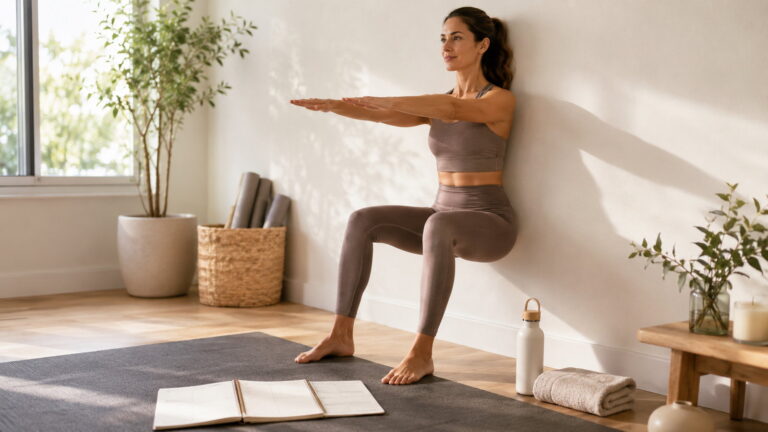
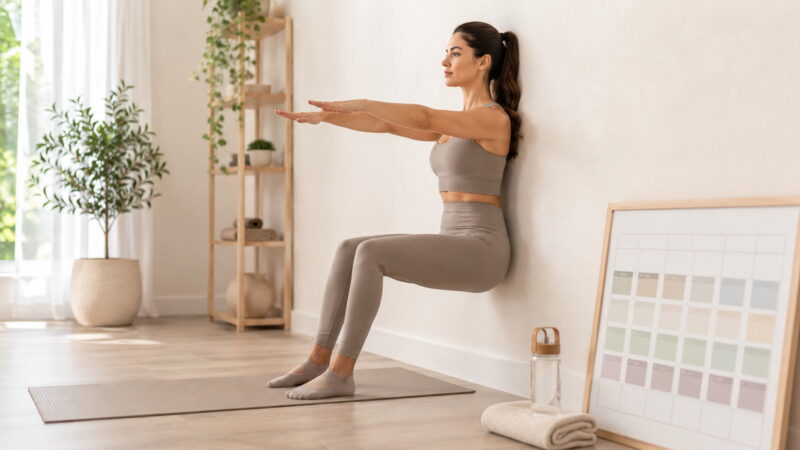
Wall-supported squat
Setup: Stand with your back against the wall and feet far enough forward that you can bend the knees without feeling crowded. Keep the feet stable.
Movement: Slide down only as far as you can control, then press through the feet to return. Keep the knees moving in a direction that feels compatible with the feet.
Target: Quadriceps, glutes, and trunk control.
Common error: Sliding too low before you can control knee position or foot pressure.
Easier option: Use a smaller range and fewer repetitions.
Standing calf raise with wall support
Setup: Face the wall with fingertips or palms lightly supported at about chest height.
Movement: Rise onto the balls of the feet without rolling the ankles outward, pause briefly, and lower with control.
Target: Calves, ankle control, and balance.
Common error: Leaning heavily into the hands.
Easier option: Use more hand support while keeping the movement small.
Wall-supported standing leg lift
Setup: Stand side-on to the wall with one hand lightly supported. Keep the standing knee soft rather than locked.
Movement: Lift the outside leg only as far as you can without tipping the torso. Lower slowly.
Target: Hip muscles and single-leg stability.
Common error: Leaning away from the wall to create a larger leg lift.
Easier option: Reduce the range and keep both hands near support if needed.
Wall bridge
Setup: Lie on your back with the feet placed on the wall and knees comfortably bent. Adjust the distance so the feet can stay stable.
Movement: Exhale, press through the feet, and lift the hips to a height you can control without forcing the lower back. Lower gradually.
Target: Glutes, hamstrings, and trunk stabilization.
Common error: Pushing the hips so high that the movement becomes a back arch.
Easier option: Lift only a few inches and focus on even pressure through both feet.
Wall leg press or slide
Setup: Lie on your back with the feet on the wall. Keep the pelvis stable.
Movement: Slide or press one or both feet along the wall through a controlled range, then return without letting the lower back arch excessively.
Target: Legs and trunk control.
Common error: Extending the legs farther than the trunk can control.
Easier option: Shorten the range and move one leg at a time.
Incline wall plank
Setup: Place the hands on the wall and walk the feet back until the body forms a comfortable incline.
Movement: Maintain a long body line while gently pressing the wall away. Breathe normally.
Target: Trunk, shoulders, chest, and whole-body stabilization.
Common error: Letting the hips sag or the shoulders shrug.
Easier option: Step closer to the wall.
A Simple First Wall Pilates Routine
Use this as a practice session, not a race. Rest 30 to 60 seconds between exercises or longer if your breathing and form have not recovered.
- Breathing and wall alignment — 60 seconds: Stand comfortably with the wall as a reference. Take slow breaths and notice rib, pelvis, and foot position.
- Wall-supported squats — 6 to 10 repetitions: Use a shallow range at first.
- Calf raises — 8 to 12 repetitions: Keep the lowering phase controlled.
- Standing leg lifts — 6 to 10 per side: Prioritize a steady torso over height.
- Wall bridges — 6 to 10 repetitions: Pause briefly at the top without over-arching.
- Wall leg presses or slides — 6 to 8 per side: Keep the range small enough to control the trunk.
- Incline wall plank — 15 to 30 seconds: Step closer if the shoulders or lower back lose position.
- Easy mobility and breathing — 1 to 2 minutes: Finish with gentle comfortable movement rather than forcing a stretch.
One round may be enough for your first session. If the exercises feel controlled and you recover easily, you can repeat selected movements for a second round on a later session.
A 10-minute beginner option
When time is limited, use four movements: wall squat, calf raise, standing leg lift, and wall bridge. Perform one controlled set of each, rest as needed, then repeat the sequence once if your form remains stable. A short routine done consistently is more useful than an ambitious plan you repeatedly skip.
How Often Beginners Should Practice
Two or three sessions per week is a practical starting point for many beginners, especially when the sessions contain meaningful muscular work. That is not a medical rule and it is not the only effective schedule. Short, light technique practice may be done more often if you recover well, while harder sessions may need more space between them.
Add difficulty only when the current version is repeatable. Useful readiness signs include:
- you can breathe throughout the set;
- your range stays consistent from the first repetition to the last;
- your feet or hands do not keep slipping;
- you can maintain balance without sudden grabbing;
- you recover normally by the next session;
- the exercise feels easier without becoming sloppy.
Progress by changing one variable at a time: range, repetitions, leverage, time under tension, complexity, or the amount of wall support. More days are not the only form of progression.
What to Do When a Move Feels Wrong
If your lower back arches during leg work, shorten the range. If your knees feel crowded in a wall squat, adjust your foot position or use less depth. If your feet slide, change the floor setup before continuing. If your neck feels tense, reduce shoulder effort and check whether the exercise is too demanding.
Muscular effort can feel challenging, but sharp pain, radiating pain, new numbness or weakness, significant dizziness, chest pain or pressure, unusual shortness of breath, or loss of balance/control are reasons to stop and seek appropriate guidance rather than trying to “fix” the movement by pushing harder.
Who Should Modify Wall Pilates or Get Individual Guidance First
Generic routines cannot account for every health condition or life stage. Individual guidance may be appropriate if you have a recent injury or surgery, significant balance concerns, persistent or unexplained pain, clinician-imposed restrictions, pregnancy or postpartum considerations that affect exercise choices, or a chronic condition that changes how you tolerate activity.
The wall can provide support, but it does not guarantee safety. Choose exercises that match your current capacity and follow any restrictions you have already been given by a qualified healthcare professional.
Your First Two Weeks: Build Consistency Before Complexity
For the first one to two weeks, repeat a small set of movements instead of changing the routine every day. Familiarity lets you notice whether your control is actually improving.
A simple progression could look like this:
- Week 1: two short sessions, one set of each movement, conservative range.
- Week 2: two or three sessions, adding a few repetitions or a second set only where form remains strong.
After that, you may be ready for a more structured multi-week challenge if you can complete your beginner routine with stable breathing, controlled range, predictable recovery, and no need to force painful movements. The purpose of the beginner phase is not to delay progress—it is to give you the control that makes progression meaningful.
If Wall Pilates is one part of a broader routine, Mayobook’s fitness, weight loss and body transformation hub can help you compare related approaches without treating one exercise method as a complete plan.