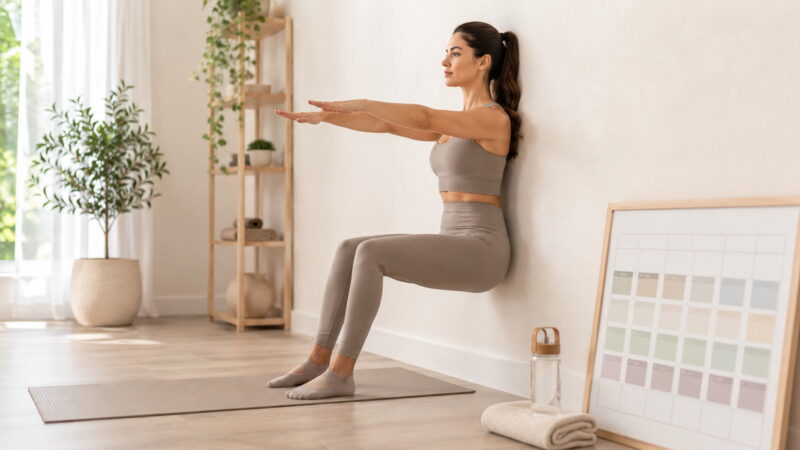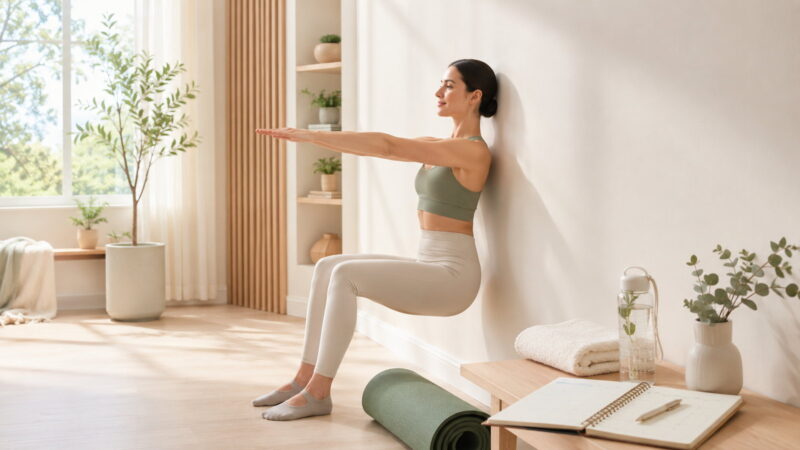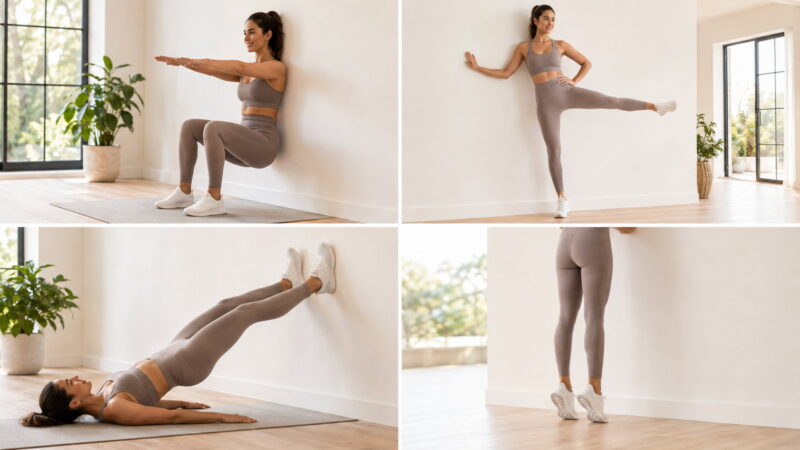
Does Wall Pilates work? Yes—when “work” means improving things that the exercises actually train, such as movement control, muscular endurance, balance, mobility, trunk stability, and exercise confidence. A well-designed Wall Pilates routine can produce real fitness progress, especially for beginners or people who benefit from the wall as support and feedback.
What it cannot do is guarantee a specific amount of weight loss, remove fat from one body area, reshape everyone’s body on the same timeline, or replace every other form of exercise. Whether it works for you depends on the difficulty of the routine, how consistently you train, whether you progress it, your starting point, and the goal you are trying to achieve.
Does Wall Pilates Work? Yes—Within the Right Expectations
Wall Pilates works for the same basic reason other exercise works: your body adapts to repeated, appropriately challenging movement. The wall changes the exercise by providing an external surface for support, feedback, leverage, or resistance. That can make some Pilates-style movements easier to learn and others more challenging.
If a movement requires your muscles to create meaningful force, control a range of motion, stabilize your trunk, or maintain balance, repeated practice can improve your ability to perform that task. But the stimulus must be large enough to matter. An exercise that felt challenging in week one may eventually become too easy to keep producing progress unless you change range, repetitions, tempo, leverage, support, or resistance.
What “Working” Actually Means
The most important question is not simply “Does Wall Pilates work?” but “Work for what?” Different goals require different outcomes.
For core control
Wall planks, bridges, controlled leg movements, and standing exercises can train the trunk to stay organized while the arms or legs move. Progress may show up as less rib flaring, better control of the pelvis, smoother movement, or the ability to use a harder variation without losing position.
For muscular endurance
If you can perform more technically consistent repetitions, hold a position longer, or complete a session with less breakdown at a similar effort, the training is working. Wall Pilates is often well suited to this kind of moderate-load endurance work.
For balance and confidence
The wall can reduce fear and give you a stable contact point during standing work. A meaningful result may be needing less hand support, controlling a weight shift more smoothly, or feeling steadier during single-leg movements.
For mobility
Repeated controlled movement through a comfortable range can improve the range you can use in the specific movements you practice. That does not mean Wall Pilates automatically increases flexibility everywhere; mobility gains tend to reflect the joints and ranges you actually train.
For strength
Wall Pilates can build strength when an exercise is sufficiently challenging, particularly for beginners. But as you become stronger, bodyweight and wall-based variations may become less efficient for continued strength gains unless you add resistance or choose harder leverage.
For weight loss or visible body change
Wall Pilates contributes physical activity and may support a broader weight-management plan, but it does not control energy balance by itself. Visible changes are also influenced by nutrition, total activity, sleep, genetics, medications, health conditions, starting body composition, and time. A workout method can contribute without being the sole cause.
Why Wall Pilates Can Produce Results
Several training mechanisms explain why a good program can work.
- Repeated muscular tension: muscles adapt when they are repeatedly required to produce and control force.
- Motor learning: practicing the same movement patterns improves coordination and efficiency.
- External feedback: wall contact helps many people notice whether they are shifting, arching, rotating, or losing pressure.
- Scalable leverage: moving closer to or farther from the wall can change difficulty in selected exercises.
- Reduced balance demand: support can let a beginner focus on the target movement before reducing assistance later.
- Convenience: a routine that is easy to access at home may be easier to repeat consistently, and consistency is one of the biggest determinants of progress.
The wall itself is not the source of the adaptation. It is a tool that changes how you perform the exercise.
Where Wall Pilates Falls Short
Wall Pilates becomes less effective when people expect it to do jobs it was not designed to do.
It is not automatically progressive
Repeating the same 10-minute routine forever does not guarantee continued adaptation. Once the movements feel easy, you need a progression strategy. That may mean more range, slower tempo, longer time under tension, less support, harder exercise variations, or appropriate external resistance.
It may not provide enough resistance for advanced strength goals
If your goal is substantial strength or muscle gain, progressive resistance training with heavier loads is generally easier to scale. Wall Pilates can remain part of your routine, but it may not be the most efficient primary tool.
It does not provide every cardiovascular benefit
Some faster routines can elevate heart rate, but that does not make them equivalent to a structured aerobic program. Walking, cycling, swimming, running, or other cardiovascular activity may still be useful depending on your goals and abilities.
It cannot guarantee fat loss from a specific area
Training the abdominal or leg muscles does not force the body to remove fat from those exact areas. Claims about “melting belly fat” or targeting one body part should not be used as the standard for deciding whether the exercises work.
Why Results Differ From Person to Person
Two people can complete the same Wall Pilates routine and get different outcomes because the same exercise can represent a very different challenge.
A beginner may find a wall squat or incline plank demanding enough to stimulate adaptation. Someone who already strength-trains may find the same movements too easy. One person may progress the exercises every few weeks, while another keeps the same range and tempo. Recovery, nutrition, total weekly activity, sleep, age, health status, medications, and genetics can also influence what changes and how quickly.
Consistency matters, but consistency with an under-challenging routine is not the same as progressive training. Doing more days is not always the answer; sometimes you need a better stimulus.
How to Tell Whether Your Wall Pilates Routine Is Working
Use repeatable performance markers instead of relying only on the mirror or scale.
- Can you perform more controlled repetitions at the same effort?
- Can you use a larger comfortable range without compensating?
- Can you slow the lowering phase and stay in control?
- Do you need less wall or hand support for balance?
- Can you complete a harder variation with the same quality?
- Does a session that once felt difficult now feel manageable?
- Are you recovering predictably instead of becoming progressively more sore or fatigued?
If several of those markers improve over four to eight weeks, the routine is doing something useful even if visible change is slower.
If nothing improves, ask whether the exercises are challenging enough, whether your form is directing effort where intended, whether your schedule is consistent, and whether your goal requires a different training method. Progress is not proof that one workout is magical, and lack of progress is not always proof that Wall Pilates is useless.
Bottom Line
Wall Pilates works when the exercises match your current ability, create enough muscular and coordination demand, and become progressively harder as you adapt. It is especially practical for accessible home training, movement control, muscular endurance, balance support, and beginner-friendly progression.
Judge it by the outcomes it can reasonably influence—not by viral transformation promises. If your goals also include major strength gains, cardiovascular conditioning, or body-composition change, build a broader plan around it. Mayobook’s Fitness, Weight Loss & Body Transformation hub can help you compare those complementary approaches.