
Wall Pilates Benefits: What It Can—and Cannot—Do
Wall Pilates can improve core control, muscular endurance, mobility, balance, and movement confidence—but it is not a shortcut to spot fat loss or dramatic transformation. Here is what the method can realistically do, where the evidence is stronger, and where the hype goes too far.
Keep Learning—Listen Free
Short, practical audiobooks for your next step.

Imposter Syndrome: Why Success Still Makes You Feel Like a Fraud | Full Audiobook
Imposter syndrome can make real success feel undeserved and every new achievement…

How to Stop Catastrophizing: Break the Worst-Case Thinking Loop | Full Audiobook
Learn how to stop catastrophizing and break the worst-case thinking loop that…

Emotionally Immature Parents: How Their Patterns Shape Your Adult Life | Full Audiobook
Emotionally immature parents can shape adult relationships, boundaries, self-worth and the way…

High-Functioning Anxiety: Why You Look Fine but Never Feel at Peace | Full Audiobook
High-functioning anxiety can make you look calm, capable and successful while constant…

The Art of War Explained: Sun Tzu’s Strategy for Winning Without Fighting | Full Audiobook
The Art of War, Sun Tzu, Art of War explained, strategy, winning…

Arthur Schopenhauer: Why You’re Never Satisfied — The Psychology of Desire | Full Audiobook
Arthur Schopenhauer, Schopenhauer philosophy, the psychology of desire, hedonic adaptation, the hedonic…

Friedrich Nietzsche: What “God Is Dead” Really Means — And How to Create Meaning | Full Audiobook
Friedrich Nietzsche, “God is dead,” Nietzsche philosophy, nihilism, existentialism, the meaning of…

High Agency: How to Become the Person Who Always Finds a Way | Full Audiobook
High agency is the psychology of becoming resourceful, taking initiative, and creating…

How to Find Your Purpose When You Feel Lost: Build a Life That Actually Means Something
Learn how to find your purpose when you feel lost, discover what…
Wall Pilates is useful for a simple reason: the wall changes how you organize your body against gravity. It can give you a stable contact point, clearer feedback about alignment, and a way to adjust leverage without buying specialized equipment. Those features can make Pilates-style strength and control work more approachable at home. They do not, however, turn the wall into a special fat-burning tool or make every exercise safer, harder, or more effective than other forms of training.
The most realistic benefits are improved movement control, muscular endurance, balance confidence, mobility practice, and a convenient way to build a consistent exercise habit. How much you gain depends on the exercises you choose, how challenging they are for you, whether you progress them over time, and what else you do for strength, cardiovascular fitness, recovery, and nutrition.
What Are the Main Benefits of Wall Pilates?
Wall Pilates can support several fitness goals, but it helps to separate what is plausible from what is sometimes promised online. The strongest case for Wall Pilates comes from the training principles it shares with Pilates more broadly: controlled movement, repeated muscular effort, trunk stabilization, coordination, breathing, and progressively more demanding variations.
- Core control: many exercises ask the abdominal, back, hip, and pelvic muscles to stabilize the trunk while the arms or legs move.
- Muscular endurance: repeated controlled contractions can improve your ability to sustain moderate muscular effort.
- Movement awareness: the wall gives tactile feedback that can make it easier to notice shifting, arching, collapsing, or uneven pressure.
- Mobility: controlled ranges of motion can help you practice moving hips, shoulders, and spine more deliberately.
- Balance confidence: selected standing exercises allow you to use the wall as external support while you develop control.
- Accessibility: it requires little equipment and can be practiced in a small home space.
These are meaningful benefits even if your appearance does not change quickly. Better control, easier movement, more stable balance, and the ability to progress an exercise are legitimate training outcomes.
Why the Wall Changes the Exercise
The wall can serve four different roles: support, feedback, resistance, and leverage. Which role matters depends on the movement.
In a standing exercise, placing a hand or part of the back against the wall may reduce balance demand so you can concentrate on hip or leg movement. In a floor-based bridge with the feet on the wall, the contact point changes the angle at which you push and can alter which muscles feel most challenged. In a wall squat, sliding the back against the wall can reduce some balance requirements while the legs still work to control the descent and ascent.
The wall is also useful as a feedback surface. If one side of your pelvis loses contact, your ribs flare strongly, or your feet slide, you receive immediate information that you may not notice in free space. That does not mean every change in contact is automatically an error; the intended position depends on the exercise. The value is that you have another cue to work with.
More pressure is not automatically better. Pushing aggressively into the wall can cause you to brace unnecessarily, hold your breath, or shift stress into joints. The goal is enough contact to support the movement you are trying to perform while still maintaining controlled breathing and a range you can manage.
Core Strength, Control, and Muscular Endurance
Wall Pilates is often described as a core workout, and that description can be accurate when the routine actually challenges the trunk. Your core is not one muscle and it does not work only during crunching movements. It helps transfer force between the upper and lower body, manage the position of the rib cage and pelvis, and keep the trunk controlled while the limbs move.
Exercises such as wall-supported bridges, controlled leg slides, standing leg lifts, wall planks, and slow squat variations can require the abdominal wall, spinal stabilizers, glutes, and hip muscles to work together. The training effect depends on difficulty. If you can perform an exercise indefinitely with no meaningful effort or loss of control, it may no longer provide enough stimulus for further adaptation.
Progression can come from increasing range, slowing the lowering phase, using a longer lever, reducing assistance, adding repetitions, extending time under tension, combining movements, or adding appropriate external resistance. That matters because doing the same easy routine for months is different from progressively training the same movement patterns.
Wall Pilates is generally better suited to control and muscular endurance than to maximizing strength or muscle size. Someone whose primary goal is substantial strength development will usually benefit from progressively heavier resistance training as well.
Posture Awareness, Alignment, and Mobility
The wall can make body position easier to feel. For example, it may help you notice whether your shoulders are creeping upward, whether your knees are drifting inward during a squat, or whether you are extending through the lower back instead of controlling the pelvis and ribs.
That awareness can improve how you organize a movement, but it is more accurate to talk about posture awareness than about permanently “fixing” posture. Healthy people naturally use many postures throughout a day. Exercise can strengthen muscles, improve movement options, and make certain positions more comfortable, but there is no single perfect posture that everyone must maintain.
Mobility can improve when you repeatedly move through a comfortable, controlled range. Wall-assisted shoulder work, hip movements, calf work, and selected spinal mobility patterns can make the wall useful as a reference point. Mobility gains are usually specific to what you practice, so a routine that never challenges a particular range should not be expected to improve it dramatically.
Balance, Confidence, and Low-Impact Accessibility
For beginners or people who feel uncertain during unsupported standing exercise, a wall can provide reassurance. That can be especially useful when learning how to shift weight, control a single-leg movement, or slow down a squat or lunge pattern.
Low-impact means the exercise generally avoids repeated jumping or hard landing forces. It does not mean effortless or risk-free. A slow wall squat can become demanding. A floor transition can be difficult for someone with limited mobility. A single-leg variation can still challenge balance. The right exercise is the one that fits your present capacity and can be performed with control.
This is why Wall Pilates can be approachable without being automatically appropriate for everyone. If you have significant balance problems, recent surgery or injury, unexplained pain, clinician-imposed exercise restrictions, or symptoms such as fainting, chest pain, or unusual shortness of breath, generic online exercise guidance is not a substitute for individualized assessment.
What Wall Pilates Cannot Promise
The popularity of Wall Pilates has produced claims that go well beyond what a workout can guarantee. A useful program should not need those claims.
It cannot target belly fat
Training the abdominal muscles can make them stronger and improve trunk control, but exercising one area does not reliably force the body to remove fat from that same area. Changes in body fat are influenced by overall energy balance, nutrition, activity, sleep, genetics, medications, health conditions, and time.
It cannot guarantee weight loss
Wall Pilates contributes physical activity, and physical activity can support weight management. But the calories used in a workout are only one part of a much larger picture. A 10- or 20-minute session does not guarantee a particular change on the scale.
It cannot guarantee dramatic body reshaping in 28 days
Four weeks can be enough to become more coordinated, more consistent, and better able to perform a routine. Some people may also notice changes in muscular endurance, mobility, or appearance. The size and speed of visible changes vary too much to promise a universal transformation.
It is not a complete substitute for every form of training
Wall Pilates can be one useful component of a broader fitness plan. It does not automatically provide the cardiovascular stimulus of sustained aerobic training or the high resistance required for maximal strength development. Depending on your goals, walking, cycling, swimming, resistance training, sport, mobility work, or supervised rehabilitation may all have roles that Wall Pilates does not replace.
It is not a treatment for every pain problem
Movement can be helpful for many people, but pain has many possible causes. If an exercise repeatedly produces sharp, radiating, worsening, or destabilizing symptoms, the answer is not to keep pushing because the routine is labeled “low impact.” Reduce or stop the movement and seek appropriate professional guidance when needed.
When Wall Pilates Is Most—and Least—Useful
Wall Pilates tends to be a good fit when you want an inexpensive home workout, are learning controlled Pilates-style movement, prefer external support, want moderate resistance without large equipment, or need a practical way to practice consistently.
It may be less complete when your primary goal is maximal strength, substantial muscle gain, high-level cardiovascular conditioning, sport-specific performance, or rehabilitation from an injury or medical condition. In those cases, the wall can still be useful, but it should not be mistaken for a complete program simply because it is convenient.
The best method is not the one with the strongest social-media claim. It is the one that creates an appropriate training stimulus, fits your current ability, can be progressed, and is sustainable enough for you to repeat.
How to Get More of the Benefits Without Chasing Hype
Start by treating Wall Pilates as training rather than as a challenge you must survive. Choose exercises you can perform with deliberate breathing and stable control. Use a range of motion you can own. Stop a set when technique deteriorates significantly instead of chasing an arbitrary repetition target.
As movements become easier, progress one variable at a time. You might increase the range, use a slightly longer lever, add a few controlled repetitions, reduce the amount of wall support, or select a more demanding variation. Give harder sessions enough recovery instead of assuming that daily high-volume work is always better.
Track outcomes that reflect actual adaptation: smoother movement, more controlled repetitions, greater comfortable range, better balance, less need for assistance, improved session tolerance, or the ability to progress an exercise. If weight loss or body composition is your goal, evaluate Wall Pilates as one part of your overall routine rather than judging it by a viral before-and-after timeline.
Wall Pilates does not need to be magical to be worthwhile. Its real advantage is practical: a wall can make controlled, progressive movement easier to access. Used with realistic expectations and appropriate progression, that can be more valuable than any transformation promise.
For broader evidence-aware fitness and body-composition guidance, explore Mayobook’s fitness, weight loss and body transformation hub.
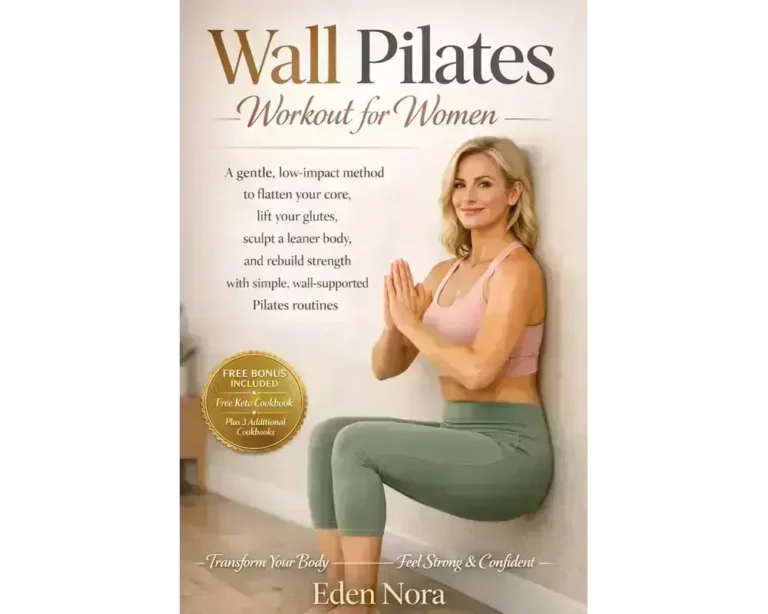
Want the complete system?
Explore the full book for a deeper, structured guide.
Wall Pilates Workout for Women
Wall Pilates Workout for Women offers a gentle, low-impact way to strengthen your core, lift your glutes, improve posture, and sculpt a leaner body…
View the BookMore in Weight Loss & Detox
View category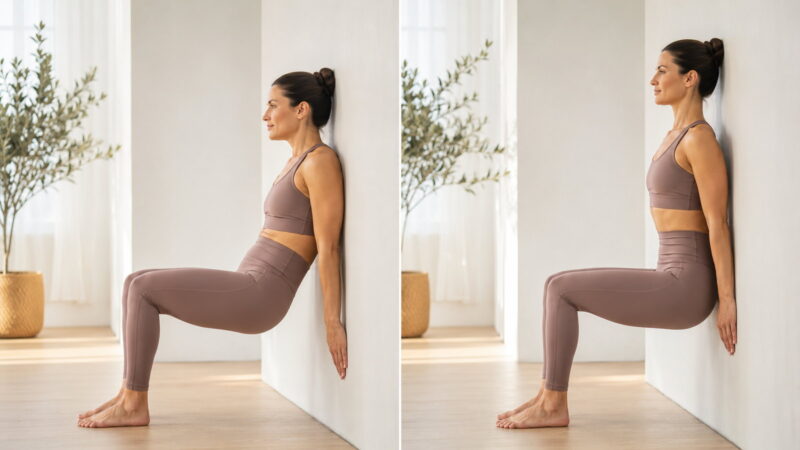
Wall Pilates Mistakes: Common Form Errors and How to Fix Them
Small setup and form errors can make Wall Pilates feel ineffective or uncomfortable. Learn how to correct wall distance, rib and pelvic control, knee tracking, breathing, tempo, progression, and common pain-provoking compensations without forcing your body through warning signs.
Wall Pilates Before and After: Realistic Results at 4, 8, and 12 Weeks
Wall Pilates results rarely follow a dramatic 28-day transformation script. Learn what may realistically improve around 4, 8, and 12 weeks, why visible changes vary, and how to track strength, control, mobility, balance, and consistency more reliably than photos alone.
Keep exploring
Fitness, Weight Loss & Body Transformation
See the wider Mayobook topic hub with guides, answers, comparisons, and books.
Explore the topic
Wall Pilates for Beginners: How to Start, Exercises, and First Routine
Go deeper with a longer structured guide connected to this topic.
View guide
Wall Pilates vs Reformer Pilates: Which Is Better for Your Goals?
See a decision-stage page that helps readers compare the next best option.
Compare options