
Wall Pilates Before and After: Realistic Results at 4, 8, and 12 Weeks
Wall Pilates results rarely follow a dramatic 28-day transformation script. Learn what may realistically improve around 4, 8, and 12 weeks, why visible changes vary, and how to track strength, control, mobility, balance, and consistency more reliably than photos alone.
Keep Learning—Listen Free
Short, practical audiobooks for your next step.

Imposter Syndrome: Why Success Still Makes You Feel Like a Fraud | Full Audiobook
Imposter syndrome can make real success feel undeserved and every new achievement…

How to Stop Catastrophizing: Break the Worst-Case Thinking Loop | Full Audiobook
Learn how to stop catastrophizing and break the worst-case thinking loop that…

Emotionally Immature Parents: How Their Patterns Shape Your Adult Life | Full Audiobook
Emotionally immature parents can shape adult relationships, boundaries, self-worth and the way…

High-Functioning Anxiety: Why You Look Fine but Never Feel at Peace | Full Audiobook
High-functioning anxiety can make you look calm, capable and successful while constant…

The Art of War Explained: Sun Tzu’s Strategy for Winning Without Fighting | Full Audiobook
The Art of War, Sun Tzu, Art of War explained, strategy, winning…

Arthur Schopenhauer: Why You’re Never Satisfied — The Psychology of Desire | Full Audiobook
Arthur Schopenhauer, Schopenhauer philosophy, the psychology of desire, hedonic adaptation, the hedonic…

Friedrich Nietzsche: What “God Is Dead” Really Means — And How to Create Meaning | Full Audiobook
Friedrich Nietzsche, “God is dead,” Nietzsche philosophy, nihilism, existentialism, the meaning of…

High Agency: How to Become the Person Who Always Finds a Way | Full Audiobook
High agency is the psychology of becoming resourceful, taking initiative, and creating…

How to Find Your Purpose When You Feel Lost: Build a Life That Actually Means Something
Learn how to find your purpose when you feel lost, discover what…
Wall Pilates before-and-after content is easy to misunderstand because photographs compress a complicated process into two images. The camera cannot show whether someone became more coordinated, can hold a position longer, needs less wall support, sleeps better, changed nutrition, added walking or strength training, or simply stood in different lighting.
A more useful timeline separates functional changes from visible changes. Many people notice better exercise familiarity, control, and muscular endurance before they see a meaningful difference in body shape. Visible change can happen, but its timing depends on far more than Wall Pilates alone.
What Results Can You Realistically Expect From Wall Pilates?
Results fall into several categories, and each moves at a different pace:
- Skill and coordination: learning where to place your feet, how much pressure to use, how to breathe through effort, and how to control the ribs and pelvis.
- Muscular endurance: completing more controlled repetitions or longer sets before form deteriorates.
- Balance and confidence: using less support or feeling steadier during standing movements.
- Mobility: moving through a larger comfortable range in exercises you practice consistently.
- Strength: becoming able to use more demanding leverage, range, tempo, or resistance.
- Appearance and body composition: changes influenced by training, nutrition, total activity, starting point, genetics, sleep, health status, and time.
That distinction matters. If your wall squat becomes deeper and more controlled, your bridge feels stronger, and you can progress from supported to less-supported variations, the program is producing adaptation even if a photograph does not look dramatically different.
Why Two People Can Get Very Different Results
Two people can follow the same video series and have completely different outcomes. One may be new to exercise and find the routine challenging; another may already train regularly and receive too little stimulus to change. One may increase difficulty each week; another may repeat the same easy version. One may also be walking, lifting weights, sleeping consistently, and eating in a way that supports their goals.
Important variables include:
- starting strength, mobility, and fitness;
- how often you train and how consistently you complete sessions;
- whether the exercises are actually challenging enough;
- whether difficulty progresses over time;
- total weekly physical activity;
- nutrition and energy intake;
- sleep and recovery;
- age, genetics, health conditions, and medications;
- how you measure progress.
Before-and-after photos add another layer of variability. Lighting, camera height, lens distance, posture, clothing, muscle tension, hydration, and even the time of day can change appearance. A photograph can document a moment, but it is weak evidence of what caused the difference.
Around 4 Weeks: What You May Notice First
Four weeks is usually enough time to become more familiar with a routine. If you are practicing consistently, the earliest changes are often neurological and skill-based: movements require less concentration, transitions feel less clumsy, and you can identify when your ribs flare, feet slip, or shoulders tense.
You may also notice:
- more controlled repetitions before fatigue;
- better balance during wall-supported standing work;
- less reliance on the wall in easy variations;
- a slightly larger comfortable range of motion;
- improved tolerance for a 15- or 20-minute session;
- greater confidence progressing selected exercises.
Some people will see modest visible changes after a month, especially if Wall Pilates is part of a broader change in activity or nutrition. Others will not. A 28-day challenge is better understood as a consistency and skill block than as a guaranteed body-transformation deadline.
Around 8 Weeks: Where Progress May Become More Measurable
By roughly two months, consistent training gives you more opportunities to accumulate meaningful practice. This is also where program quality becomes increasingly important. If you have progressed the movements rather than repeating the same easy session, improvements may become clearer in muscular endurance, range, balance, and exercise difficulty.
Useful comparisons at eight weeks include:
- How many controlled repetitions can you perform at the same perceived effort?
- Can you use a harder leverage or a larger range without losing form?
- Can you slow the lowering phase while maintaining control?
- Do you need less external support during balance-focused movements?
- Can you recover from a session more predictably?
If none of those variables has changed and every session feels easy, the issue may not be that Wall Pilates “doesn’t work.” The program may simply no longer provide enough challenge. Progression—not endless repetition—is what gives the body a reason to keep adapting.
Visible body changes may become more noticeable for some people by this point, but they still cannot be attributed automatically to one exercise method. Fat loss, for example, is not localized to the muscles you train and depends on broader energy balance and lifestyle factors.
Around 12 Weeks: What Longer Consistency Can Reveal
Three months is long enough to evaluate whether Wall Pilates fits your life and whether your program has a meaningful progression path. You may be able to compare a larger set of objective markers: range of motion, exercise variation, controlled repetitions, session duration, balance confidence, and the amount of assistance you use.
At twelve weeks, a beginner who has progressed appropriately may feel substantially more competent than on day one. Movements that once required conscious effort can feel more automatic. More challenging exercises may become accessible. A routine may also feel easier to sustain because the habit itself is established.
For appearance-based goals, twelve weeks can be more informative than four, but there is still no universal visual result. If your goal is significant muscle growth or maximal strength, Wall Pilates alone may not provide enough resistance. If your goal is cardiovascular conditioning, you will usually need additional aerobic work. If your goal is fat loss, nutrition and total activity remain major parts of the picture.
Better Ways to Measure Progress Than a Before-and-After Photo
A useful progress system combines one or two appearance-related measures, if those matter to you, with several performance measures. That protects you from declaring the program a failure simply because lighting, water retention, or body weight fluctuated.
Consider tracking:
- Controlled repetitions: how many technically consistent reps you can complete.
- Range: whether you can move farther without pain or compensation.
- Balance: how much support you need during selected standing exercises.
- Exercise level: whether you have moved to harder leverage or resistance.
- Session tolerance: whether a workout that once felt difficult now feels manageable.
- Consistency: how many planned sessions you actually complete.
- Recovery: how you feel the next day and whether performance remains stable.
If you use photos, standardize them: similar lighting, camera distance, clothing, time of day, and posture. Take them infrequently enough that small day-to-day fluctuations do not become the focus of your training.
If body weight or circumference is part of your goal, look at trends rather than single measurements. Short-term changes can reflect hydration, food volume, sodium intake, menstrual-cycle effects, and other factors unrelated to fat gain or loss.
If You Are Not Seeing Results, Check These Variables First
Before adding more workouts, ask whether the current program is actually matched to your goal.
Are you progressing?
If you have repeated identical easy sessions for weeks, increase the challenge deliberately. Use more controlled range, a longer lever, a slower lowering phase, fewer points of support, more demanding movement combinations, or appropriate resistance.
Is your form limiting the target muscles?
If you feel every exercise mostly in the neck, lower back, or joints, review wall distance, breathing, range, and alignment before increasing volume.
Is your frequency realistic?
Inconsistent training may provide too little stimulus, while hard daily sessions can reduce recovery and movement quality. Frequency should match the difficulty of the work and the rest of your training week.
Are you judging the wrong outcome?
A stronger, steadier, more mobile body is progress even if the scale does not move. If the only outcome you care about is body composition, evaluate nutrition and total activity rather than expecting one exercise style to control the result.
Does the program fit the goal?
Wall Pilates can be excellent for accessible movement practice and muscular endurance. It is not necessarily the most efficient tool for every objective. Adding walking, cardiovascular exercise, or progressive resistance training may be more appropriate than simply doing more of the same routine.
A realistic Wall Pilates before-and-after story is not “day 1 versus day 28.” It is a progression from unfamiliar to controlled, from easy to appropriately challenging, and from guessing about results to measuring what your body can actually do.
For broader guidance on exercise, progression, and body-composition goals, explore Mayobook’s fitness, weight loss and body transformation hub.
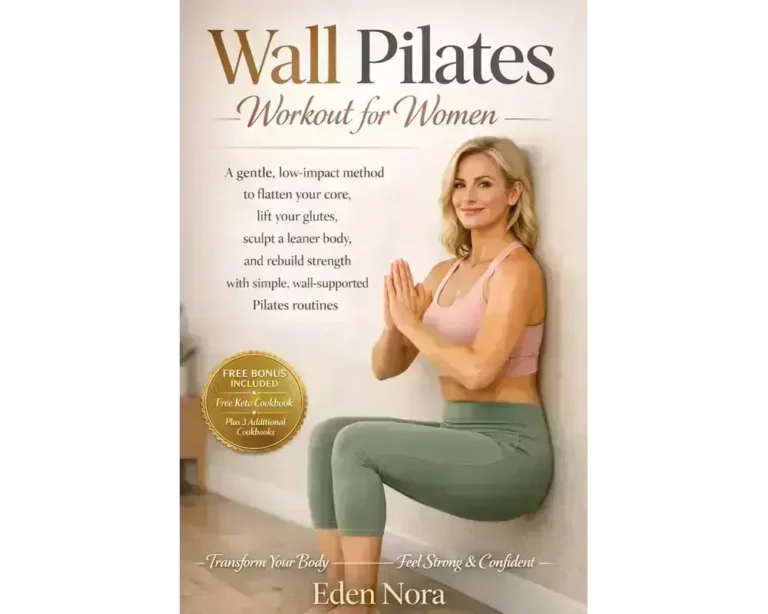
Want the complete system?
Explore the full book for a deeper, structured guide.
Wall Pilates Workout for Women
Wall Pilates Workout for Women offers a gentle, low-impact way to strengthen your core, lift your glutes, improve posture, and sculpt a leaner body…
View the BookMore in Weight Loss & Detox
View category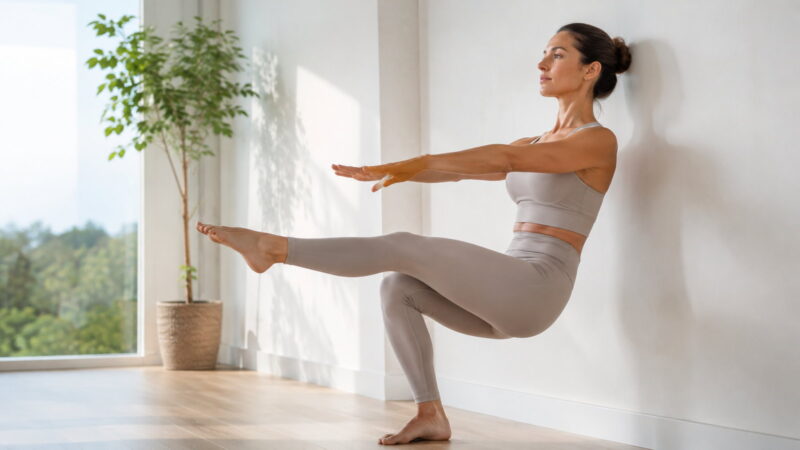
Wall Pilates Benefits: What It Can—and Cannot—Do
Wall Pilates can improve core control, muscular endurance, mobility, balance, and movement confidence—but it is not a shortcut to spot fat loss or dramatic transformation. Here is what the method can realistically do, where the evidence is stronger, and where the hype goes too far.
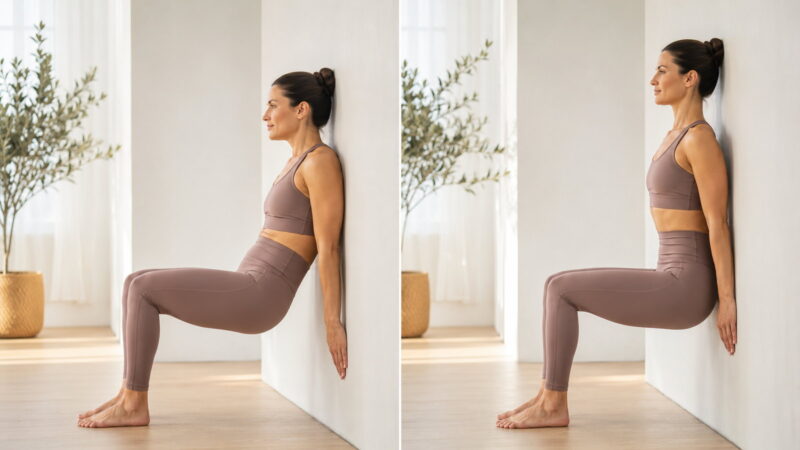
Wall Pilates Mistakes: Common Form Errors and How to Fix Them
Small setup and form errors can make Wall Pilates feel ineffective or uncomfortable. Learn how to correct wall distance, rib and pelvic control, knee tracking, breathing, tempo, progression, and common pain-provoking compensations without forcing your body through warning signs.
Keep exploring
Fitness, Weight Loss & Body Transformation
See the wider Mayobook topic hub with guides, answers, comparisons, and books.
Explore the topic
Wall Pilates for Beginners: How to Start, Exercises, and First Routine
Go deeper with a longer structured guide connected to this topic.
View guide
Wall Pilates vs Reformer Pilates: Which Is Better for Your Goals?
See a decision-stage page that helps readers compare the next best option.
Compare options