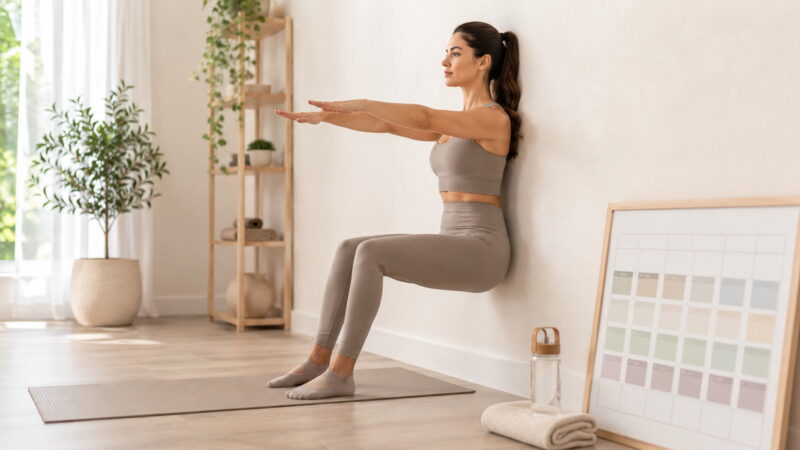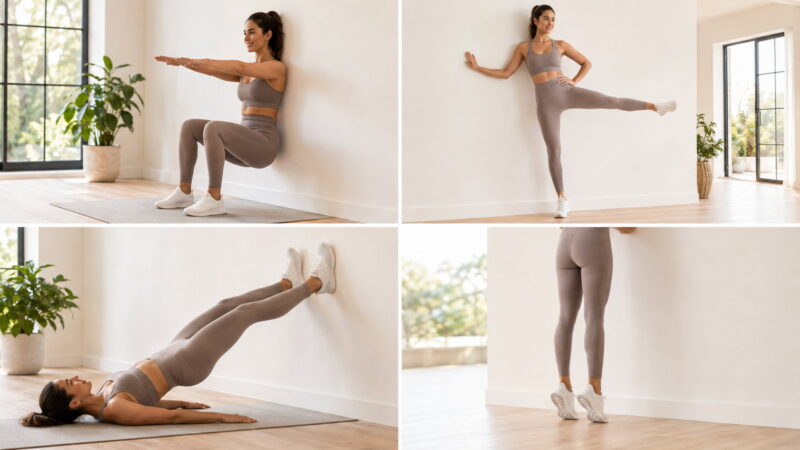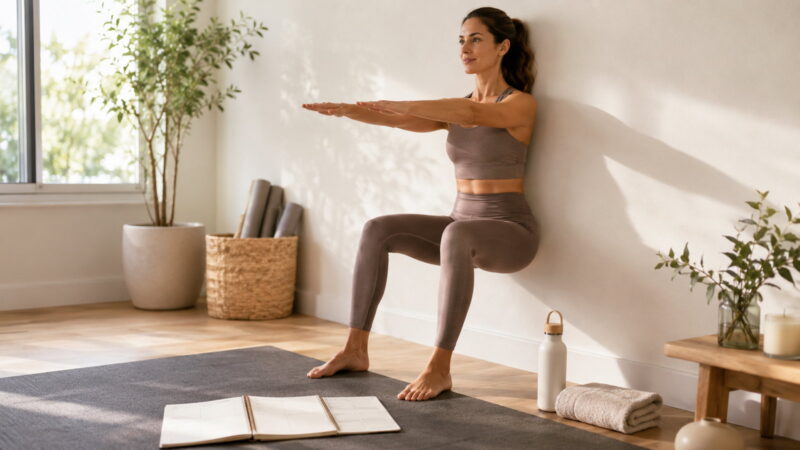
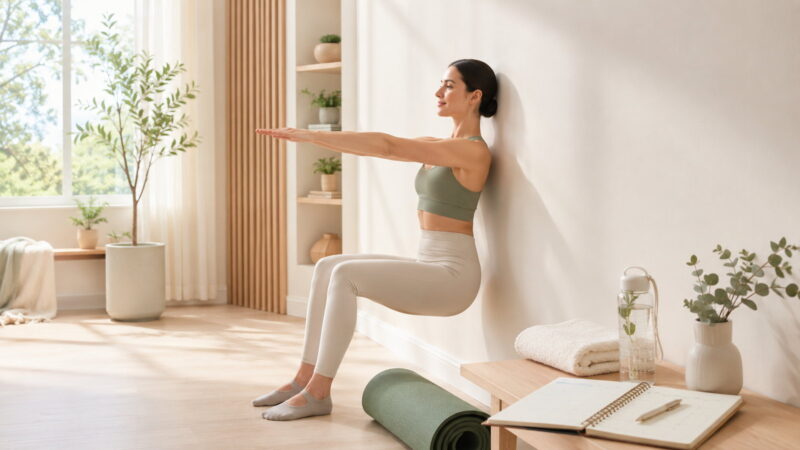
How often should you do Wall Pilates? For many beginners, 2 to 3 purposeful sessions per week is a practical starting point, with easier mobility or technique practice on other days if desired. As your fitness improves, you may train more often—but frequency should rise only if you are recovering well and the additional sessions still have a clear purpose.
The important distinction is between moving every day and training the same muscles hard every day. A gentle 10-minute mobility-focused Wall Pilates session creates a very different recovery demand from a longer session using deeper ranges, slower tempo, longer holds, unilateral work, or added resistance.
If you are building your routine around Wall Pilates, use recovery and progression—not a viral streak—as the guide for how many days you train.
How Often Should You Do Wall Pilates? A Practical Starting Point
A useful default is:
- New beginners: 2 to 3 moderate sessions per week.
- Comfortable beginners: 3 sessions per week, with optional light technique or mobility practice between them.
- More experienced exercisers: 3 to 5 sessions can work when intensity varies and Wall Pilates is balanced with other training.
- Daily movement: possible when some days are intentionally easy rather than seven demanding sessions in a row.
These are flexible starting points, not medical prescriptions. Session length, exercise difficulty, other workouts, sleep, health, stress, age, and recovery all change how much training makes sense.
Beginners: Start With a Frequency You Can Recover From
Beginners often improve fastest when they leave enough space between demanding sessions to learn the movements without accumulating fatigue. Two or three well-controlled workouts are usually more useful than forcing seven rushed ones.
At first, use the days between harder sessions to notice how your body responds. Mild muscular soreness can happen after unfamiliar exercise, but you should not need to feel sore for a workout to be effective.
You may be ready to add another session when:
- your form remains consistent through the current sessions;
- normal soreness resolves before the next workout;
- your energy and motivation are stable;
- you can progress exercises without compensating;
- the added session fits your week without displacing recovery or other useful activity.
If those conditions are not present, adding days is not automatically progress.
Can You Do Wall Pilates Every Day?
Yes, some people can practice Wall Pilates every day—but that does not mean every day should be equally demanding.
Daily practice is more reasonable when you rotate the training stress. For example, one day might emphasize controlled leg and glute work, another might be a lighter mobility and breathing session, and another might focus on core control or balance. The total workload matters more than the calendar streak.
Daily hard sessions become less useful when the same muscles are repeatedly trained before they recover. If each workout contains long wall sits, demanding bridges, high-volume leg work, challenging planks, and added resistance, repeating that exact workload every day may reduce movement quality rather than improve it.
A good question is not “Can I do Wall Pilates today?” but “What does today’s session add to the week?”
When You Need Rest Days
Take an easier day or a full rest day when recovery is not keeping pace with training. Useful warning signs include:
- muscular soreness that remains strong or worsens across several days;
- a clear drop in repetitions, balance, control, or range at the same effort;
- persistent fatigue that makes normal sessions feel unusually difficult;
- joint discomfort that increases as the workout continues;
- poor sleep paired with declining training quality;
- loss of motivation that seems tied to accumulated fatigue rather than simple boredom.
Active recovery can mean walking, gentle mobility, easy stretching, or a very light Wall Pilates technique session. Complete rest may be more appropriate when you are unusually fatigued or when movement itself aggravates symptoms.
Stop the session and seek appropriate professional assessment for symptoms such as chest pain or pressure, fainting, severe or persistent dizziness, sudden severe pain, new neurological symptoms, unusual shortness of breath, or a loss of balance or control that makes exercise unsafe.
How Frequency Should Change as Sessions Get Harder
One of the easiest mistakes is to progress both difficulty and frequency at the same time.
If you move from supported squats to deeper ranges, add resistance bands, extend plank holds, perform more unilateral work, slow the lowering phase, or increase session length, you have already raised the training dose. You may not need another workout day as well.
A more sustainable progression often looks like this:
- First improve control and range.
- Then increase the difficulty of selected exercises.
- Then increase total work within the current number of sessions.
- Only add another training day when the current schedule is well tolerated and the extra day serves a useful purpose.
This makes progression easier to evaluate because you are not changing every variable at once.
Signs You’re Doing Too Much—or Not Enough
You may be doing too much if:
- performance is declining from session to session;
- your form consistently breaks down earlier than it used to;
- soreness or joint discomfort never settles before the next hard workout;
- you keep adding sessions but are no longer progressing exercises;
- Wall Pilates is interfering with sleep, other training, or normal daily activity.
You may be doing too little for your goal if:
- weeks pass with no increase in control, range, repetitions, resistance, or exercise difficulty;
- sessions are so infrequent that each workout feels like starting over;
- the exercises no longer require meaningful effort and you never progress them;
- your total weekly activity is too low for a broader fitness goal that Wall Pilates alone cannot cover.
Soreness is not the deciding test. A well-designed program can produce progress without making you sore after every session.
A Simple Weekly Frequency Framework by Goal
For general fitness and consistency
Try 2 to 3 Wall Pilates sessions each week and combine them with regular walking or other movement. This is often enough to build a repeatable habit without making Wall Pilates the only form of exercise you do.
For skill and technique practice
Use 2 to 3 normal sessions plus short, low-fatigue practice on selected off days. These lighter sessions should reinforce breathing, alignment, balance, and control rather than becoming hidden extra workouts.
For muscular endurance and greater challenge
Three purposeful sessions may be enough if they include progressive variations and adequate total work. If you add a fourth session, reduce overlap so the same muscles are not challenged heavily in exactly the same way every day.
When combining Wall Pilates with strength or cardio
Count all training, not just Wall Pilates. If you already lift weights, run, cycle, swim, play a sport, or attend other classes, your recovery needs reflect the whole week. A Wall Pilates session that seems moderate by itself may feel very different after a hard lower-body strength day.
During a challenge
A challenge can include frequent practice if easier days and recovery are built into the schedule. Do not double up missed sessions simply to preserve the calendar. Resume, repeat, or reduce the next session based on how you are recovering.
Bottom Line
For most beginners, 2 to 3 Wall Pilates sessions per week is a sensible place to start. You can practice more often when some sessions are lighter and your recovery, form, and performance remain good.
Progress does not require turning every available day into a hard workout. Increase challenge first, watch how you recover, and let frequency serve your goal rather than become the goal itself. For broader programming and exercise guidance, continue through Mayobook’s Fitness, Weight Loss & Body Transformation hub.