
Heart-rate variability (HRV)
Beat-to-beat variation in heart timing; some metrics reflect parasympathetic cardiac modulation.
A precise, evidence-aware reference to vagal influence, HRV, measurement limits and practical autonomic support.
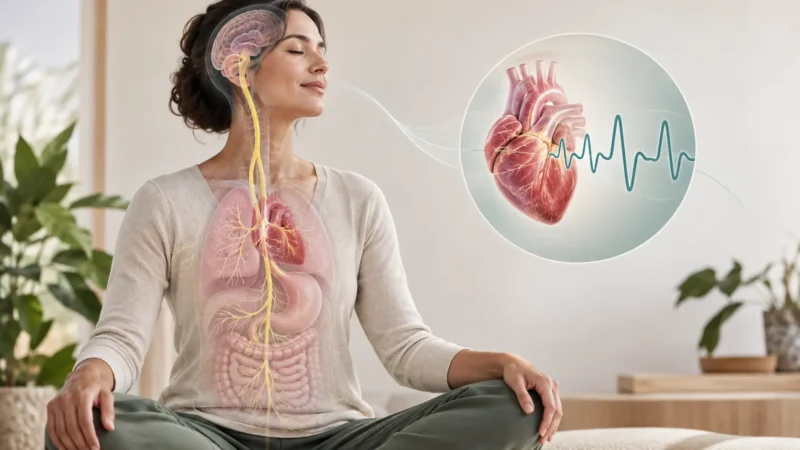
Vagal tone is a functional research concept describing aspects of parasympathetic influence associated with the vagus nerve. It is usually inferred from physiological signals such as vagally mediated heart-rate variability rather than measured as a direct nerve-strength score.
The term is useful when discussing flexible autonomic regulation, but it is often oversimplified in wellness content. Breathing pattern, age, fitness, medications, sleep, stress and measurement conditions can all affect the signals used to estimate vagal influence.
Use this map to move through the concept in a clear order: meaning, mechanism, use, and wider context.
Vagal tone is a functional idea used to describe aspects of parasympathetic influence associated with the vagus nerve, especially its role in flexible regulation of the heart and other organs. It is not a literal measure of how “strong” your vagus nerve is, and there is no single consumer test that produces a definitive vagal-tone score.
In research, vagal influence is usually inferred from physiological patterns rather than measured directly. That distinction matters because wellness language often turns a nuanced regulatory concept into an on-or-off claim: low vagal tone means you are dysregulated, high vagal tone means you are healthy, and one special exercise can “reset” the system. Human autonomic regulation is more complicated than that.
The vagus nerve is cranial nerve X and a major communication pathway within the parasympathetic nervous system. Its branches carry sensory and motor information between the brainstem and structures in the neck, chest and abdomen. Among its many functions, vagal pathways help modulate heart rate, support digestive signaling and participate in voice and swallowing.
At the heart, parasympathetic vagal activity can slow the rate generated by the sinoatrial node. This influence changes from moment to moment as breathing, posture, activity, emotion, blood pressure and other signals shift. A calm feeling may coincide with increased parasympathetic influence, but calmness is not produced by the vagus nerve alone. Sympathetic activity, respiratory mechanics, attention, endocrine signals and many other systems also contribute.
Researchers commonly use indirect cardiovascular measures. One important family of measures is heart-rate variability (HRV): the variation in time between successive heartbeats. Certain HRV metrics, especially when measured under controlled conditions, can provide information about parasympathetic modulation of the heart.
Respiratory sinus arrhythmia is another relevant phenomenon. Heart rate tends to speed slightly during inhalation and slow during exhalation, a pattern influenced in part by vagal pathways. Because breathing rate and depth strongly affect this pattern, respiratory conditions must be considered when interpreting vagally mediated HRV.
Consumer wearables can estimate heart rate and some HRV metrics, but they do not directly measure the vagus nerve. Device algorithms, sensor quality, movement, sleep stage, time of day and sampling duration can all change the number you see.
A higher HRV is not automatically “better” in every person or every situation. HRV varies with age, fitness, illness, medications, sleep, alcohol use, hydration, training load, emotional state, breathing pattern and measurement conditions. Comparing your own readings under similar conditions can sometimes be more informative than comparing your value with someone else’s.
Slow breathing can temporarily increase several HRV measures. That is a real physiological effect, but it does not mean a single breathing session permanently raised your vagal tone. Acute changes during a technique and durable changes in health or autonomic function are different questions.
There is no need to chase exotic “nerve hacks.” Practices that support broader cardiovascular, respiratory and recovery systems are more defensible starting points.
It does not mean forcing the body into an extreme state. Carotid pressure, forceful neck manipulation, aggressive breath-holding and extreme cold challenges are not sensible ways to pursue a wellness metric. It also does not mean that every symptom—fatigue, anxiety, digestive discomfort, dizziness or poor sleep—can be diagnosed as “vagus nerve dysfunction.” These symptoms have many possible causes.
Likewise, a wearable reading should not be used as proof that your vagus nerve is damaged or “blocked.” HRV is context-sensitive and is best interpreted as one piece of information rather than a diagnosis.
Self-care techniques are not a substitute for evaluation of concerning symptoms. Seek appropriate medical care for fainting, persistent or severe palpitations, chest pain, significant shortness of breath, new neurological symptoms, persistent swallowing difficulty, or other unexplained symptoms that are severe or worsening. The point is not to assume a vagus-nerve problem, but to avoid missing conditions that require proper assessment.
If your goal is practical, begin with evidence-aware breathing or gentle relaxation rather than trying to “measure” your vagus nerve. If you want to understand medical vagus nerve stimulation, learn about clinical VNS separately from home exercises. And if you are comparing popular techniques such as humming, cold exposure, massage or somatic practices, judge each by the evidence for the actual technique—not by whether it is marketed with the word “vagus.”
For a structured overview of practical techniques, visit Vagus Nerve Exercises. You can also browse the broader Fitness, Weight Loss & Body Transformation topic hub for related Mayobook resources.
Beat-to-beat variation in heart timing; some metrics reflect parasympathetic cardiac modulation.
Normal respiratory-linked heart-rate variation influenced partly by vagal pathways.
The autonomic branch involved in many rest, digestion and recovery functions.
Vagal tone is not the same thing as a wearable HRV number. HRV can provide indirect information about parasympathetic cardiac modulation, but it is context-sensitive and does not directly measure the vagus nerve.
Use these connected pages for the next step.

New to Wall Pilates? Learn how to set…
Read next
Vagal tone is most useful as a careful physiological concept, not as a wellness score to optimize at all costs. Focus on the broader conditions that support healthy regulation and interpret biomarkers in context.