
Vagus Nerve Yoga: What the Trend Means and What the Evidence Supports
“Vagus nerve yoga” is a wellness label, not a standardized medical protocol. Here is what the trend usually includes, what yoga and breathing research can reasonably support, and how to try a gentle sequence without overclaiming direct vagus stimulation.
Keep Learning—Listen Free
Short, practical audiobooks for your next step.

Carl Jung Psychology & Shadow Work: Understand Your Unconscious Mind | Full Audiobook
Carl Jung psychology and shadow work explained in a deep full audiobook…

How to Lower Cortisol Naturally: High Cortisol Symptoms & Cortisol Belly | Full Audiobook
How to lower cortisol naturally, understand high cortisol symptoms, reduce chronic stress,…
How to Simplify Your Life: Minimalism, Simple Living & Decluttering | Full Audiobook
How to simplify your life with minimalism, simple living and decluttering —…

How to Overcome Social Anxiety: Stop Overthinking & Build Social Confidence | Full Audiobook
How to overcome social anxiety, stop overthinking conversations, overcome fear of judgment,…
How to Focus Under Pressure: Discipline, Mental Strength & Success Mindset | Full Audiobook
How to focus under pressure, build discipline, develop mental strength, and create…

How to Focus & Build Self-Discipline: Train Your Brain to Ignore Distractions | Full Audiobook
Learn how to focus, build self-discipline, improve concentration, and train your brain…

Avoidant Attachment: Why Avoidants Pull Away When You Get Close | Full Audiobook
Understand avoidant attachment and why avoidants pull away when relationships get close,…

Attachment Styles Explained: Anxious vs Avoidant & How to Become Secure | Full Audiobook
Understand attachment styles and learn how anxious attachment, avoidant attachment and secure…

Insulin Resistance Explained: Blood Sugar, Insulin Sensitivity & Metabolic Health | Full Audiobook
Learn what insulin resistance really is and how blood sugar, insulin sensitivity,…
What Is “Vagus Nerve Yoga”?
“Vagus nerve yoga” is not a standardized clinical treatment or a recognized single style of yoga. It is a newer wellness label applied to familiar practices—slow breathing, gentle movement, supported postures, humming, mindful attention and relaxation—that may help some people feel less physiologically aroused.
The useful question is therefore not whether a special pose can physically “switch on” the vagus nerve. It is whether components of a gentle yoga practice can influence breathing, attention, muscle tension and autonomic state in ways that support relaxation. That narrower claim is much more defensible.
Why the Term Is Trending
Nervous-system language has moved into mainstream wellness. People increasingly search for tools that feel practical when they are tense, overstimulated or having trouble winding down. The vagus nerve has become a convenient symbol for “rest and digest,” and yoga already offers a familiar collection of breath, movement and attention practices. Combining the two creates an intuitive label—even though the science does not recognize “vagus nerve yoga” as a distinct protocol.
How Yoga Practices May Affect Autonomic State
A yoga session can change several things at once. Breathing often becomes slower and more regular. Movement and stretching can reduce perceived muscular tension. Attention is redirected toward body sensations rather than ongoing cognitive demands. Resting positions reduce physical effort. These overlapping factors can alter subjective arousal and physiological measures such as heart rate and HRV.
Slow breathing has the clearest direct evidence among these components for changing respiratory-linked heart-rate patterns. Yoga research as a whole has reported potentially favorable HRV findings, but reviews also emphasize small samples, inconsistent protocols and variable study quality. That makes it reasonable to say yoga may support autonomic regulation in some contexts—not that a specific pose mechanically stimulates the vagus nerve.
What the Evidence Supports—and What It Does Not
Research supports yoga as a practice that can improve some stress-related, physical and psychological outcomes in various populations. Autonomic findings are promising in some studies, but evidence for a unique, direct vagus-specific effect is much less established. Older reviews of yoga and HRV found suggestive changes, while controlled-trial reviews also highlighted methodological weaknesses and insufficiently convincing evidence for firm conclusions.
That distinction protects the value of the practice. A routine can be useful because it slows breathing, reduces effort and helps you settle without needing a dramatic claim about “resetting” a nerve.
A Gentle Vagus-Nerve-Yoga-Inspired Sequence
Use comfort rather than intensity as the organizing principle. This sequence can be done in about ten minutes.
- Arrive for one minute. Sit in a supportive chair or on a mat. Let your eyes rest on a neutral point and notice where your body is supported.
- Breathe comfortably for two minutes. Allow the breath to become a little slower without pulling in unusually large breaths. If a longer exhale feels natural, let it lengthen slightly; do not force a ratio.
- Use gentle spinal and shoulder movement for three minutes. Slowly roll the shoulders, reach the arms within a comfortable range, and alternate a mild seated or hands-and-knees rounding and lengthening of the back. Keep the neck neutral and avoid deep manipulation.
- Choose a supported resting posture for two minutes. Recline, sit back in a chair, or use cushions so that no position requires strain or balance.
- Finish with two quiet minutes. Return to natural breathing. You may add a soft hum on one or two easy exhalations if it feels comfortable.
If any step causes dizziness, pain, air hunger or distress, return to normal breathing and a neutral posture.
How to Adapt the Practice for Morning, Daytime or Bedtime
Morning: keep the movement portion slightly more active and finish seated or standing if balance is secure. Daytime: use a short sequence—one minute of orienting, two minutes of comfortable breathing and a few gentle shoulder movements. Bedtime: reduce movement, dim stimulation and spend more time in supported stillness.
The goal is not to manufacture a particular nervous-system state on command. It is to create conditions that make downshifting easier.
Claims to Treat Carefully
Be cautious with promises that a pose will “reset the vagus nerve,” instantly release stored trauma, detox the nervous system or prove that you have moved from “fight or flight” into a medically defined state. Feeling calmer is meaningful, but it does not identify a specific neural mechanism by itself.
Similarly, a temporary change in a wearable HRV reading during slow breathing should not be interpreted as proof that a yoga sequence repaired a damaged nerve.
Who Should Modify or Skip Certain Techniques
Choose stable, supported positions if you have balance limitations. Avoid breath-holding, forceful breathing, deep neck pressure and abrupt position changes if they provoke symptoms. People with significant cardiovascular, respiratory or neurological conditions, recurrent fainting, recent surgery, or pain that changes with movement may need individualized guidance before adopting a new practice.
Stop and seek appropriate evaluation for chest pain, fainting, severe shortness of breath, new neurological symptoms or other concerning symptoms rather than trying to “push through” with a nervous-system exercise.
Vagus Nerve Yoga vs. Other Vagus Practices
Use this trend label as a practical doorway, not as a medical category. If your main goal is learning the physiology of slow breathing, a dedicated breathing guide is more precise. If you are curious about “somatic” practices, those deserve their own evidence and terminology. And if you are researching electrical vagus nerve stimulation, clinical VNS is fundamentally different from yoga or relaxation exercises.
The most evidence-aware approach is simple: keep the gentle practices that help you function or settle, discard exaggerated mechanism claims, and judge each technique by the quality of evidence for what it actually does.
For a broader practical overview of self-guided techniques, see Vagus Nerve Exercises.
Want the complete system?
Explore the full book for a deeper, structured guide.
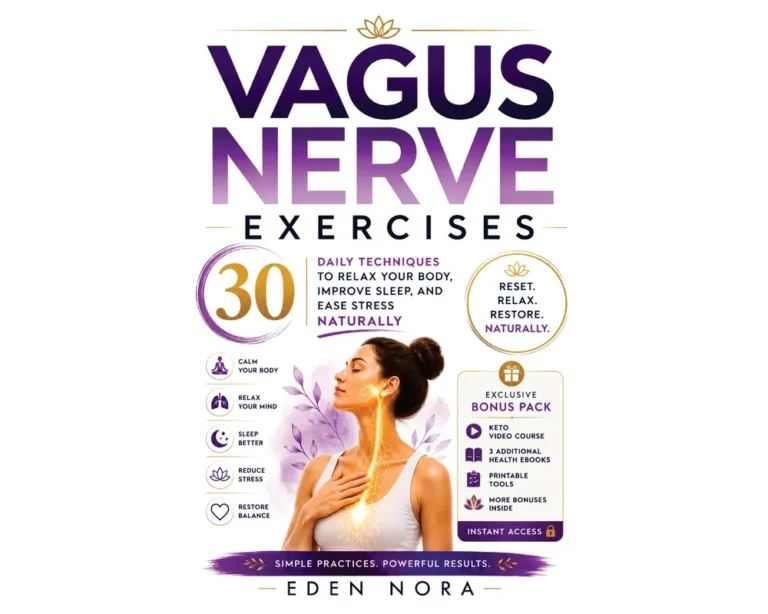
Vagus Nerve Exercises
Vagus Nerve Exercises 30 Daily Techniques to Relax Your Body, Improve Sleep, and Ease Stress Naturally Does your body feel constantly tense, overstimulated, exhausted,…
View the Book