
Vagus Nerve Meditation: What It Is, How It May Help, and Evidence Limits
“Vagus nerve meditation” usually combines mindfulness, breathing and relaxation rather than a distinct clinical method. Learn what the evidence says, try a grounded 10-minute practice and understand why “vagus reset” claims go too far.
Keep Learning—Listen Free
Short, practical audiobooks for your next step.

How to Be Happy Alone Without Feeling Lonely: The Psychology of Emotional Independence
Learn how to be happy alone without feeling lonely and build emotional…

How to Stay Unbothered When People Disrespect You: The Psychology of Unshakable Self-Respect
How to deal with disrespect without losing your peace, confidence, or self-respect…

How to Learn Anything: Self-Education in the Age of AI | Full Audiobook
How to learn anything, become self-educated, and think for yourself in the…

Perimenopause Symptoms: Hormones, Weight Gain, Sleep & Brain Fog | Full Audiobook
Perimenopause symptoms, hormones, weight gain, sleep problems, and brain fog are explained…

Investing for Beginners: Stock Market, Index Funds & Building Wealth | Full Audiobook
Investing for beginners, stock market basics, index funds, ETFs, diversification, compound growth,…

Personal Finance for Beginners: Budgeting, Money Management & Financial Literacy | Full Audiobook
Personal finance for beginners, budgeting, money management, and financial literacy explained in…

Time Management: How to Stop Procrastinating & Be More Productive | Full Audiobook
Time management, how to stop procrastinating, and how to be more productive…

How to Sleep Better: Insomnia, Deep Sleep & Falling Asleep Faster | Full Audiobook
How to sleep better, manage insomnia, get more deep sleep, and fall…

Psychology of Leadership: Leadership Skills, Influence & Communication | Full Audiobook
Psychology of leadership, leadership skills, influence, communication skills, and workplace psychology explained…
What Is Vagus Nerve Meditation?
“Vagus nerve meditation” is not a standardized medical protocol. The phrase usually refers to familiar meditation practices—breath awareness, mindfulness, body awareness, relaxation and sometimes humming—described through the language of the vagus nerve and the parasympathetic nervous system.
That label can be useful if it encourages people to learn about autonomic regulation. It becomes misleading when meditation is presented as a direct treatment for “vagus nerve dysfunction” or when a feeling of calm is treated as proof that a nerve has been reset.
How Meditation Could Influence Autonomic State
Meditation can change several processes at once. Attention moves away from ongoing demands. Breathing may become slower. Muscle tension may decrease. Emotional reactivity may soften. These changes can influence heart rate and other autonomic measures without requiring a single vagus-specific mechanism.
When meditation includes deliberately slow breathing, some of the HRV effect may come from the breathing itself. That is important when interpreting studies: a “meditation effect” and a “breathing effect” can overlap.
What Research Can—and Cannot—Tell Us
Research on meditation, mindfulness and vagally mediated HRV is mixed. A meta-analysis examining HRV in meditation did not find sufficient evidence that meditation consistently increases resting vagally mediated HRV compared with control conditions. More recent brief-mindfulness reviews have found some favorable RMSSD findings, but also substantial heterogeneity and study-quality limitations.
The balanced conclusion is not that meditation “does nothing.” Meditation can be useful for attention, stress management and other outcomes. The narrower claim—that meditation reliably and specifically increases vagal tone—needs more evidence.
HRV itself is indirect and strongly affected by respiration. A higher reading during a breathing-focused meditation does not prove that the vagus nerve has been permanently changed.
A 10-Minute Evidence-Aware Practice
Choose a stable seated or reclined position. Keep your eyes open or closed according to comfort.
- Minutes 0–2: Arrive. Notice the physical support underneath you and three neutral details in the environment. Let breathing remain natural.
- Minutes 2–5: Follow the breath. Notice where breathing is easiest to feel. If it becomes naturally slower, allow that. Do not take unusually large breaths or hold the breath.
- Minutes 5–7: Optional gentle slowing. Let each breathing cycle become slightly longer while remaining comfortable. A softly lengthened exhale is fine if it does not create air hunger.
- Minutes 7–9: Open attention. Include sounds, body sensations and thoughts without needing to change them. The task is noticing, not forcing calm.
- Minutes 9–10: Stop controlling. Let the breath return completely to its own rhythm and notice how you feel.
If focusing on breathing increases anxiety, switch to external sound or visual attention. Meditation does not need to be breath-centered to count.
Using Sound, Humming or a Soft Vocal Exhale
Some “vagus meditations” add humming or chanting. Humming can prolong exhalation and create a steady sensory focus. Small studies show HRV changes during humming, but the current evidence does not establish that humming is uniquely effective because it directly stimulates the vagus nerve.
If you enjoy it, use one or two soft humming exhalations near the middle of the practice. If it feels artificial or strains the throat, leave it out. The meditation does not become less effective because it is silent.
What You Might Notice—and What It Does Not Prove
You might notice slower breathing, less shoulder tension, a quieter stream of thought, warmth, sleepiness or simply a greater awareness of how activated you felt before sitting down. You might also notice very little.
None of those responses can diagnose vagal tone. A yawn is not proof that the vagus nerve “switched on.” Tingling is not proof of trauma release. A higher wearable HRV value is not proof of repair. Subjective relaxation can be valuable on its own without turning it into a medical conclusion.
Why “Vagus Reset Meditation” Is an Overstatement
The autonomic nervous system is not an electronic device with a reset button. It is continuously adapting to posture, breathing, movement, emotion, temperature, digestion, activity and the environment. A meditation session may shift some of those processes toward lower arousal, but the word reset suggests a discrete before-and-after event that is not how the system works.
A better goal is practice regulation: repeatedly creating conditions in which attention and breathing can become less urgent. That framing is more realistic and less likely to make you feel as though a difficult day means your nervous system has failed.
When Meditation Is Not the Right Tool
Stop if meditation creates escalating distress, panic, dissociation, severe dizziness or a sense that focusing inward is making symptoms substantially worse. You can use a more external practice—walking, listening to neutral sounds or speaking with someone supportive—and seek appropriate professional guidance if distress is persistent or severe.
Do not use meditation as a substitute for medical evaluation of fainting, chest pain, significant palpitations, severe shortness of breath, neurological symptoms or other concerning physical symptoms.
Meditation vs. Breathing, Yoga and Somatic Practice
Meditation primarily trains attention and awareness. A breathing guide teaches respiratory pacing more precisely. Yoga adds structured movement and postures. Somatic practice emphasizes body sensation and movement. These categories overlap, but they are not interchangeable.
If you want the strongest physiological evidence for a practical vagus-related technique, start with comfortable slow breathing. If you want an attention practice that may help you relate differently to stress and arousal, meditation can be a useful choice—without needing to call it a vagus reset.
For the broader Mayobook practice framework, see Vagus Nerve Exercises.
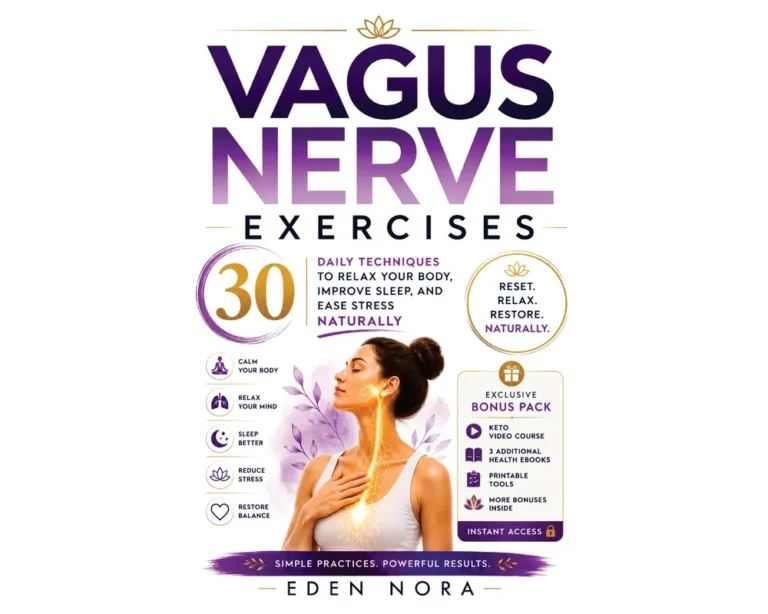
Want the complete system?
Explore the full book for a deeper, structured guide.
Vagus Nerve Exercises
Vagus Nerve Exercises 30 Daily Techniques to Relax Your Body, Improve Sleep, and Ease Stress Naturally Does your body feel constantly tense, overstimulated, exhausted,…
View the BookMore in Meditation
View category
Vagus Nerve Yoga: What the Trend Means and What the Evidence Supports
“Vagus nerve yoga” is a wellness label, not a standardized medical protocol. Here is what the trend usually includes, what yoga and breathing research can reasonably support, and how to try a gentle sequence without overclaiming direct vagus stimulation.