
Herbal Antibiotics First Aid Kit: What to Keep, What It’s For, and What It Can’t Replace
A sensible herbal first-aid kit is built around supportive care, basic hygiene, clear labels, and a plan for escalation—not around the idea that herbs can replace diagnosis or prescription antibiotics. This guide explains what may be reasonable to keep, what each item is actually for, and which symptoms should override the kit entirely.
Keep Learning—Listen Free
Short, practical audiobooks for your next step.

How to Stay Unbothered When People Disrespect You: The Psychology of Unshakable Self-Respect
How to deal with disrespect without losing your peace, confidence, or self-respect…

How to Learn Anything: Self-Education in the Age of AI | Full Audiobook
How to learn anything, become self-educated, and think for yourself in the…

Perimenopause Symptoms: Hormones, Weight Gain, Sleep & Brain Fog | Full Audiobook
Perimenopause symptoms, hormones, weight gain, sleep problems, and brain fog are explained…

Investing for Beginners: Stock Market, Index Funds & Building Wealth | Full Audiobook
Investing for beginners, stock market basics, index funds, ETFs, diversification, compound growth,…

Personal Finance for Beginners: Budgeting, Money Management & Financial Literacy | Full Audiobook
Personal finance for beginners, budgeting, money management, and financial literacy explained in…

Time Management: How to Stop Procrastinating & Be More Productive | Full Audiobook
Time management, how to stop procrastinating, and how to be more productive…

How to Sleep Better: Insomnia, Deep Sleep & Falling Asleep Faster | Full Audiobook
How to sleep better, manage insomnia, get more deep sleep, and fall…

Psychology of Leadership: Leadership Skills, Influence & Communication | Full Audiobook
Psychology of leadership, leadership skills, influence, communication skills, and workplace psychology explained…

Carl Jung Psychology & Shadow Work: Understand Your Unconscious Mind | Full Audiobook
Carl Jung psychology and shadow work explained in a deep full audiobook…
An “herbal antibiotics first aid kit” sounds like a box of natural substitutes for prescription antibiotics. That is the wrong way to build one. A useful kit is better understood as a preparedness system for minor problems, short-term symptom support, basic wound care, and informed decision-making while you watch for signs that professional treatment is needed.
What an Herbal Antibiotics First Aid Kit Can—and Cannot—Do
The phrase herbal antibiotics is informal. Some herbs contain compounds that inhibit microorganisms in laboratory studies; some have traditional-use histories; a smaller number have human evidence for particular symptoms. None of those categories should be assumed to mean that a home herbal product can diagnose an infection, select the right antimicrobial treatment, or safely replace prescription antibiotics when a bacterial infection requires them.
A sensible kit can help with four things:
- basic hygiene and first aid for minor wounds or irritation;
- comfort measures for uncomplicated short-term symptoms;
- clearly labeled herbal products whose intended role and safety limits you understand;
- preparedness information so you know when to stop self-care and where to seek help.
It cannot rule out pneumonia, a dental abscess, kidney infection, spreading cellulitis, sepsis, or another condition where delayed treatment matters.
Start With the Problem, Not the Herb
The safest question is not “Which herb kills this?” It is “What kind of problem is this, and is home supportive care appropriate?” Different situations carry different risks.
| Situation | Reasonable supportive role | What not to assume | Escalation trigger |
|---|---|---|---|
| Minor superficial cut or scrape | Clean water, gentle washing, appropriate dressing, observation | That a strong herbal extract disinfects better than standard wound care | Increasing redness, swelling, pus, fever, severe pain, red streaking, or a deep/contaminated wound |
| Mild cold or uncomplicated cough | Fluids, rest, comfort measures, selected symptom-supportive products | That symptom relief proves an infection has been cured | Breathing difficulty, chest pain, dehydration, confusion, persistent or rapidly worsening fever |
| Tooth pain or gum swelling | Short-term comfort while arranging dental assessment | That an herbal rinse can drain or cure an abscess | Facial swelling, fever, difficulty swallowing, spreading swelling, severe pain |
| Urinary burning or frequency | Hydration and prompt clinical assessment depending on risk | That a urinary herb prevents progression to kidney infection | Fever, flank pain, vomiting, pregnancy, worsening symptoms, recurrent or complicated UTI |
| Red, warm, painful skin area | Observation only if truly minor and nonprogressive | That a topical herbal product treats cellulitis | Spreading redness, fever, severe tenderness, drainage, rapid progression, systemic illness |
This triage mindset is more valuable than owning a long list of antimicrobial herbs.
How to Build the Kit Around Roles, Not Marketing Claims
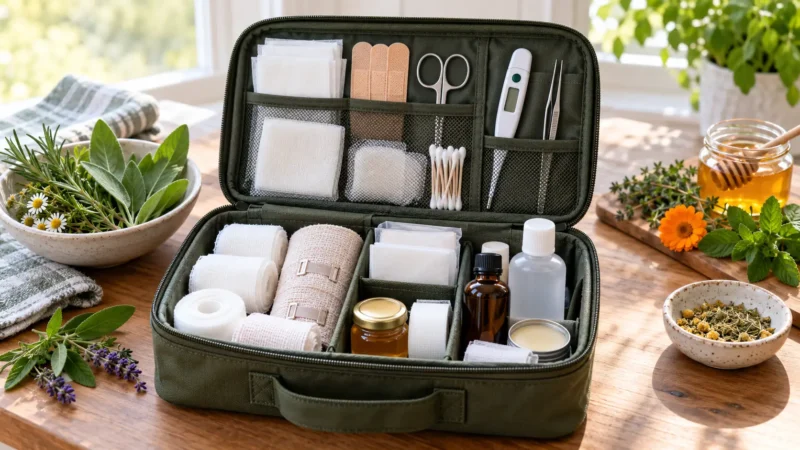
A practical kit starts with standard first-aid essentials, then adds only a small number of clearly understood herbal items. The goal is not to collect every product labeled “immune,” “antibacterial,” or “detox.”
Basic wound and hygiene supplies
- clean water access or sterile saline for rinsing when appropriate;
- mild soap for surrounding skin;
- sterile gauze, adhesive bandages, tape, and clean dressings;
- disposable gloves;
- tweezers and small scissors reserved for first aid;
- a thermometer;
- hand sanitizer for situations where handwashing is not immediately available.
Symptom-support items
These should be selected for a defined supportive role rather than a general promise to “fight infection.” For example, honey may be useful for cough in people older than one year; a labeled thyme preparation may fit a cough-support role; and some elderberry products have limited evidence for respiratory symptom relief. None of these items should be treated as proof that the underlying infection has been cleared.
Herbal preparations with a clear identity
If you include a botanical product, keep it in the original container with the full ingredient list, concentration, expiry date, directions, and warnings. Avoid unlabelled homemade concentrates, mystery tinctures, or decanted essential oils.
Your information layer
A small card or digital note with allergies, current medicines, major health conditions, pregnancy status where relevant, emergency contacts, primary-care information, and local urgent-care options can be more important than another supplement.
Herbal Options: Evidence, Intended Role, and Cautions
The table below illustrates how to think about common candidates. It is not a treatment protocol.
| Item | Possible supportive role | Evidence level | Major caution | Not a replacement for |
|---|---|---|---|---|
| Thyme preparation | Productive cough or respiratory comfort with specific preparations | Traditional-use/regulatory context plus limited human evidence; laboratory antimicrobial findings are separate | Essential oil is far more concentrated than culinary thyme or tea | Assessment or antibiotics for serious bacterial respiratory infection |
| Elderberry | Possible short-term cold or flu symptom support | Limited and mixed human evidence | Raw or unripe plant material can cause illness; pregnancy evidence is limited | Antivirals, antibiotics, or urgent respiratory care when indicated |
| Andrographis | Possible symptom relief in uncomplicated acute respiratory illness | Randomized-trial signal with important quality and formulation limitations | GI and skin reactions can occur; use extra caution with medicines and during pregnancy | Treatment of pneumonia or another serious infection |
| Goldenseal | No well-established first-aid treatment role | Insufficient rigorous human efficacy evidence | Meaningful drug-interaction potential; avoid during pregnancy/breastfeeding and in infants | Antibiotics or diagnosis of infection |
| Uva ursi | Narrow traditional-use context for mild lower urinary symptoms in adult women | Traditional-use recognition plus modern trial data showing a benefit-risk tradeoff | Greater symptom burden in a key trial; kidney disorders and UTI red flags require medical care | Routine unsupervised treatment of active or complicated UTI |
If you want deeper context on why laboratory antimicrobial activity and human treatment evidence are different, Mayobook’s guide on how herbal antibiotics work explains the evidence ladder in more detail.
Storage, Labels, Shelf Life, and Product Quality
A first-aid kit becomes less safe when labels disappear. Keep products in their original packaging. Record the date opened when that matters. Check expiry dates several times a year. Replace products that have changed smell, color, texture, seal integrity, or storage conditions.
- Do not store heat-sensitive products in a hot car or damp bathroom.
- Do not transfer essential oils, tinctures, or concentrates into unmarked bottles.
- Keep adult and child products clearly separated.
- Keep concentrated herbal products away from children and pets.
- Do not assume two brands with the same herb name have the same concentration or extract.
- Keep a current medication and allergy list with the kit.
Product quality matters especially for supplements because preparation and standardization vary. A familiar herb name does not guarantee that a product resembles the preparation used in a study.
Pregnancy, Children, Chronic Conditions, and Medication Interactions
Ordinary culinary exposure and concentrated medicinal products are not the same thing. A herb used safely as a seasoning may have a very different risk profile as an essential oil, standardized extract, or high-dose capsule.
Use a much lower threshold for professional review when the person is pregnant or breastfeeding, a young child, elderly or frail, immunocompromised, living with kidney or liver disease, taking several prescription medicines, or has a history of significant allergic reactions.
Goldenseal is a good example of why this matters: it can alter the way the body processes medications. Uva ursi has a narrow traditional-use context and specific kidney cautions. Concentrated essential oils carry risks that do not apply to culinary herbs. There is no universal list of “safe combinations,” so product-specific interaction checking belongs with a pharmacist or clinician.
Readers wondering whether herbal products can simply stand in for conventional treatment should also review whether herbal medicine can replace modern medicine and Mayobook’s evidence-focused explanation of whether herbal antibiotics work.
The Red Flags That Override the Kit
The kit stops being the main plan when symptoms suggest serious infection, significant dehydration, airway or breathing problems, or rapid progression.
- difficulty breathing, chest pain, confusion, bluish lips or face;
- persistent high fever, shaking chills, severe weakness, or rapidly worsening illness;
- spreading redness, severe skin pain, red streaking, pus with systemic symptoms, or a deep puncture/bite wound;
- facial or neck swelling, dental swelling with fever, difficulty swallowing, or inability to open the mouth normally;
- fever with flank/back pain, vomiting, or urinary symptoms suggesting possible kidney involvement;
- severe dehydration, inability to keep fluids down, fainting, or markedly reduced urination;
- infection concerns in pregnancy, infancy, immunocompromise, or serious chronic disease.
Delayed care can matter even when symptoms began as something mild. A natural product does not make a deteriorating illness safer to watch.
A Better Preparedness Plan: What to Record Before You Need It
A strong kit is mostly preparation. Before an illness or injury occurs, make sure you can answer the following:
- What prescription medicines and supplements does each household member take?
- What allergies or previous serious reactions are known?
- Which products in the kit are for symptom support only?
- Which products should not be used in pregnancy or children?
- Where is the nearest urgent-care clinic, dentist, pharmacy, or emergency department?
- Who is the primary-care contact?
- Which first-aid supplies are expired or depleted?
- Are all herbal products labeled with their exact preparation and concentration?
- Does everyone in the household know which symptoms override self-care?
For a broader preparedness reference, the Herbal Antibiotics resource can help you compare common herbs, evidence levels, and safety boundaries. Mayobook’s Herbal Medicine topic hub also provides wider context. For the direct comparison between herbal products and prescription treatment, see Herbal Antibiotics vs Antibiotics.
Bottom Line
The best herbal first-aid kit is not the one with the most bottles. It is the one that makes supportive care easier, keeps products identifiable, prevents unsafe improvisation, and helps you recognize the moment when the right “natural” decision is to seek medical or dental care.

Want the complete system?
Explore the full book for a deeper, structured guide.
Herbal Antibiotics
A calm, practical guide to herbal antibiotics and natural infection remedies. Learn how to respond early to illness, injury, and infection using responsible herbal…
View the BookKeep exploring
Herbal Medicine
See the wider Mayobook topic hub with guides, answers, comparisons, and books.
Explore the topic
How Herbal Antibiotics Work—A Clear Guide to Natural Infection Support
Go deeper with a longer structured guide connected to this topic.
View guide
Herbal Antibiotics vs Antibiotics – What’s the Difference—and Which Should You Use?
See a decision-stage page that helps readers compare the next best option.
Compare options