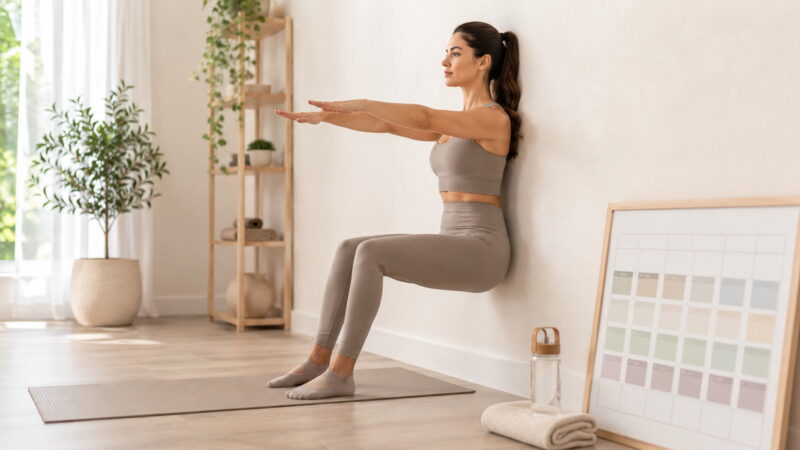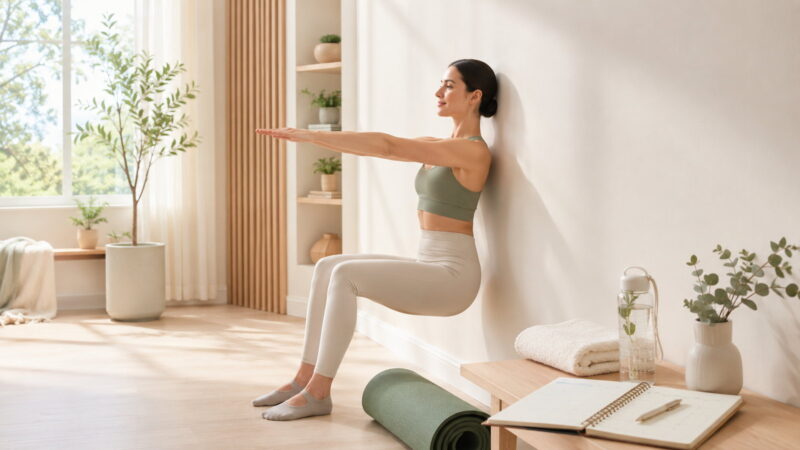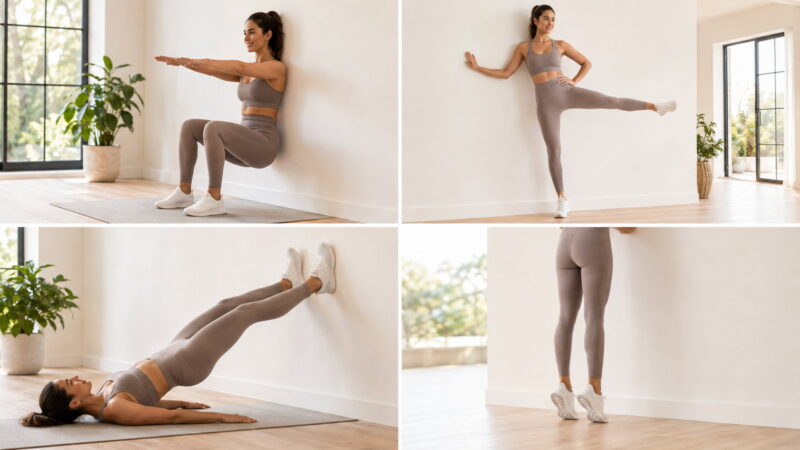
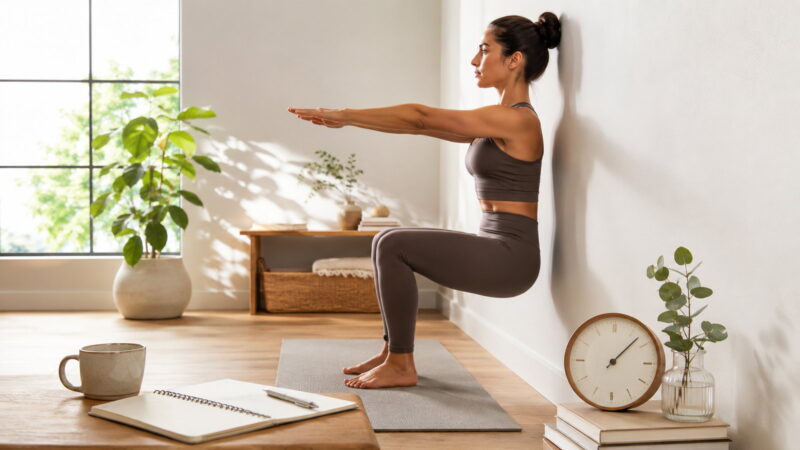
How long does it take to see results from Wall Pilates? Many people can notice some functional improvements within the first few weeks—such as better exercise control, more repetitions with good form, improved balance confidence, or less fatigue during familiar movements. Visible changes in body shape or body composition are much less predictable and usually take longer.
Your timeline depends on where you start, how consistently you train, whether the exercises become progressively more challenging, your total activity, nutrition, sleep, recovery, and health context. A calendar alone cannot guarantee a transformation.
If you are using Wall Pilates as your main home program, judge early progress by what you can do before relying on what you can see in the mirror.
How Long Does It Take to See Results From Wall Pilates? The Short Answer
A realistic way to think about the timeline is:
- First few weeks: you may become more familiar with the exercises and notice better coordination, control, balance, and local muscular endurance.
- Around four weeks: consistent beginners may be able to perform harder variations, tolerate longer sessions, or use less support. Some people may notice small appearance changes, but they are not guaranteed.
- Beyond four weeks: continued progress depends increasingly on whether the routine keeps challenging you. Visible body-composition changes, when they occur, vary substantially from person to person.
These are broad expectations, not deadlines. Someone who is new to exercise may notice functional changes faster than someone whose starting fitness is already high.
The First Results Are Often Skill and Endurance—not Appearance
Early exercise progress is often neurological and skill-based. Your body becomes more familiar with the movement pattern, you learn how to organize the trunk and pelvis, and you waste less effort trying to balance or remember the sequence.
That can show up as:
- cleaner repetitions;
- better breathing during a set;
- more stable balance with less wall support;
- greater comfortable range of motion;
- longer holds without losing position;
- less fatigue during a workout you have repeated before.
Those are real results. They may appear before any obvious change in photos or clothing fit.
What Can Change After About Four Weeks?
After roughly a month of consistent practice, a beginner may reasonably expect better familiarity with the exercises and some improvement in muscular endurance or movement control if the sessions provide enough challenge.
You might find that a wall squat feels steadier, a bridge requires less concentration, a plank variation lasts longer, or you can perform a movement through a greater controlled range. Those changes indicate adaptation even if your body looks similar.
Visible change is possible, but four weeks is too short to promise a specific appearance outcome. Day-to-day changes in hydration, lighting, posture, clothing, digestion, and camera angle can make photos look dramatically different without representing the same amount of body-composition change.
Why Visible Results Usually Take Longer—and Vary More
Appearance depends on several processes that do not move at the same speed. Improved posture or muscle control can subtly change how you carry yourself. Muscle growth generally requires repeated progressive loading over time. Fat loss depends on overall energy balance rather than one exercise method.
Wall Pilates also cannot decide where body fat comes off first. Training the abdomen may strengthen the trunk, but it does not selectively remove fat from the stomach.
That is why two people can complete the same routine and have very different visual results. Genetics, starting body composition, food intake, total daily movement, medications, health conditions, stress, sleep, and training history all influence the outcome.
What Determines Your Timeline
- Consistency: regular training gives your body repeated opportunities to adapt.
- Challenge: exercises must remain difficult enough to create a training stimulus.
- Progression: increasing range, leverage, tempo, repetitions, hold time, or resistance helps prevent the routine from becoming too easy.
- Starting fitness: beginners often experience faster early skill gains than trained exercisers.
- Total activity: walking, strength training, cardio, work demands, and other exercise all contribute to the weekly workload.
- Nutrition: food intake strongly affects body-composition goals and recovery.
- Sleep and recovery: poor recovery can limit performance and make progression harder.
- Measurement: the result you choose to track changes what “progress” looks like.
Repeating exactly the same easy workout indefinitely can make the calendar longer without creating much new adaptation.
How to Know You’re Progressing Before You “See” It
Track objective markers that are less vulnerable to lighting or mood:
- repetitions completed with the same or better form;
- how long you can hold a position without compensating;
- how much wall support you need for balance;
- comfortable range of motion;
- whether you can progress to a harder variation;
- how difficult a familiar session feels;
- how consistently you complete the planned workouts.
If appearance is part of your goal, measurements or photos can be useful when taken under similar conditions and spaced far enough apart to show meaningful trends. They do not need to be checked every day.
When to Adjust Your Routine
If several weeks pass and nothing about the workout is improving, review the program rather than automatically adding more days.
Ask:
- Have the exercises become too easy?
- Are you using enough range or resistance to create meaningful effort?
- Is your technique limiting the intended movement?
- Are you training consistently enough to build on the previous session?
- Are you recovering between harder workouts?
- Does Wall Pilates actually match the goal you are trying to reach?
For example, advanced strength goals may require heavier resistance than Wall Pilates alone provides. Body-fat goals depend on the wider activity-and-nutrition picture. If the goal is simply better control and muscular endurance, progression within Wall Pilates may be enough.
Bottom Line
You may notice Wall Pilates results in the form of better control, endurance, balance, and exercise confidence within a few weeks. Around four weeks, those functional improvements may be clearer. Visible or body-composition changes generally take longer and vary too much to promise on a fixed schedule.
Measure progress by performance first, keep increasing the challenge as appropriate, and treat appearance as only one possible outcome. For broader guidance on fitness and body-composition goals, continue through Mayobook’s Fitness, Weight Loss & Body Transformation hub.