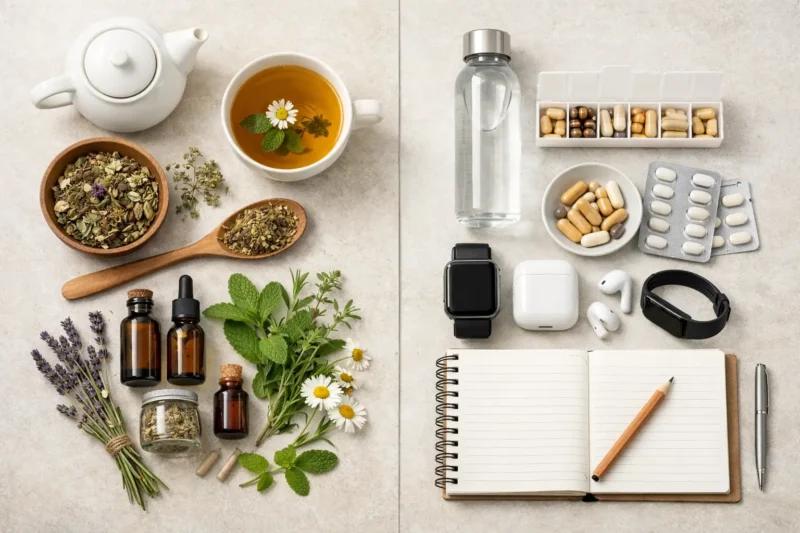
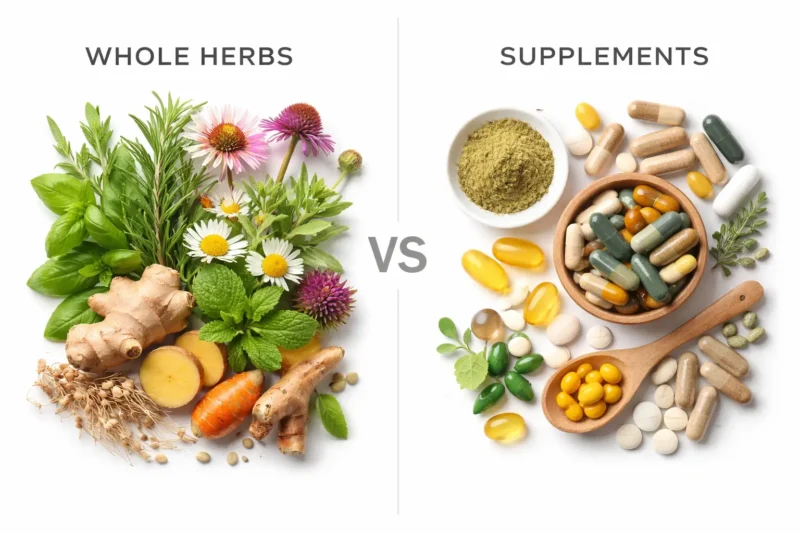
Herbal medicine and dietary supplements are not opposing categories. Herbal medicine describes the use of plants and plant preparations for health-related purposes. A dietary supplement is a product category defined in part by how a product is formulated, taken, and labeled. A capsule containing an herbal extract can be both an herbal product and a dietary supplement. A vitamin D tablet is a dietary supplement but not herbal medicine.
The distinction matters because a product’s form, ingredient, concentration, evidence, and safety considerations tell you more than whether its packaging says “natural.” In the United States, herbal supplements are a type of dietary supplement—not a separate, automatically safer class.
What counts as herbal medicine?
Herbal medicine is a broad term for practices involving botanicals. Examples include preparing ginger as a tea, using a plant extract in a tincture, or purchasing a standardized herbal capsule. The term describes the plant-based approach; by itself, it does not tell you whether a preparation is effective for a particular medical condition.
A preparation can contain many plant constituents or a more defined extract. Neither “whole plant” nor “standardized” proves safety or better outcomes. A traditional history of use is helpful cultural context, but it is different from evidence that a specific product has been tested in people.
What is a dietary supplement?
Under U.S. rules, a dietary supplement is generally a product intended for ingestion to supplement the diet and labeled as a dietary supplement. Its ingredients may include vitamins, minerals, amino acids, herbs or other botanicals, and their extracts. This is a broader category than herbal products.
An herbal capsule labeled “dietary supplement” may therefore fall within both descriptions. A magnesium tablet is a supplement without being herbal. A botanical skin salve is not automatically a dietary supplement merely because it contains an herb: topical products fall under other rules. Other countries classify products differently.
Examples that make the overlap clear
- Chamomile tea: an herbal preparation; whether a packaged product is legally a dietary supplement depends on its intended use and labeling.
- Echinacea capsules labeled as a dietary supplement: an herbal product and a supplement.
- Vitamin B12 tablets: a dietary supplement, but not herbal medicine.
- A topical herbal cream: a botanical preparation, but not an ingestible dietary supplement.
- A concentrated botanical extract: its safety and evidence depend on the exact plant, preparation, dose, and intended use.
Does one work better than the other?
There is no meaningful universal winner. “Herbal medicine” identifies the kind of ingredients or practice; “dietary supplement” describes a regulated category of products. Those labels cannot predict which one works faster or offers better results. Evidence must be evaluated for the specific ingredient, formulation, dose, condition, and population.
For example, a clinician may recommend a particular nutrient supplement when a deficiency is documented. That does not establish that any herb is inferior, or that a concentrated botanical capsule is more effective than a tea. Marketing claims about plant “synergy” should not be mistaken for proof from controlled human studies.
How are herbal supplements regulated in the United States?
The U.S. Food and Drug Administration generally does not approve dietary supplements for safety and effectiveness before they are marketed. Manufacturers are responsible for compliance with applicable requirements; FDA can take action against unsafe or unlawfully marketed products. Supplements are regulated, but they are not preapproved as prescription drugs are.
The FDA’s supplement guidance explains these requirements. The NIH National Center for Complementary and Integrative Health clarifies that botanicals may be dietary-supplement ingredients and that evidence varies widely.
How to evaluate a specific product
- Identify the ingredient: check the botanical’s common and scientific name, the plant part, and other ingredients.
- Check the form and strength: tea, powder, tincture, and standardized extract are not necessarily interchangeable.
- Match evidence to the claim: look for human studies of the actual preparation for the intended purpose.
- Review safety: consider medicines, allergies, pregnancy, breastfeeding, surgery, and underlying conditions.
- Inspect the label: for a U.S. dietary supplement, look for the Supplement Facts panel and disclosed serving amounts; a label alone does not establish efficacy.
Herbal products and supplements can interact with prescription medicines, and product quality varies. Ask a healthcare professional or pharmacist about a specific product, particularly when taking medication or treating an illness. Neither category should replace appropriate diagnosis or prescribed treatment.
Where to read next
For foundational terminology and preparation methods, explore Herbal Medicine for Beginners. For a practical choice between particular product types, see the in-depth Herbal Remedies vs Supplements comparison. Mayobook’s Herbal Medicine topic hub organizes related safety and preparation resources.
If you prefer book-length background reading, The Herbal Remedies Encyclopedia is a related Mayobook title. It is educational reading, not a source of individualized medical instructions.