
Withanolides
Withanolides are the primary active compounds responsible for ashwagandha’s adaptogenic effects. They help regulate the body’s stress response and support balance across multiple systems.
Ashwagandha explained clearly—how it supports stress resilience, energy balance, and long-term mental and physical stability.
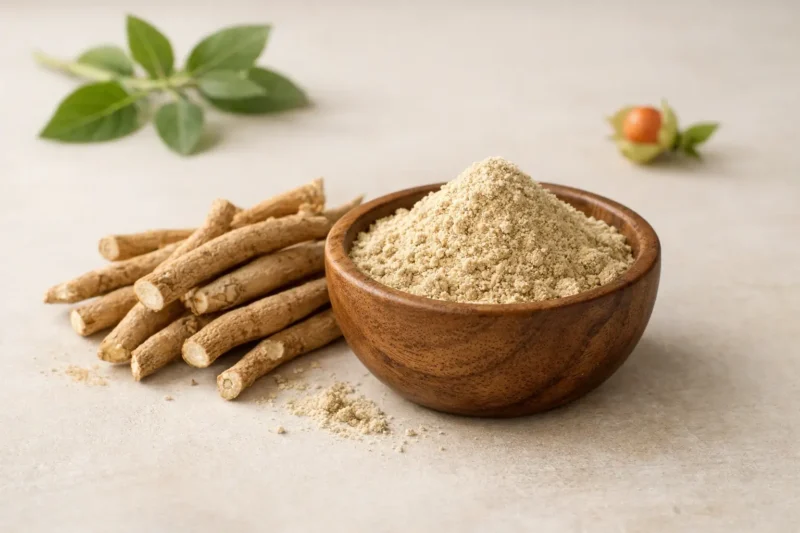
Ashwagandha is an adaptogenic herb derived from Withania somnifera, used to help the body manage stress, support energy levels, and promote overall balance.
Ashwagandha is one of the most widely used herbs for managing stress and supporting the body’s response to pressure. Unlike herbs that act quickly on symptoms, ashwagandha works by helping the body adapt to stress over time.
If you’re considering ashwagandha, it’s important to understand that it is not an instant calming remedy. Its effects build gradually, making it most effective when used consistently as part of a long-term routine.
Use this map to move through the concept in a clear order: meaning, mechanism, use, and wider context.
Ashwagandha is one of the most well-known adaptogenic herbs in herbal medicine, valued for its ability to help the body manage stress, improve energy levels, and support overall balance. Derived from Withania somnifera, it has been used for centuries in traditional medicine systems to promote resilience and stability.
Unlike herbs that target specific symptoms, ashwagandha works more broadly. It helps the body adapt to stress, making it useful for both mental and physical challenges.
Ashwagandha is classified as an adaptogen, meaning it helps the body respond to stress more effectively. This is different from herbs that provide immediate relief.
Its role is not to eliminate stress but to:
Ashwagandha influences several systems:
It helps regulate stress hormones, including cortisol, which plays a key role in how the body responds to pressure.
Stress is one of the most common issues in modern life. Ashwagandha helps by supporting the body’s ability to manage stress over time.
It is often used for:
Ashwagandha is often used to support energy levels, particularly in cases of chronic fatigue. By helping regulate stress, it indirectly supports better energy balance.
Ashwagandha can also support sleep quality by reducing stress and promoting relaxation. This makes it useful for individuals who struggle with stress-related sleep issues.
Unlike fast-acting herbs, ashwagandha is most effective when used consistently. Its benefits build over time, making it suitable for long-term use in appropriate amounts.
Ashwagandha is generally safe but should be used with awareness of individual conditions and potential interactions.
Moderation and consistency are key.
Ashwagandha is not about quick fixes—it is about building resilience.
Used correctly, it becomes a powerful ally in managing stress and maintaining balance over time.
Withanolides are the primary active compounds responsible for ashwagandha’s adaptogenic effects. They help regulate the body’s stress response and support balance across multiple systems.
These compounds contribute to ashwagandha’s calming and stabilizing effects on the nervous system, helping reduce feelings of stress and tension.
Sitoindosides are associated with antioxidant and anti-stress activity, supporting the body’s ability to adapt to physical and mental stress.
These compounds contribute to hormonal balance and help explain ashwagandha’s role in supporting energy, recovery, and overall vitality.
Ashwagandha does not act like a sedative—it supports the body’s ability to handle stress rather than simply suppressing symptoms.
Use these connected pages for the next step.

Discover natural antibiotics in herbal medicine, including powerful…
Read next

Herbal medicine cannot fully replace modern medicine, but…
Read next
If you’re looking for a complete, structured approach to natural infection defense—not just a list ...…
Explore booksWhen the overview is clear but practical application still matters, this deeper resource shows how the concept fits into a complete framework and how to use it well.
Ashwagandha works best when used consistently—it strengthens resilience, not just relief.