
Dating, Relationships & Social Skills
Understanding relationships goes far beyond attraction—it involves communication, emotional intelligence, self-awareness, and the ability to build meaningful connections that stand the test of time. Whether it’s dating, friendships, or long-term partnerships, the quality of your relationships shapes your confidence, happiness, and overall life experience. In this topic, you’ll discover how to improve your social skills, develop confidence in real-world interactions, and navigate modern dating with clarity and purpose. You’ll learn how attraction works, how to communicate effectively, and how to build relationships based on trust, respect, and emotional connection. From first impressions to deeper emotional bonds, this section is designed to help you understand people better, express yourself more clearly, and create stronger, healthier relationships in every area of your life.

Latest guides for Dating, Relationships & Social Skills
Explore all guides → How to Stop People-Pleasing Without Feeling GuiltyStopping people-pleasing often creates guilt before it creates relief. Learn how to distinguish healthy guilt from conditioned boundary guilt, say no without overexplaining, tolerate…Read guide →
 How to Set Boundaries as a People-Pleaser: A Practical Step-by-Step GuideLearn how to set boundaries as a people-pleaser without becoming harsh or overexplaining. This practical guide covers identifying limits, saying no, handling guilt, responding…Read guide →
 How To Improve Social IntelligenceA practical, evidence-aware system for improving social intelligence through observation, listening, perspective-taking, communication, feedback and deliberate practice.Read guide →
Dating, relationships, and social skills are central to how we connect, communicate, and build meaningful experiences with others. Whether you’re trying to navigate modern dating, improve your confidence in social situations, or create deeper emotional connections, understanding how relationships work is one of the most valuable skills you can develop.
At its core, building strong relationships is not about luck or appearance—it’s about awareness, communication, emotional intelligence, and consistent personal growth. Many people struggle not because they lack potential, but because they lack clarity on what truly creates connection and trust.
This topic is designed to give you that clarity.
The Foundation of Meaningful Relationships
Every healthy relationship—whether romantic or social—rests on a few core principles:
- Trust
- Communication
- Respect
- Emotional connection
- Consistency
Without these, even strong attraction will eventually fade.
In dating, it’s easy to focus only on chemistry or initial impressions. But long-term success comes from understanding how to sustain connection beyond the early stages. That means learning how to communicate openly, listen actively, and handle challenges with maturity.
Strong relationships are built, not found.
Understanding Attraction and Connection
Attraction is often misunderstood. It’s not just physical—it’s emotional, psychological, and behavioral.
There are three key layers:
1. Physical Attraction
This is the first layer—appearance, body language, and presence. While important, it is not enough to sustain a relationship.
2. Emotional Attraction
This is where real connection begins. It comes from:
- shared experiences
- vulnerability
- understanding
- emotional safety
3. Intellectual and Value-Based Attraction
Long-term relationships depend heavily on:
- shared values
- life goals
- compatibility in thinking and decision-making
Understanding these layers helps you approach dating with more awareness instead of confusion or guesswork.
The Role of Social Skills in Relationships
Social skills are the bridge between intention and connection.
You may have good intentions, but without the ability to communicate effectively, those intentions won’t translate into meaningful interactions.
Key social skills include:
- Active listening — truly understanding what others are saying
- Clear expression — communicating your thoughts without confusion
- Body language awareness — non-verbal signals often speak louder than words
- Emotional awareness — recognizing both your feelings and others’
Improving your social skills improves every area of your life—not just dating.
Building Confidence in Social and Dating Situations
Confidence is often seen as something you either have or don’t have, but in reality, it is built through experience and self-awareness.
True confidence comes from:
- knowing your values
- understanding your strengths
- accepting your imperfections
- taking consistent action despite discomfort
In dating and relationships, confidence is not about being perfect—it’s about being comfortable with who you are.
When you develop this kind of confidence:
- you communicate more clearly
- you attract the right people
- you avoid chasing validation
Confidence creates clarity—and clarity creates better decisions.
Communication: The Core of Every Relationship
Most relationship problems come down to one issue:
Poor communication
Learning how to communicate effectively can transform your relationships.
What good communication looks like:
- expressing thoughts honestly but respectfully
- listening without interrupting
- asking questions instead of assuming
- resolving conflict without escalation
What poor communication looks like:
- avoiding important conversations
- reacting emotionally instead of thoughtfully
- misunderstanding intentions
- shutting down or withdrawing
Strong communication builds trust, and trust builds lasting relationships.
Navigating Modern Dating
Modern dating can feel confusing.
With apps, social media, and endless options, people often struggle with:
- uncertainty
- mixed signals
- lack of commitment
- unrealistic expectations
To navigate dating effectively, you need clarity:
Know what you want
Are you looking for:
- casual dating?
- a serious relationship?
- long-term partnership?
Without clarity, you’ll attract confusion.
Set boundaries
Boundaries are not restrictions—they are standards that protect your time, energy, and emotional wellbeing.
Avoid chasing validation
The more you seek approval, the more you lose control of your decisions.
Healthy dating is about alignment—not approval.
Emotional Intelligence in Relationships
Emotional intelligence is one of the most powerful skills in building strong relationships.
It involves:
- understanding your emotions
- managing your reactions
- recognizing others’ feelings
- responding with empathy
People with high emotional intelligence:
- handle conflict better
- communicate more effectively
- build deeper connections
- maintain healthier relationships
Without emotional intelligence, even good relationships can become unstable.
Common Relationship Mistakes to Avoid
Many people repeat the same patterns without realizing it.
Here are some of the most common mistakes:
1. Ignoring red flags
Early warning signs often get overlooked due to attraction or excitement.
2. Over-investing too early
Rushing emotional commitment can create imbalance and pressure.
3. Lack of boundaries
Without boundaries, relationships become unclear and unhealthy.
4. Poor communication habits
Avoiding difficult conversations leads to bigger problems later.
5. Seeking validation instead of connection
When your focus is on being liked, you lose sight of compatibility.
Awareness of these mistakes helps you make better decisions.
Building Healthy, Long-Term Relationships
Strong relationships are not perfect—they are stable, respectful, and continuously evolving.
Key elements of long-term success:
- Consistency — showing up reliably over time
- Mutual respect — valuing each other’s individuality
- Growth mindset — evolving together, not staying stagnant
- Conflict resolution — addressing issues constructively
- Shared vision — aligning on future goals
Relationships require effort—but the right ones feel natural, not forced.
Improving Yourself to Improve Your Relationships
One of the most important truths:
The quality of your relationships reflects the quality of your personal growth.
Instead of focusing only on others, focus on becoming:
- more self-aware
- more emotionally stable
- more communicative
- more disciplined
When you improve yourself:
- your standards improve
- your choices improve
- your relationships improve
Social Skills Beyond Dating
While this topic focuses on dating and relationships, social skills extend far beyond romantic connections.
They impact:
- friendships
- professional relationships
- networking
- leadership
- everyday interactions
Learning how to connect with people is a lifelong advantage.
Where to Start
If you’re just beginning your journey, start with:
- understanding attraction and communication
- improving your confidence in small social situations
- practicing active listening
- learning how to express yourself clearly
Then move into:
- deeper emotional intelligence
- relationship dynamics
- long-term connection strategies
Final Thought
Dating, relationships, and social skills are not fixed traits—they are skills that can be learned, improved, and mastered over time.
The more you understand yourself and others, the easier it becomes to build meaningful connections.
With the right knowledge and consistent effort, you can create relationships that are not only fulfilling but also stable, respectful, and deeply rewarding.
Latest questions for Dating, Relationships & Social Skills
Explore all questions →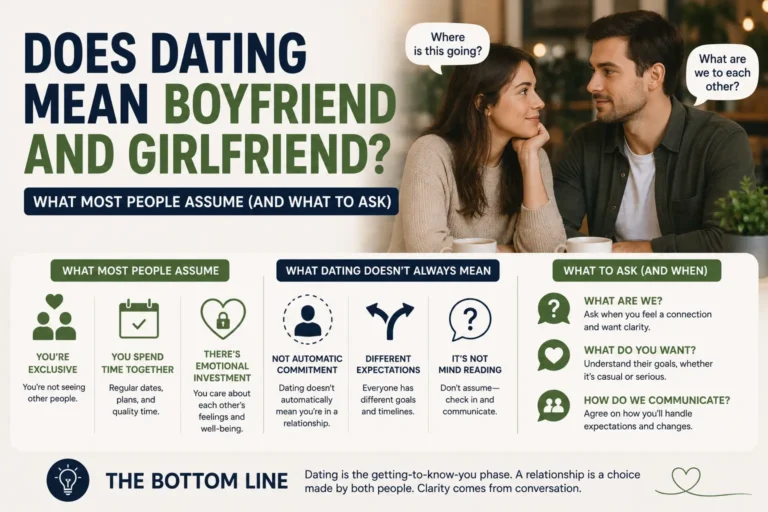 Does Dating Mean Exclusive? How to Know Without Guessing
Dating does not automatically mean exclusivity. Learn what exclusive dating actually means, the signs that matter, and the exact conversation that confirms where you…
Read answer →
Does Dating Mean Exclusive? How to Know Without Guessing
Dating does not automatically mean exclusivity. Learn what exclusive dating actually means, the signs that matter, and the exact conversation that confirms where you…
Read answer →
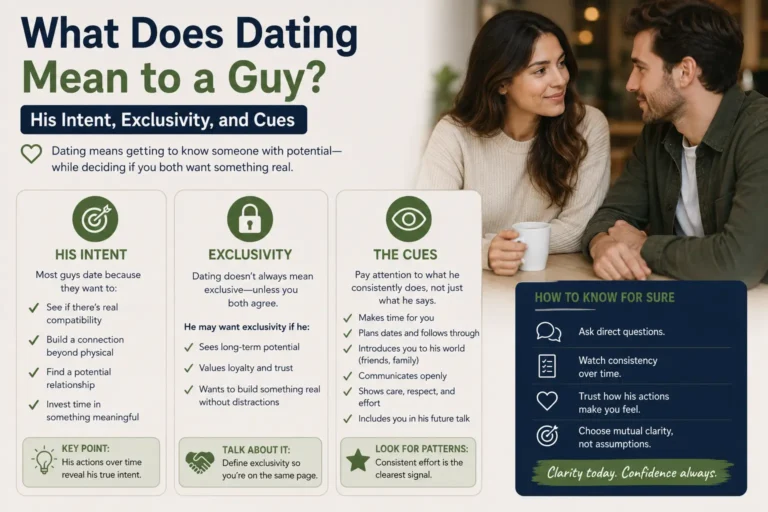 What Does Dating Mean to a Guy? His Intent, Exclusivity, and Cues
Wondering what dating means to a guy? Learn how intent, exclusivity expectations, and real behavior cues shape the label when the conversation stays unclear.
Read answer →
What Does Dating Mean to a Guy? His Intent, Exclusivity, and Cues
Wondering what dating means to a guy? Learn how intent, exclusivity expectations, and real behavior cues shape the label when the conversation stays unclear.
Read answer →
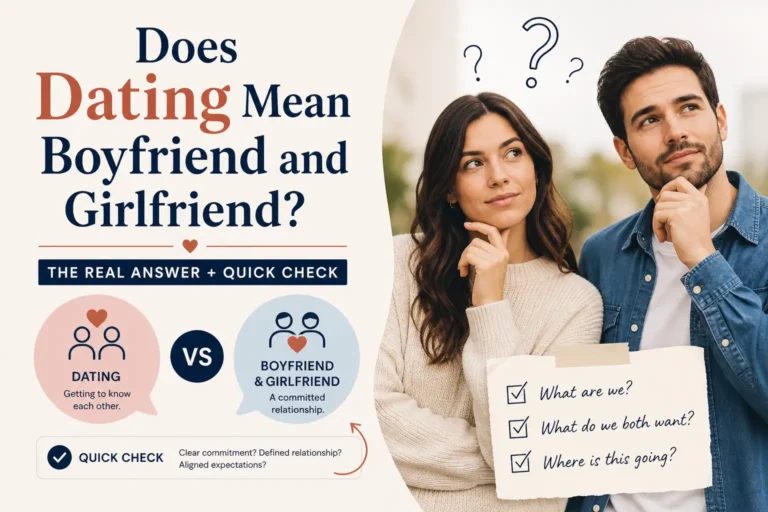 Does Dating Mean Boyfriend and Girlfriend? The Real Answer + Quick Check
Dating doesn’t automatically mean boyfriend and girlfriend. Learn the real meaning, the difference between “dating” and exclusivity, and a quick checklist to confirm where…
Read answer →
Does Dating Mean Boyfriend and Girlfriend? The Real Answer + Quick Check
Dating doesn’t automatically mean boyfriend and girlfriend. Learn the real meaning, the difference between “dating” and exclusivity, and a quick checklist to confirm where…
Read answer →
Latest references for Dating, Relationships & Social Skills
Explore all references → People-Pleasing and Childhood Trauma: What the Evidence Can and Cannot Tell Us
Childhood trauma can contribute to people-pleasing when appeasement or self-silencing becomes linked with safety, but it is not the only cause. Learn what research…
Open reference →
People-Pleasing and Childhood Trauma: What the Evidence Can and Cannot Tell Us
Childhood trauma can contribute to people-pleasing when appeasement or self-silencing becomes linked with safety, but it is not the only cause. Learn what research…
Open reference →
 People-Pleasing and Anxious Attachment: How They Overlap and Differ
People-pleasing and anxious attachment often overlap around fear of rejection, reassurance seeking and boundary difficulty, but they are not the same. Learn the key…
Open reference →
People-Pleasing and Anxious Attachment: How They Overlap and Differ
People-pleasing and anxious attachment often overlap around fear of rejection, reassurance seeking and boundary difficulty, but they are not the same. Learn the key…
Open reference →
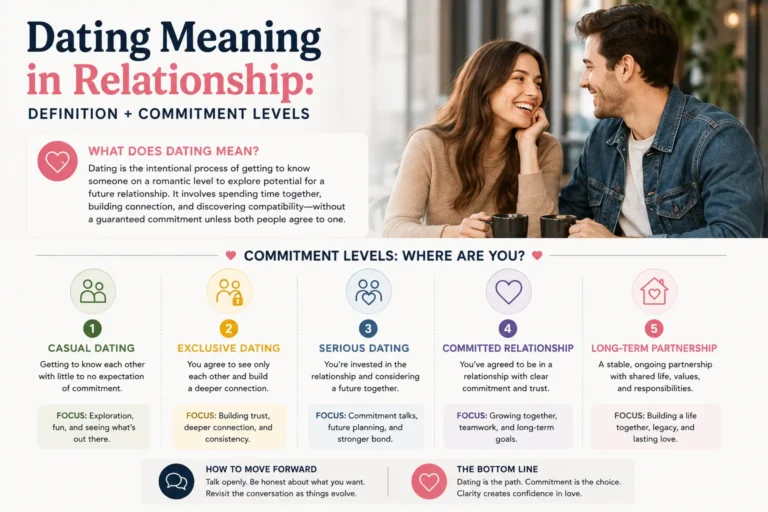 Dating’s Meaning in Relationship: Definition + Commitment Levels
Wondering what “dating” really means in a relationship? Learn the common definition, how commitment levels differ, and what behaviors usually match each one.
Open reference →
Dating’s Meaning in Relationship: Definition + Commitment Levels
Wondering what “dating” really means in a relationship? Learn the common definition, how commitment levels differ, and what behaviors usually match each one.
Open reference →
Latest comparisons for Dating, Relationships & Social Skills
Explore all comparisons →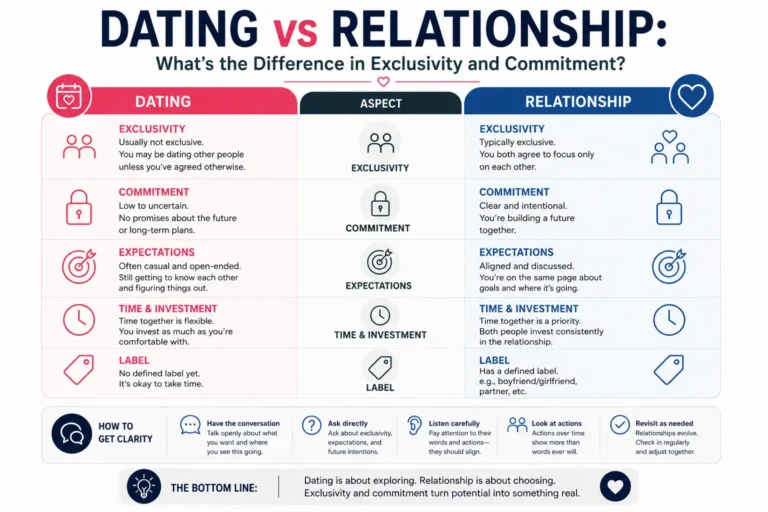 Dating vs. Relationship: What’s the Difference in Exclusivity and Commitment?
Confused about dating vs relationship? Compare exclusivity, commitment, and expectations. Then learn how to move from casual dating to clear relationship status.
Compare →
Dating vs. Relationship: What’s the Difference in Exclusivity and Commitment?
Confused about dating vs relationship? Compare exclusivity, commitment, and expectations. Then learn how to move from casual dating to clear relationship status.
Compare →
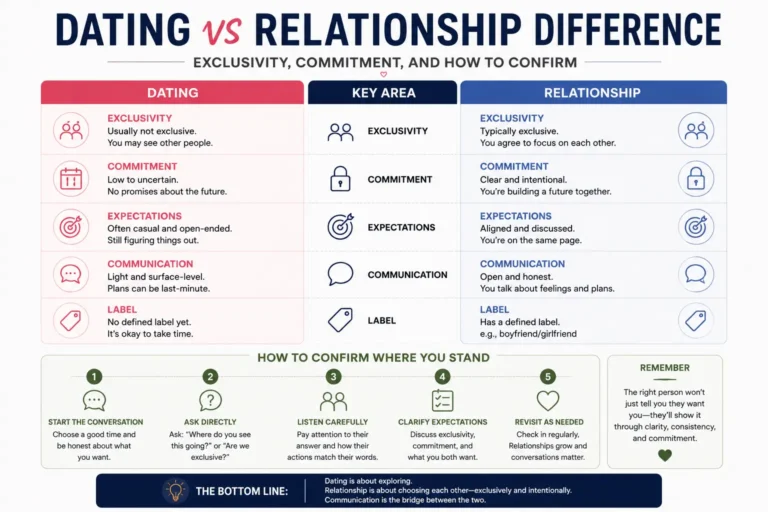 Dating vs Relationship Difference: Exclusivity, Commitment, and How to Confirm
Not sure where “dating” ends and a relationship begins? Compare exclusivity and commitment, then learn how to confirm the status with clarity.
Compare →
Dating vs Relationship Difference: Exclusivity, Commitment, and How to Confirm
Not sure where “dating” ends and a relationship begins? Compare exclusivity and commitment, then learn how to confirm the status with clarity.
Compare →
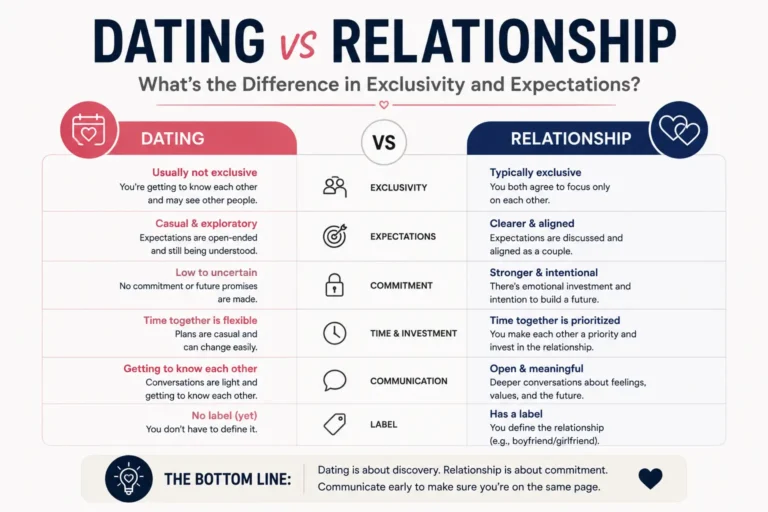 Dating vs. Relationship: What’s the Difference in Exclusivity and Expectations?
Dating and relationship can look similar, but they differ in exclusivity, commitment, and expectations. Compare the signs side-by-side and decide what fits you.
Compare →
Dating vs. Relationship: What’s the Difference in Exclusivity and Expectations?
Dating and relationship can look similar, but they differ in exclusivity, commitment, and expectations. Compare the signs side-by-side and decide what fits you.
Compare →
Latest articles for Dating, Relationships & Social Skills
Explore all articles → Social Intelligence And Conflict Resolution
Social intelligence supports conflict resolution by helping people separate facts from assumptions, understand stakes and power, listen beneath positions, calibrate responses and repair without…
Read article →
Social Intelligence And Conflict Resolution
Social intelligence supports conflict resolution by helping people separate facts from assumptions, understand stakes and power, listen beneath positions, calibrate responses and repair without…
Read article →
 People-Pleasing and Resentment: Why Saying Yes Can Turn Into Anger
People-pleasing can create resentment when repeated yeses hide unspoken limits and expectations. Learn why the cycle develops, how to recognize it early, and how…
Read article →
People-Pleasing and Resentment: Why Saying Yes Can Turn Into Anger
People-pleasing can create resentment when repeated yeses hide unspoken limits and expectations. Learn why the cycle develops, how to recognize it early, and how…
Read article →
 Social Intelligence In Leadership
Social intelligence in leadership means reading group dynamics, understanding stakeholder perspectives, adapting communication, handling conflict and building trust without relying on charisma or manipulation.
Read article →
Social Intelligence In Leadership
Social intelligence in leadership means reading group dynamics, understanding stakeholder perspectives, adapting communication, handling conflict and building trust without relying on charisma or manipulation.
Read article →
Latest audiobooks for Dating, Relationships & Social Skills
Explore all audiobooks → Is He Cheating? 5 Signs You Shouldn’t Ignore
5 signs a man is cheating can be difficult to recognize until small changes become consistent patterns. Drawing on Matthew Hussey's relationship insights, relationship…
Listen →
Is He Cheating? 5 Signs You Shouldn’t Ignore
5 signs a man is cheating can be difficult to recognize until small changes become consistent patterns. Drawing on Matthew Hussey's relationship insights, relationship…
Listen →
 How to Be Charismatic: Why Calm, Confident People Command Respect
What is charisma, and why do some people instantly command respect? Discover the science of charisma and the psychology behind presence, confidence, emotional intelligence,…
Listen →
How to Be Charismatic: Why Calm, Confident People Command Respect
What is charisma, and why do some people instantly command respect? Discover the science of charisma and the psychology behind presence, confidence, emotional intelligence,…
Listen →
 Biblical Submission Isn’t What Most People Think | Christian Marriage Explained
What does the Bible really teach about submission in marriage? Few biblical topics have generated more confusion, debate, and misunderstanding than biblical submission. In…
Listen →
Biblical Submission Isn’t What Most People Think | Christian Marriage Explained
What does the Bible really teach about submission in marriage? Few biblical topics have generated more confusion, debate, and misunderstanding than biblical submission. In…
Listen →
Frequently asked questions about Dating, Relationships & Social Skills
01What makes a healthy relationship?
A healthy relationship is built on trust, communication, respect, and emotional support between both individuals. It involves open and honest conversations, the ability to resolve conflicts calmly, and a mutual understanding of boundaries and expectations. In strong relationships, both people feel valued, heard, and supported without losing their individuality. Consistency, reliability, and shared values also play a major role in maintaining long-term connection and stability.
02How can I improve my social skills and confidence?
Improving social skills and confidence starts with small, consistent actions. Practice active listening, maintain eye contact, and engage in conversations without overthinking your responses. Building confidence also comes from self-awareness—understanding your strengths and accepting your imperfections. Over time, regular social interaction, stepping outside your comfort zone, and learning from real experiences will naturally improve both your confidence and your ability to connect with others.
03How do I start a conversation in dating or social situations?
Starting a conversation becomes easier when you focus on curiosity rather than pressure. Begin with simple, natural questions based on your environment or shared context, such as asking about interests, experiences, or opinions. Avoid trying to impress—instead, aim to connect. Good conversation is less about saying the perfect thing and more about showing genuine interest, listening carefully, and responding thoughtfully.
04Why do relationships fail so often?
Most relationships fail due to poor communication, lack of emotional understanding, unmet expectations, and absence of trust. Many people avoid difficult conversations, leading to unresolved issues that grow over time. In some cases, incompatibility in values, goals, or emotional maturity also plays a role. Successful relationships require effort, clarity, and the willingness to grow together rather than avoid problems.
05How can I build emotional attraction in a relationship?
Emotional attraction develops through meaningful interaction, trust, and shared experiences. It grows when people feel understood, respected, and emotionally safe with each other. You can build emotional attraction by being authentic, listening actively, showing empathy, and sharing your thoughts and feelings honestly. Unlike physical attraction, emotional connection deepens over time and is essential for long-term relationships.
06What are the most important social skills for building relationships?
The most important social skills for building relationships include effective communication, emotional intelligence, active listening, and self-awareness. Being able to express yourself clearly, understand others’ emotions, and respond with empathy creates stronger and more meaningful connections. Body language, tone of voice, and the ability to handle conflict respectfully also play a crucial role in maintaining healthy relationships.