
Intent
What makes it romantic rather than purely social
A practical reference for understanding what dating usually means, and how people map it to commitment.
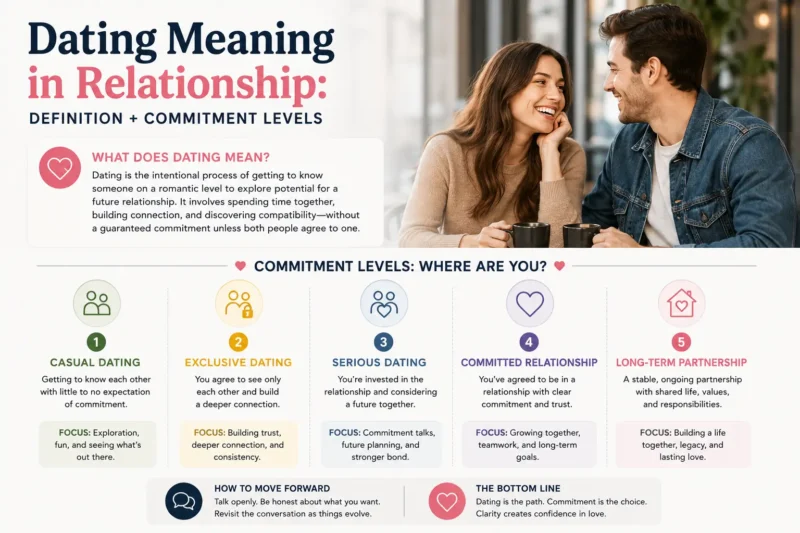
Dating meaning in relationship is a label people use for a romantic connection that’s more intentional than casual hanging out, but not always as clearly defined as a committed “boyfriend and girlfriend” relationship. In practice, it can range from exclusive and relationship-bound to openly seeing someone while still keeping options. The key is what both people agree on and what behaviors they consistently show.
“Dating” is one of the most overloaded words in modern relationships. Two people can both say they’re “dating” while holding very different expectations about exclusivity, seriousness, timing, and how public the connection is. This is why misunderstandings happen: people treat the same word as a shortcut for their own assumptions. A useful way to read the label is to look at patterns—how you’re introduced to each other’s lives, whether plans feel consistent, and whether conversations about exclusivity and intent are clear. If you’re trying to decide whether you’re on the same page, this guide gives you a realistic map from low-clarity dating to more committed partnership.
Use this map to move through the concept in a clear order: meaning, mechanism, use, and wider context.
Dating can feel simple on paper—until you’re the one living it. If you’ve ever wondered what “dating” really means in a relationship, you’re not alone. The phrase is widely used, but it often hides different expectations about exclusivity, seriousness, and what comes next. This reference breaks down the common meaning and the commitment levels people typically map to the word.
In most modern contexts, dating's meaning in a relationship is a label for a romantic connection where people are spending time with intention. That intention might be to build something meaningful, or it might be to explore chemistry without immediate pressure. What it usually does not guarantee is a fixed status. Many people who say they’re “dating” are not necessarily claiming exclusivity, a defined commitment, or a specific timeline.
Think of “dating” as a spectrum of closeness and agreement. Two people can both be telling the truth and still be on different pages about what the truth means. That’s why your lived experience—how often you see each other, how consistent communication is, and whether expectations are discussed—matters more than the label itself.
Most misunderstandings start in one of three places.
First, exclusivity. Some people assume dating automatically means “we’re not seeing other people.” Others assume it means “we’re romantically interested, but we haven’t agreed on exclusivity.” If you’re unsure, you’re not being “too much”—you’re noticing a missing agreement.
Second, intent. Someone might be dating with the intention to find a long-term partner, while another person is dating to enjoy the present and keep options open. Both can call it dating, and neither is required to read your mind.
Third, consistency and social framing. If you’re always the one initiating, plans are vague, or you’re never included in each other’s lives, the label may be doing more emotional work than it’s actually backing up.
People often use “dating” as a comfort zone: close enough to feel romantic, but not so formal that it creates pressure. Here’s how commitment levels typically show up when you pay attention to patterns.
This looks like chemistry and occasional plans, but limited clarity. You may not be introduced to friends, exclusivity may never come up, and future talk is minimal. If you’re asking what this means, you might hear flexible language like “we’ll see” or “I’m not sure yet.”
Communication becomes more regular and plans become more consistent. You might meet each other’s friends or have repeat dates. Exclusivity may be discussed indirectly (“I don’t want drama”) or directly (“Are you seeing anyone else?”). The difference here is that both people are moving toward a clearer definition.
This level is marked by explicit or clearly implied exclusivity. You’re not just spending time—you’re choosing each other. Conversations about boundaries are more straightforward, and there’s less confusion about who you are socially to each other. If you’re wondering, “Does dating mean boyfriend and girlfriend?” exclusive dating is often the bridge, but it may still stop short of formal labeling.
At this level, people often act like a couple while waiting for the “official” moment. You may see more consistency, shared routines, and more direct future alignment. The label “dating” may remain because someone prefers gradual steps, but the behavior suggests seriousness.
What about “I’m dating someone” and “what does dating mean to a guy”?
Language can shift by gender and personality, but the core issue is still agreement. When someone says “I’m dating someone,” they might mean they’re romantically involved with one person, or they might mean they’re exploring multiple connections. Similarly, “What does dating mean to a guy?” often gets asked because some men may use the word to avoid vulnerability or to keep things casual. But it’s not universal.
The most reliable approach is to ask one clarifying question rather than guessing. For example, “When you say you’re dating, do you mean exclusively, or are you still seeing other people?” The goal isn’t to interrogate—it’s to align definitions so you can both relax.
Does dating always mean boyfriend and girlfriend?
No. Dating can overlap with boyfriend and girlfriend status, but it doesn’t automatically equal it. “Boyfriend and girlfriend” typically signals a more concrete relationship label—often with mutual expectations about exclusivity, public identity, and a shared direction.
Many couples move from dating to boyfriend/girlfriend once they agree on exclusivity and intent. Others prefer to stay in the “dating” label longer. Either can be healthy if both people are honest about expectations and consistent in behavior. The problem is when one person assumes boyfriend/girlfriend while the other is still in flexible dating mode.
The “7 types of dating” idea is helpful, but don’t let it replace your conversation
You might see “7 types of dating” lists online. Those categories can be useful for reflection—helping you notice whether you’re in a casual, exclusive, or relationship-minded dynamic. But real life doesn’t always fit neatly into categories. Two people can experience the same “type” differently based on communication style, cultural norms, and what they agree to.
Use any “types” framework as a starting point, not a verdict. If you want clarity, the best next step is a direct, respectful conversation that focuses on how each person defines dating in your specific situation.
If you’re trying to figure out what dating means to you—or what it means to the other person—try a calm, values-based approach.
This reduces pressure because you’re not demanding a label immediately. You’re asking for clarity, which is different. If the other person responds with defensiveness or constant avoidance, that’s information too.
Clarity usually arrives through repeated patterns:
You get consistent plans, not just last-minute interest.
Conversations about boundaries feel respectful rather than threatening.
You’re included more often—friends, events, and future plans.
Both people show willingness to define the relationship rather than leaving you guessing.
If those signs are absent, you may still be dating, but it may be a version that doesn’t meet your needs. That doesn’t make you wrong; it means your expectations and theirs need alignment—or you need to decide what you’ll accept.
Final thoughts
“Dating” is a useful word, but it isn’t a contract. The most emotionally protective approach is to treat it as a starting point and confirm the agreement behind it—especially exclusivity and intent. When you ask clear questions and watch consistent behavior, you turn confusion into information. And when you discover you’re not on the same page, you can make choices that respect both your time and your feelings. You deserve clarity that matches your effort, not a vague label that keeps you waiting.
| Attribute | Summary |
|---|---|
| Exclusivity | May be unclear; can be exclusive or open depending on what’s agreed |
| Intent | Often romantic; may range from “getting to know” to “looking for a partner.” |
| Communication | Texts/plans vary; clarity improves when expectations are discussed |
| Public presence | From private/low-key to being presented as a couple |
| Future talk | Sometimes avoided; usually more present as commitment increases |
| Attribute | Summary |
|---|---|
| Exclusivity | May be unclear; can be exclusive or open depending on what’s agreed |
| Intent | Often romantic; may range from “getting to know” to “looking for a partner.” |
| Communication | Texts/plans vary; clarity improves when expectations are discussed |
| Public presence | From private/low-key to being presented as a couple |
| Future talk | Sometimes avoided; usually more present as commitment increases |
What makes it romantic rather than purely social
The boundary that defines who else is in the picture
Reliable behavior that matches the label
How openly people discuss status and expectations
Dating vs. “boyfriend and girlfriend” is often less about feelings and more about agreement. Many people use “dating” to mean “we like each other and are spending time with romantic intent,” without locking in exclusivity or a timeline. A committed relationship usually includes clearer boundaries and shared definitions of the future, even if the future isn’t immediate. Also, dating meaning in relationship psychology matters because people use labels to manage comfort: some want emotional closeness without the pressure of a formal status, while others want clarity quickly. The difference shows up in what gets discussed and what gets consistently followed through.
Use these connected pages for the next step.
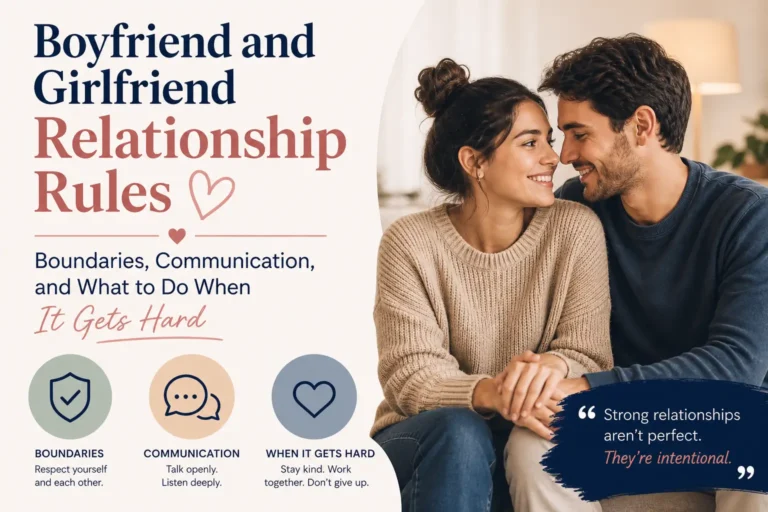
Turn the label into a healthier system. Learn…
Read next
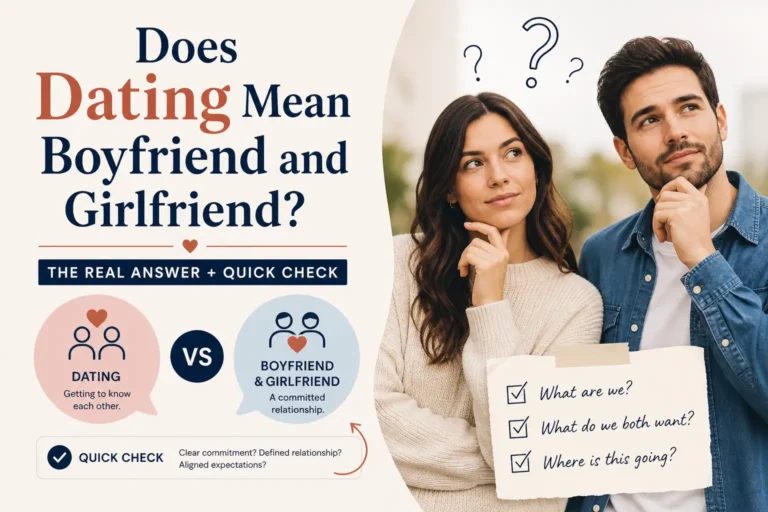
Dating doesn’t automatically mean boyfriend and girlfriend. Learn…
Read next“Dating” is a useful word, but it isn’t a contract. The most emotionally protective approach is to treat it as a starting point and confirm the agreement behind it—especially exclusivity and intent. When you ask clear questions and watch consistent behavior, you turn confusion into information. And when you discover you’re not on the same page, you can make choices that respect both your time and your feelings. You deserve clarity that matches your effort, not a vague label that keeps you waiting.