
Intent
Sets the tone—romantic interest rather than purely friendly hanging out.
Dating meaning in relationship is the in-between stage where two people spend time together with romantic intent, before “official” labels are agreed on.
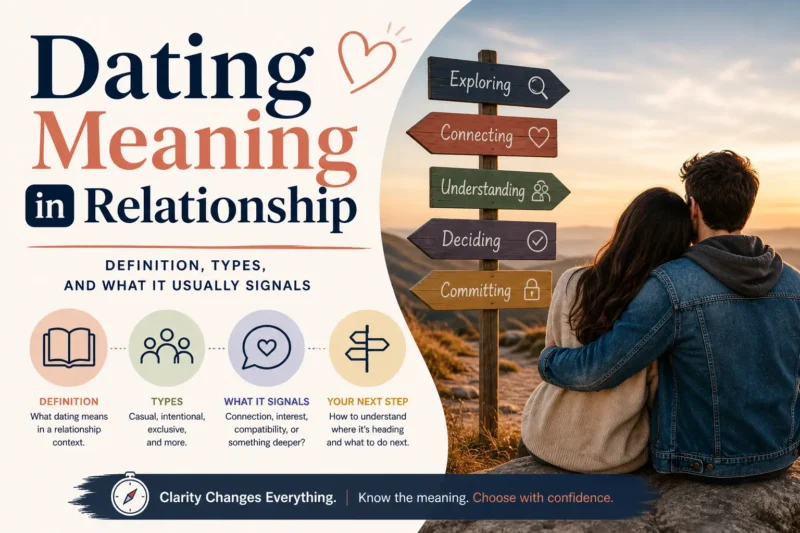
Dating meaning in relationship refers to a mutual, romantic-leaning connection where people choose to spend time together to learn about compatibility. It can be casual or heading toward something serious, but it usually stops short of being fully defined by official terms like “boyfriend/girlfriend” or “exclusive.” How it feels depends on what both people have agreed to, not on a universal rule.
People search for dating meaning in relationship because modern dating often lacks clear signals. One person hears “we’re dating” and thinks “we’re building toward a relationship,” while the other hears “we’re dating” and thinks “we’re enjoying time together without labels.” This confusion shows up in everyday questions like “am I dating someone meaningfully?” and “what does dating mean to a guy?” Knowing the most common interpretations helps you reduce guesswork, ask better questions, and protect your expectations—especially when feelings are growing faster than the labels.
Use this map to move through the concept in a clear order: meaning, mechanism, use, and wider context.
“Dating meaning in a relationship” is one of those phrases that sounds simple until you live inside it. Two people can both say they’re “dating,” yet one thinks that means a serious track toward a defined relationship, while the other thinks it’s a low-pressure way to get to know each other. The confusion isn’t always a sign of bad intent. Often it’s just a mismatch in what the label is supposed to include.
At its core, dating is a romantic-leaning connection where people choose to spend time together with the intention of learning about compatibility. That can look like regular dates, thoughtful check-ins, and being emotionally invested. However, dating rarely comes with automatic rules about exclusivity or official status.
| Attribute | Summary |
|---|---|
| Core idea | Romantic connection with time spent to assess compatibility |
| Common agreement level | Often flexible; varies by couple |
| Exclusivity | Not guaranteed unless clearly discussed |
| Official label | Usually not required; “boyfriend/girlfriend” is a separate step |
| Emotional meaning | Can be casual or serious depending on mutual expectations |
In everyday terms, dating often answers, “Are we more than friends?” and “Are we interested in each other romantically?” It usually does not fully answer, “Are we only seeing each other?” or “Do we agree to be boyfriend/girlfriend?” Those are separate conversations.
| Attribute | Summary |
|---|---|
| Core idea | Romantic connection with time spent to assess compatibility |
| Common agreement level | Often flexible; varies by couple |
| Exclusivity | Not guaranteed unless clearly discussed |
| Official label | Usually not required; “boyfriend/girlfriend” is a separate step |
| Emotional meaning | Can be casual or serious depending on mutual expectations |
Most misunderstandings begin when someone treats “dating” like a commitment shortcut. For example, one person might hear “we’re dating” and assume exclusivity is implied. Another person might hear the same words and assume the connection is open-ended.
This is why questions like “I'm dating someone meaning” or “What does dating mean to a guy” keep showing up. People are trying to decode whether the label signals safety, seriousness, or just “we’re seeing where this goes.” The most helpful mindset is: dating is a stage, not a contract.
The snapshot most people miss: Dating vs. exclusivity vs official
Think of the dating label as the middle layer. Exclusivity and official status are different layers that can come before or after, depending on the couple.
Dating: shared romantic time and interest, with flexible boundaries.
Exclusivity: an agreement that you’re not pursuing other romantic options.
Official: a named relationship (often with public acknowledgment), where commitment is clearly communicated.
A couple can be dating without exclusivity. They can also be exclusive without being “official” in the social sense. That’s why the exact words matter less than the agreement behind them.
Not everyone fits neatly into a category, but these “types” can help you map what’s happening.
If you’ve seen “7 types of dating” mentioned in forums, treat it as a starting framework. Your situation is still determined by what you and your partner agree on.
People often use “dating” to mean one of three things:
When you don’t know which meaning your partner is using, the simplest solution is to ask. Not in an interrogating way—more like aligning on a shared map.
Dating meaning in relationship psychology: why labels feel so personal
Dating labels aren’t just vocabulary. They affect how safe people feel. In psychology terms, people manage uncertainty by looking for cues. If someone feels emotionally invested, unclear status can feel like ongoing risk: “Am I valued? Am I being chosen?”
That’s why discussions about dating meaning in relationship psychology often focus on attachment and expectations. When someone’s attachment style leans toward anxiety, ambiguity can feel heavier. When someone is more avoidant, pressure to define things can feel suffocating. Neither is a moral failing. But both need communication and realistic expectations.
This also explains why “dating meaning in relationships” posts can be so intense. Online communities often reflect frustration from repeated mismatches between intention and interpretation. Still, your best compass is your own conversations, not a thread.
If you want clarity, you’ll get further by asking for alignment rather than pushing for a specific label.
Try focusing on three questions, in a gentle tone:
You can also share your own needs. For example: “I’m enjoying you, and I’m also someone who needs clarity about exclusivity before I get too attached.” That’s not pressure—it’s honesty.
Sometimes you don’t need to guess; the pattern becomes visible. Clarity often shows up through consistent behavior:
If dating is moving toward exclusivity, you’ll usually see more intentional planning, fewer ambiguous “maybe” moments, and more direct conversations about boundaries.
If dating is meant to stay casual, you may see reluctance around labels, less consistency, and more comfort with open-ended arrangements.
Still, behavior should be paired with conversation. A person can be consistent and still avoid clarity, and a person can talk clearly while acting inconsistently.
Dating a girl means a relationship: avoid stereotypes, ask for meaning
You might see people searching for “dating a girl meaning in a relationship,” but the gendered phrasing can distract from what matters: the agreement between two people. Whether the dynamic is “with a girl,” “with a guy,” or otherwise, the key is the same—what does the label include for them?
If you’re dating someone and you want to understand their expectations, ask what they mean by “dating,” how they view exclusivity, and whether they see a future together. That’s the fastest path to emotional clarity.
Dating, meaning being in a relationship, is a flexible stage defined by romantic intent and time together, not by guaranteed exclusivity or official status. The label can point toward something serious, but it can also stay open-ended. If you want to protect your heart and reduce confusion, focus on alignment: intent, exclusivity, and what “official” means to both of you.
Final note: when you’re unsure, it’s okay to pause and ask for clarity before you fully commit emotionally.
Sets the tone—romantic interest rather than purely friendly hanging out.
The behavior that signals the connection is more than a one-off meetup.
How quickly the couple checks in about feelings, boundaries, and expectations.
Whether dating includes seeing other people.
The biggest boundary is between “dating” and “official/exclusive.” Dating often describes the activity and intention (getting to know each other romantically), but it may not include exclusivity, commitment, or public recognition. “Official” usually implies a shared agreement that the connection is the primary romantic focus and is named. “Exclusivity” is narrower than “official”: it can be agreed privately without public labels. Understanding these differences prevents misunderstandings that can happen when one person assumes commitment while the other is still exploring.
Use these connected pages for the next step.
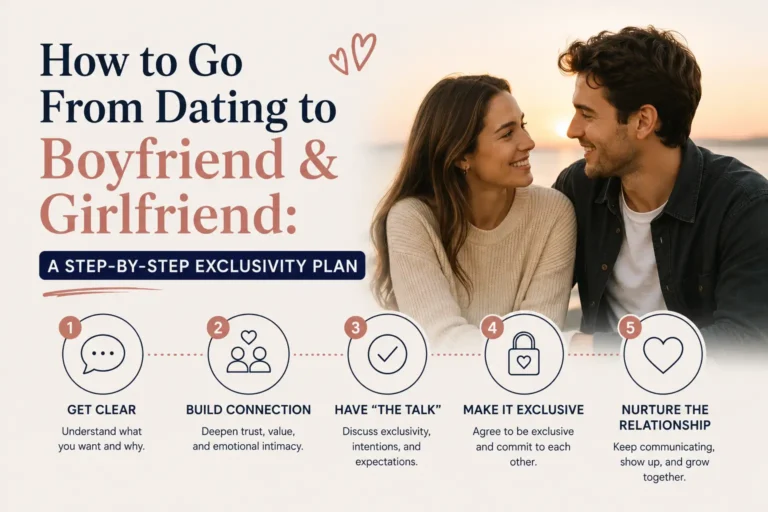
Turn “we’re dating” into a clear boyfriend-girlfriend label.…
Read next

Dating anxiety is more than nerves—it's persistent worry…
Read nextDating meaning in relationship is less about the word and more about the agreement behind it. If you’re feeling confused, you’re not “too much”—you’re noticing a gap between how you interpret the label and how your partner does. A respectful conversation about intent, exclusivity, and timeline can turn uncertainty into something calmer and more workable. You deserve clarity that matches your emotional pace, not a situation that keeps you guessing. If the answers don’t align, that’s also information—use it to choose what’s healthiest for you.