
Intent to connect
Romantic focus
A practical reference for what “dating” typically means, how common labels translate, and how to verify exclusivity without guessing.
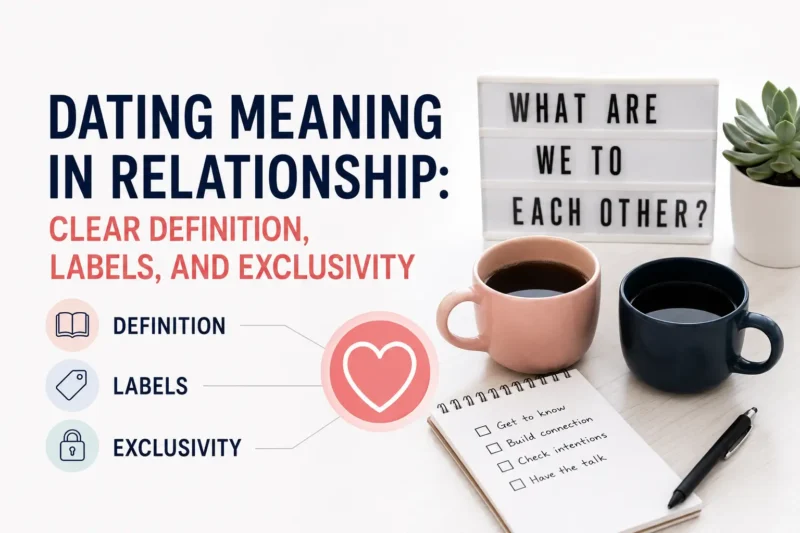
Dating meaning in relationship is the phase where two people are seeing each other romantically, but the relationship may not be defined with a specific label like “boyfriend and girlfriend.” In many cases, it implies interest, time together, and a willingness to learn each other, while still leaving room for flexibility. Because “dating” is used differently across cultures and friend groups, the most reliable definition comes from what both people agree on.
People search this because “dating” can feel clear in theory and confusing in real life. One person hears “we’re dating” and assumes exclusivity; another hears “dating” and thinks it’s open-ended. This is where misunderstandings often start—especially when texts slow down, introductions to friends happen at different speeds, or social media posts create assumptions. In dating meaning in relationship psychology, the key issue is expectations: people interpret the same word through their own assumptions, past experiences, and fear of being too “serious” too soon. A quick, respectful conversation can prevent a lot of emotional whiplash.
Use this map to move through the concept in a clear order: meaning, mechanism, use, and wider context.
If you’ve ever heard “we’re dating” and then wondered what that actually means for you, you’re not alone. “Dating” can sound like a simple label, but in practice it often covers a range of commitment levels. This guide anchors the definition, explains common interpretations, and helps you confirm exclusivity or next steps with less guessing.
Most confusion comes from the gap between a word and an agreement. “Dating” is commonly used to describe romantic involvement, but it doesn’t always come with a shared contract about exclusivity, future intent, or how public the relationship should be. You might be interpreting dating as “we’re choosing each other,” while your partner might interpret it as “we’re getting to know each other.”
Even when both people like each other, they may have different comfort levels with labels. Some people avoid titles because they fear pressure. Others avoid flexibility because it can feel emotionally unsafe. When you notice the mismatch, it’s usually not a character flaw—it’s an expectation gap.
In most everyday usage, dating means two people are spending time together with romantic interest. There’s usually an intention to learn about compatibility, not just casual hangouts. You may see behaviors like planning dates, checking in, meeting friends, or being more emotionally available.
What dating usually does not automatically guarantee is exclusivity or a formal commitment. That’s why you can hear “I’m dating someone meaning” in one context and “Does dating mean boyfriend and girlfriend?” in another. The same word can be used to describe both “early romantic exploration” and “exclusive partnership in progress,” depending on the individuals involved.
Exclusivity is a specific boundary: it answers the question “Are we seeing other people?” Without that agreement, “dating” can remain ambiguous. Two people can be affectionate, consistent and still not be exclusive. Conversely, two people can be exclusive while still not using a title.
Think of it like this: dating describes the activity and vibe; exclusivity describes the boundary. If you care about monogamy (or any specific arrangement), you’ll want to name it directly instead of hoping it’s implied.
People often use different phrases to communicate closeness without committing to a label. Here are a few common ways language shows up and what to clarify.
“Seeing each other” often means ongoing dates or contact, but it can still be non-exclusive. “Talking” can mean early interest and screening, sometimes with limited emotional investment. “Dating” is usually more established than “talking,” but it still may not be exclusive.
Then there are personal variations, like “dating with girl meaning in relationship,” which can show up in searches when someone is trying to understand how a person frames their role or seriousness. The most important point: gendered wording doesn’t tell you the commitment level. The agreement does.
If you’re trying to interpret “7 types of dating” ideas
Online, you’ll see lists that describe different “types of dating,” such as casual dating, exclusive dating, or dating with a purpose. These can be helpful as vocabulary, but they’re not universal categories. Your situation may not fit neatly into a list, and your partner may use “dating” as an umbrella term.
Use these “types” as prompts for questions, not as rules. If you can name which type you want—casual, exclusive, or intentional—you can then ask where your partner lands. That’s how you turn theory into clarity.
Behavior can provide clues, but it’s easy to over-read. Instead of trying to decode every text or social post, focus on patterns that relate directly to expectations.
Look for consistency in effort, honesty about availability, and how they respond when you bring up boundaries. If you ask gently and they avoid the conversation, that’s information. If they answer clearly and align with your needs, that’s also information.
A helpful mindset is: Signals are context, not proof. If you want exclusivity, you need words or explicit agreement—not just hope.
A good clarity conversation feels calm, specific, and respectful. You’re not trying to trap them; you’re trying to align expectations.
Start with your perspective: share what you’re experiencing and what you need to feel secure. Then ask an open question that invites a direct answer. For example, you can say you enjoy spending time together and ask whether you’re both dating exclusively. If you want a timeline, ask what “dating” means to them right now and what they hope it becomes.
If they’re not ready to define exclusivity, you can still decide what’s acceptable for you. You don’t have to force a label to protect your feelings. But you do need to protect your boundaries.
Expectations can change as you learn more about each other. Revisit clarity when something shifts—like meeting friends, becoming more emotionally involved, or noticing you’re thinking about them differently than before.
Also revisit if you feel recurring discomfort. If you keep wondering “are we exclusive?” that usually means your needs aren’t being met by the current level of clarity. A relationship can be kind and still not be a good fit if you’re carrying ambiguity alone.
Sometimes one person wants exclusivity and the other prefers flexibility. That doesn’t automatically mean someone is lying or manipulating you, but it does mean you have a compatibility issue.
You have a few options: you can agree on a new boundary, pause dating until you’re aligned, or step back if you can’t meet in the middle. The healthiest choice is the one that protects both people from resentment and assumption.
If you’re stuck in a loop of mixed signals, consider whether avoidance is a pattern. You deserve clarity, not emotional guessing games.
| Attribute | Summary |
|---|---|
| Core meaning | Romantic involvement without a guaranteed formal status |
| Exclusivity | Not automatically implied; must be clarified |
| Typical signals | Intent to spend time, get to know each other, some level of emotional investment |
| What it is not | Not the same as a committed title unless explicitly agreed |
| Best next step | Ask what “dating” means to them and share your own expectations |
| Attribute | Summary |
|---|---|
| Core meaning | Romantic involvement without a guaranteed formal status |
| Exclusivity | Not automatically implied; must be clarified |
| Typical signals | Intent to spend time, get to know each other, some level of emotional investment |
| What it is not | Not the same as a committed title unless explicitly agreed |
| Best next step | Ask what “dating” means to them and share your own expectations |
Romantic focus
Ongoing behavior
Depth of care
How public it feels
“Dating” is usually a social and romantic activity label, not a relationship-status contract. “Boyfriend and girlfriend” tends to signal a clearer commitment, public recognition, and often exclusivity. However, some couples use “dating” while still being exclusive, and others use “together” or “seeing each other” for different reasons. The distinction that matters is not the word itself—it’s the agreement behind it: how you define exclusivity, how you handle other people, and what level of emotional and practical investment you both consider “normal.”
Use these connected pages for the next step.

Turn the label into a healthier system. Learn…
Read next
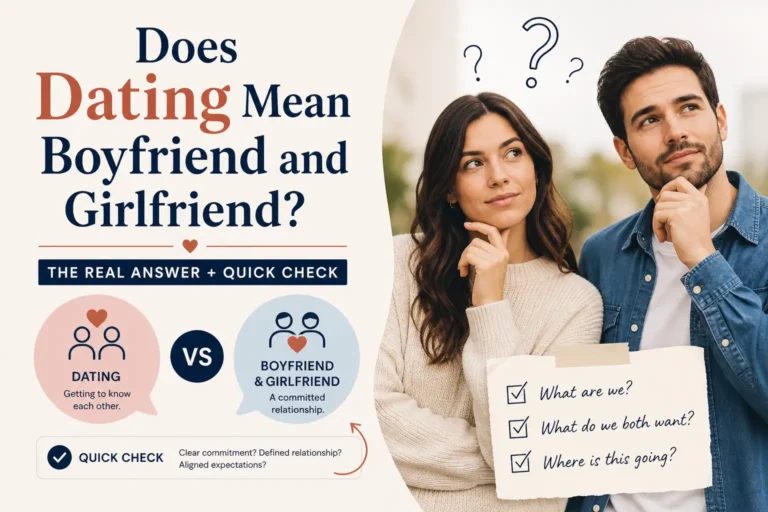
Dating doesn’t automatically mean boyfriend and girlfriend. Learn…
Read next“Dating” is a starting point, not a guarantee. It often signals romantic interest and time together, but exclusivity and commitment usually need to be named. If you want certainty, ask in a calm, specific way and share what you need to feel secure. When your meanings don’t match, that’s not a failure—it’s useful information. The goal isn’t to force a label; it’s to build an agreement that fits both of you, so you can relax into what’s real rather than decode what’s unclear.