
Romantic intent
Core signal of why you’re spending time together
Dating in a relationship context is a label for romantic involvement that can range from casual to intentionally building toward commitment.
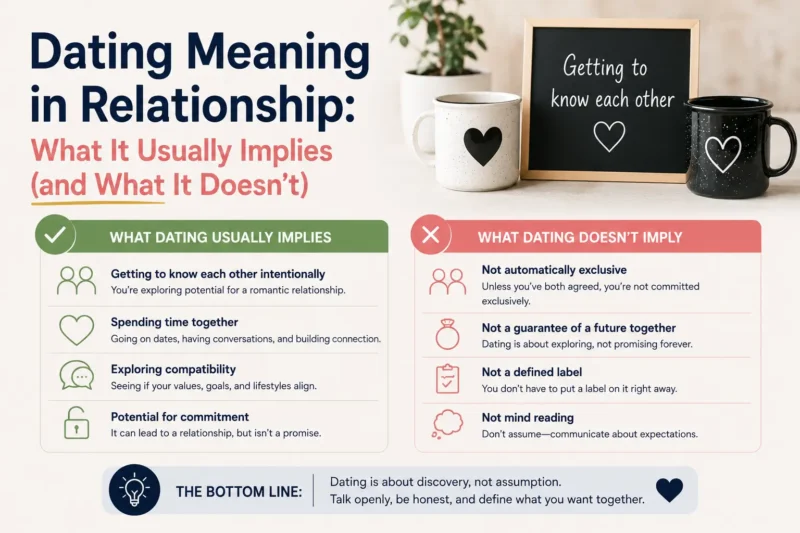
Dating meaning in relationship is a broad, real-world label for two people spending time together with romantic intent (or at least romantic availability) while deciding how to define the connection. It often includes going on dates, communicating more than friends, and exploring compatibility. However, “dating” doesn’t automatically guarantee exclusivity, a timeline for commitment, or emotional seriousness. The meaning depends on context, consistency, and what both people agree to.
People search for this definition because “dating” is used in everyday life to mean different things. One person hears “we’re dating” and assumes exclusivity or a path to a relationship. Another hears it as a low-pressure way to meet, test the vibe, and see where it goes. In dating meaning in relationship psychology terms, the label functions as a social contract: it signals interest, sets expectations (sometimes loosely), and helps people decide how to invest time and emotional energy. The practical takeaway is to treat “dating” as a starting point for clarity, not a final definition of commitment.
Use this map to move through the concept in a clear order: meaning, mechanism, use, and wider context.
If you’ve ever heard “I’m dating someone” or “we’re dating” and felt your brain immediately start guessing, you’re not alone. The phrase can mean anything from “casual, low-pressure fun” to “we’re building toward something serious,” and that gap is exactly where confusion—and hurt feelings—can happen. Here’s a clear way to understand dating meaning in relationship, plus what it usually implies and what it doesn’t.
Dating in a relationship context typically means there’s romantic intent or at least romantic availability. It usually includes more than friendly hangouts: you’re more likely to plan dates, talk about personal life, and show up as “a person they’re seeing,” not just “a friend.”
In practice, dating often signals that you’re open to exploring chemistry and compatibility. It may also come with expectations around basic respect—like not stringing someone along or acting like you’re single while benefiting from the comfort of being “someone’s date.”
Still, “dating” is a flexible label. People use it to describe a stage, not a legally binding contract.
Most misunderstandings come from one of three places: exclusivity, pacing, and public recognition.
First, exclusivity. Some people treat dating as mutually exclusive by default; others treat it as non-exclusive until a later conversation. If one person assumes “we’re only seeing each other” while the other assumes “we’re free to date,” the mismatch can feel personal—even if no one intended harm.
Second, pacing. “Dating” can mean weekly planned dates, or it can mean occasional texting and sporadic meetups. The label doesn’t always communicate effort level.
Third, public vs private status. One person may introduce you to friends or family as “my date,” while the other keeps things low-key. That difference can reflect comfort levels, but it can also reflect uncertainty.
If you’re trying to understand what dating means to you and to them, look for patterns—not just declarations. Commitment-leaning dating usually shows up in consistent behavior.
You might notice they make plans beyond the moment, follow through, and include you in parts of life that feel more “shared” than “casual.” They also tend to respond with care when you bring up boundaries, rather than dismissing your needs.
Another subtle sign is how they handle future talk. Some people avoid it entirely; others can discuss what they want without pressuring you. For example, they might say they’re interested in something real, while still respecting your pace.
These clues don’t guarantee a future relationship, but they suggest the label is doing more than keeping things vague.
It’s just as important to name what dating does not automatically guarantee.
Dating doesn’t automatically mean exclusivity. Unless you agree, you can’t assume you’re the only person in the picture.
Dating doesn’t automatically mean emotional seriousness. Someone can date casually while keeping things light, or date frequently while still not ready for vulnerability.
Dating doesn’t automatically mean a timeline. One person may be open to defining the relationship soon, while another may prefer to “see how it goes” for months.
And dating doesn’t automatically mean you’ll be treated consistently. If the label comes with disappearing acts, secrecy, or a pattern of making you feel unsure, the problem isn’t your interpretation—it’s the mismatch between the words and the behavior.
People often ask about 7 types of dating because the word “dating” can cover very different experiences. Instead of memorizing categories, you can use a practical checklist: intent, exclusivity, and integration.
Intent: Are you both exploring, or is one person clearly aiming for a relationship?
Exclusivity: Have you discussed whether you’re seeing other people?
Integration: Are you being included socially and planning with some continuity?
When you stack these together, the “type” becomes clearer. For example, “dating” with frequent plans and mutual exclusivity feels different from “dating” that stays private and inconsistent. “I'm dating someone meaning” can vary, but your job isn’t to guess forever—you’re looking for evidence and alignment.
If you want clarity, you can ask in a way that doesn’t feel like an interrogation. A helpful approach is to focus on what you both want and what you’re comfortable with right now.
You might say something like: “I like spending time with you, and I want to make sure we’re on the same page. What does dating look like for you right now—are you seeing anyone else, and where do you want this to go?”
Notice the difference: You’re not demanding a label immediately. You’re asking about boundaries and intention, which is fair. If they get defensive or avoid the question repeatedly, that’s information too.
If you’re dating with a girl meaning in your mind is “serious romance,” remember that her understanding may be different. The most respectful response is to confirm expectations directly, then decide whether your needs can be met.
You don’t need to ask every day, but you should ask when your feelings and time investment start to outpace the clarity you’re getting.
Common moments to seek clarity include:
When the relationship is starting to feel emotionally important.
When they keep the status vague but you’re acting like it’s exclusive.
When plans are inconsistent or you’re unsure whether you’re being presented as a “real” connection.
When you notice secrecy that isn’t matched by trust.
On the other hand, if you’re both comfortable with casual exploration, you can slow down emotionally and enjoy the process. The key is mutual agreement—casual only works when both people are genuinely on the same page.
Final thoughts
Dating meaning in relationship is best understood as a stage of romantic involvement, not an automatic promise of exclusivity or commitment. The label can imply interest, but it can’t replace clarity about boundaries, pacing, and what each person wants next. If you want peace of mind, watch for consistent behavior and have one calm conversation that focuses on intent and expectations. And if the answers don’t match the effort you’re receiving, trust that mismatch. You deserve a connection where the words and actions line up.
| Attribute | Summary |
|---|---|
| Typical intent | Romantic involvement or readiness to explore romance |
| Exclusivity | Not guaranteed; depends on what you both agree to |
| Timeline to commitment | Often unclear during early dating |
| Communication | More than friends, but can vary widely in frequency |
| Social context | May include public cues like introducing each other, or it may stay private |
| Consistency | Steady effort usually signals stronger intent than occasional contact |
| Attribute | Summary |
|---|---|
| Typical intent | Romantic involvement or readiness to explore romance |
| Exclusivity | Not guaranteed; depends on what you both agree to |
| Timeline to commitment | Often unclear during early dating |
| Communication | More than friends, but can vary widely in frequency |
| Social context | May include public cues like introducing each other, or it may stay private |
| Consistency | Steady effort usually signals stronger intent than occasional contact |
Core signal of why you’re spending time together
How the label shapes what each person thinks is allowed
Boundary that determines whether other dating is on the table
How quickly you move from dates to deeper involvement
The main difference is that dating is usually about a “current status,” while relationship labels are about an “agreed structure.” “Dating” can be exclusive or non-exclusive, fast or slow, and emotionally deep or mostly social. Two people can both say they’re dating yet mean different things about consistency, boundaries, and future intention. That’s why the most useful distinction isn’t between “dating vs not dating,” but between implied expectations (often unstated) and explicit agreements (what you both actually practice and confirm).
Use these connected pages for the next step.

Turn the label into a healthier system. Learn…
Read next
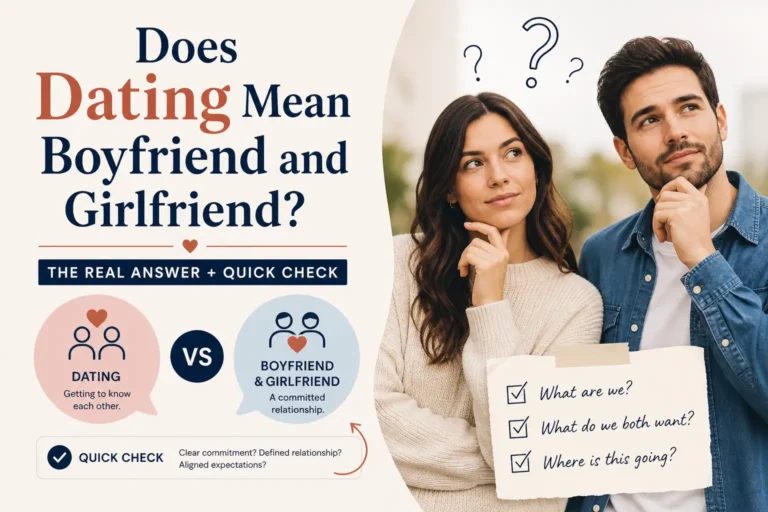
Dating doesn’t automatically mean boyfriend and girlfriend. Learn…
Read nextDating meaning in relationship is best understood as a stage of romantic involvement, not an automatic promise of exclusivity or commitment. The label can imply interest, but it can’t replace clarity about boundaries, pacing, and what each person wants next. If you want peace of mind, watch for consistent behavior and have one calm conversation that focuses on intent and expectations. And if the answers don’t match the effort you’re receiving, trust that mismatch. You deserve a connection where the words and actions line up.