There is no single natural product established as the “strongest antibiotic” for humans in the clinical sense. Some foods, herbs, extracts, essential oils, and isolated plant compounds show impressive antimicrobial activity in laboratory studies. But laboratory potency is only one part of the question. Human effectiveness also depends on dose, absorption, safety, delivery to the infection site, product standardization, and evidence that patients actually recover.
What Is the Strongest Natural Antibiotic for Humans?
The responsible answer is there is no evidence-based winner. “Strongest” can mean several different things: the lowest laboratory concentration needed to inhibit bacteria, the highest concentration of active compounds, the best symptom evidence, the most established traditional use, or the strongest evidence for treating a human infection. Those are not interchangeable measures.
Without comparative human trials, ranking garlic, oregano oil, honey, thyme, or another product as the strongest human antibiotic would overstate the evidence.
Why “Strongest” Depends on What You Measure
Laboratory studies often compare how effectively substances inhibit microbial growth under controlled conditions. A substance can look extremely potent in that setting and still be unsuitable as a human treatment if the required concentration is toxic, poorly absorbed, unstable, or unable to reach the infected tissue.
A useful human treatment has to satisfy several requirements at once: an effective exposure, acceptable safety, a reproducible formulation, and meaningful clinical outcomes.
Commonly Cited Natural Antimicrobials: What the Evidence Can Support
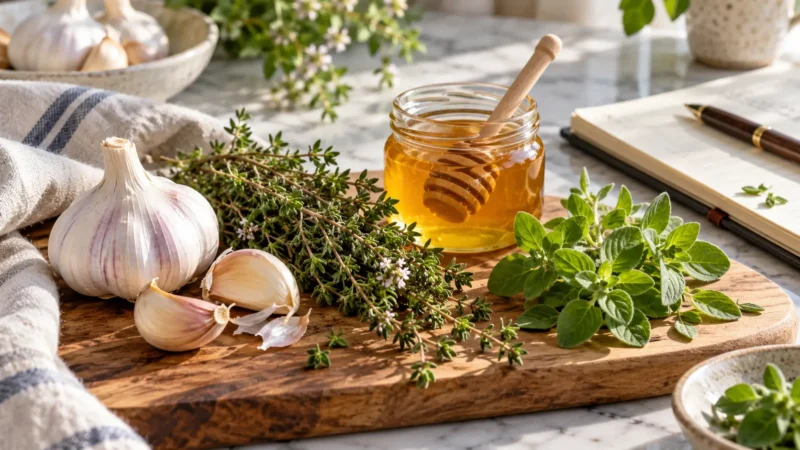
Honey has legitimate medical interest, particularly in topical wound-care contexts when medical-grade products are used appropriately. That is different from treating a systemic bacterial infection by eating ordinary honey. Mayobook’s article on honey as a natural antibiotic explores that distinction.
Garlic contains sulfur compounds with antimicrobial activity and has a long history of culinary and traditional use. Laboratory activity does not establish garlic as a substitute for antibiotics in serious human infection.
Oregano and other essential oils can show strong in-vitro antimicrobial effects, but essential oils are highly concentrated and may irritate tissues or cause toxicity if used improperly. Mayobook’s article on essential oils as natural antibiotics explains why laboratory potency and safe human use are different questions.
Thyme and its constituents also show antimicrobial activity, while specific thyme preparations have a separate traditional-use context for cough. Again, evidence for respiratory symptom support is not proof of systemic antibiotic equivalence.
Laboratory Potency Is Not the Same as Treating an Infection
The strongest laboratory result can fail clinically for several reasons. The active compound may not be absorbed well. The required concentration may be unsafe. Metabolism can change the compound before it reaches the infection. A topical effect may not translate to the bloodstream, urinary tract, lungs, or a dental abscess.
That is why “kills bacteria in a dish” is not a sufficient basis for infection-treatment dosing. The clinical question is whether a defined preparation can be used safely and predictably to improve human outcomes.
A Better Way to Evaluate a Natural Antimicrobial
Instead of asking which product is strongest, ask:
- Is there human evidence for this exact preparation?
- What outcome was measured?
- Was the product used for symptom support, topical care, or actual infection treatment?
- Is the formulation standardized?
- What are the safety and interaction concerns?
- Does evidence from this use apply to the condition being considered?
- What are the consequences if the product fails?
Mayobook’s Natural Antibiotics guide provides a broader evidence-based survey without turning laboratory findings into a treatment ranking.
When “Natural Antibiotic” Self-Treatment Is the Wrong Question
When symptoms suggest a serious or progressing infection, the priority is assessment rather than finding a stronger herb. Seek prompt care for difficulty breathing, chest pain, confusion, severe dehydration, rapidly worsening illness, spreading skin redness or swelling, significant dental or facial swelling, or urinary symptoms with fever, vomiting, or flank/back pain.
Pregnancy, infancy, frailty, immune suppression, and significant chronic disease lower the threshold for care. An indicated prescription antibiotic should not be delayed while testing whether a “stronger” natural product will work.
Bottom Line
No natural antimicrobial has been established as the strongest clinical antibiotic substitute for humans. Some substances are potent in the laboratory, some have useful topical or symptom-support evidence, and some have long traditional histories. The more meaningful question is whether the exact preparation is safe and clinically supported for the exact problem.
For broader context, see Mayobook’s Herbal Antibiotics resource and the Herbal Medicine topic hub.