
Anthocyanins
Anthocyanins
What elderberry may help, what the respiratory evidence cannot prove, and how preparation and safety change the answer
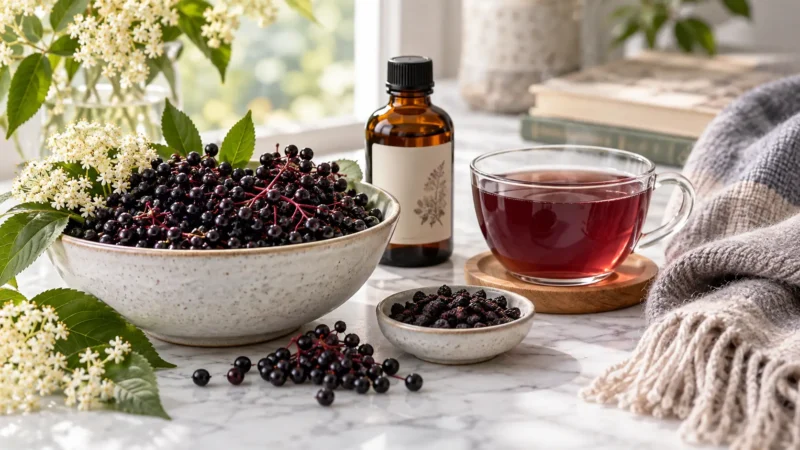
Elderberry is a botanical supplement studied mainly for symptom outcomes in viral respiratory illnesses. Some trials suggest possible symptom relief, but the human evidence is limited and mixed, and it does not establish elderberry as a treatment for bacterial respiratory infection.
Most elderberry research involves specific commercial extracts or syrups, so results should not be generalized to every gummy, tea, homemade preparation, or supplement. Symptom improvement, prevention, viral clearance, and bacterial infection treatment are different outcomes.
Use this map to move through the concept in a clear order: meaning, mechanism, use, and wider context.
Elderberry is one of the most familiar herbal products used during cold and flu season, but its reputation is broader than the evidence. Human studies have explored whether elderberry preparations can reduce the duration or severity of viral respiratory symptoms. Some results are encouraging, yet the overall evidence remains limited, products differ substantially, and the findings do not establish elderberry as a treatment for bacterial respiratory infections.
The most defensible conclusion is that certain elderberry preparations may offer symptom support in some viral respiratory illnesses, but confidence is limited by small studies, different formulations, and inconsistent results. NIH and NCCIH summaries do not support treating elderberry as a proven cure or universal preventive.
Elderberry products are usually made from berries of Sambucus species, especially black elder. Consumers encounter syrups, extracts, gummies, capsules, lozenges and teas. Those products can differ in species, plant part, extraction method, concentration, added ingredients and serving directions.
| Preparation | Common use | Main evidence caution |
|---|---|---|
| Standardized extract or syrup | Cold or flu symptom support | Study results apply most directly to the tested formulation, not every elderberry syrup. |
| Gummies or capsules | Convenience supplement | Content and standardization vary; a familiar label does not prove clinical equivalence to a studied extract. |
| Tea | Traditional comfort | Preparation and concentration differ from standardized trial products. |
| Raw or improperly prepared berries, leaves or stems | Not an appropriate shortcut to a medicinal product | Raw or inadequately processed material can cause gastrointestinal illness and other adverse effects. |
This formulation problem is central to interpreting elderberry research. A positive result from one proprietary or standardized preparation does not justify the statement that “elderberry works” regardless of product.
NCCIH describes the human evidence as limited. A small number of studies have evaluated elderberry for colds, influenza and other upper respiratory infections, with some preliminary findings suggesting improvement in symptoms. NIH dietary-supplement summaries likewise describe mixed clinical results rather than a settled treatment effect.
A systematic review of elderberry for viral respiratory illnesses found uncertainty around whether it meaningfully reduces duration or severity. This is important because a systematic review can identify a signal while still concluding that confidence is limited by study design, sample size, formulation differences or risk of bias.
For readers, the evidence should therefore be framed as possible symptom benefit with uncertainty. It should not be transformed into a claim that elderberry cures influenza, prevents complications, replaces antiviral treatment when indicated, or eradicates a respiratory pathogen.
Laboratory and mechanistic research has explored antiviral and immune-related effects of elderberry constituents. Such findings can help explain biological plausibility, but they sit lower on the evidence ladder than a well-conducted human trial with meaningful clinical outcomes.
Three distinctions protect against overstatement:
Calling elderberry a “natural antibiotic” is therefore misleading when it suggests equivalence to antibacterial medicines.
If someone chooses an elderberry product for short-term respiratory symptom support, the most useful questions are practical: What exact product is it? Does it have clear labeling? What preparation has evidence closest to the intended use? Are there additional ingredients? Is the person pregnant, breastfeeding, a child, taking prescription medicines, or living with a condition that changes supplement risk?
Following the labeled product is safer than improvising concentrated preparations. More is not automatically better, and combining several “immune” products can increase exposure without increasing evidence.
Elderberry should also remain a supportive choice rather than a reason to postpone diagnosis. A person who is seriously ill does not become safer to self-treat because a product is natural.
Commercial elderberry preparations are generally discussed differently from raw or improperly processed elder material. Raw or unripe berries and other plant parts can contain substances that may cause nausea, vomiting, diarrhea and other symptoms, so homemade preparation requires more caution than simply assuming every part of the plant is edible.
Respiratory illnesses range from mild and self-limited to potentially serious. Seek prompt assessment for difficulty breathing, chest pain, confusion, significant dehydration, bluish lips or face, persistent or rapidly worsening fever, severe weakness, or a sudden deterioration after initial improvement. Vulnerable patients—including very young children, frail older adults, pregnant people, immunocompromised people and those with significant heart or lung disease—may need earlier evaluation.
Elderberry is not a substitute for indicated antiviral treatment, antibiotics for an appropriate bacterial diagnosis, or urgent medical care. At the same time, antibiotics should not be taken simply because respiratory symptoms are uncomfortable when the illness is viral.
When a label or article says elderberry “boosts immunity” or “fights infection,” look for the actual outcome. Did a human trial measure symptom duration? Was the study preventive or therapeutic? Which formulation was used? Was the illness confirmed, or only self-reported? Were the results clinically meaningful?
This approach keeps the evidence useful without forcing a yes-or-no verdict that the science cannot support. Elderberry can be a reasonable subject for symptom-focused research while still having major evidence gaps for prevention, pathogen clearance and serious infection treatment.
For broader guidance on the difference between herbal antimicrobial evidence and clinical infection treatment, see Mayobook’s Herbal Antibiotics resource and the Herbal Medicine topic hub.
Elderberry’s evidence is neither “proven cure” nor “nothing at all.” Some human research suggests possible relief of viral respiratory symptoms, but uncertainty remains substantial and formulations are not interchangeable. Its safest evidence-based role is supportive and product-specific, with clear boundaries around bacterial infection, vulnerable groups, raw plant material and symptoms that need medical assessment.
Anthocyanins
Flavonols and phenolic acids
Whole-extract constituents
Possible relief of viral respiratory symptoms is not the same as preventing infection, curing influenza, or acting as a prescription antibiotic. Product-specific human outcomes carry more weight than laboratory antiviral mechanisms.
Use these connected pages for the next step.

Elderberry is best understood as a preparation-specific option for possible short-term respiratory symptom support, not as a proven infection cure. Its evidence is most useful when symptom outcomes, prevention claims, laboratory mechanisms, bacterial infection, and safety limits are kept separate.