
Defining element
Damiana contains multiple naturally occurring constituents whose concentrations vary with plant part and preparation.
An evidence-aware reference to Damiana (Turnera diffusa) and its preparation and safety considerations.
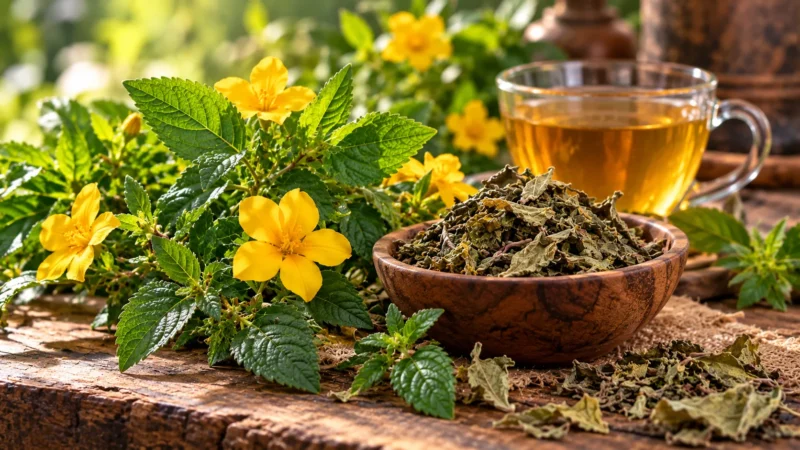
Damiana (Turnera diffusa) is a medicinal botanical commonly prepared from leaves and aerial parts and traditionally associated with libido, mood and digestive uses.
Traditional use, laboratory research and human clinical evidence should be distinguished rather than treated as equivalent.
Use this map to move through the concept in a clear order: meaning, mechanism, use, and wider context.
Damiana (Turnera diffusa) has one of the most persistent aphrodisiac reputations in Western herbalism. The aromatic shrub is native to Mexico, Central America and parts of the southwestern United States, and its leaves have been used in teas and liqueurs as well as medicinal preparations. The strength of its reputation, however, is much greater than the strength of modern human clinical evidence.
The leaves are the main medicinal material. They contain volatile compounds, flavonoids and other constituents that have been investigated in laboratory models. Damiana is sold as tea, tincture, capsules and in sexual-health blends.
Because many commercial “libido” formulas combine several herbs, amino acids or stimulants, evidence from the finished blend cannot be assigned automatically to damiana alone.
Traditional use centers on sexual desire, mood, digestion and general tonic effects. Modern marketing often turns that history into claims of increased libido, testosterone support or improved sexual performance.
Sexual function is complex. Desire, arousal, erectile function, pain, relationship factors, medication effects and hormonal disorders are different problems. A single herbal reputation does not address them all.
Rigorous human trials of damiana alone are sparse. Much of the modern interest comes from animal studies, laboratory findings and combination products. That evidence can justify further research but not a conclusion that damiana is a proven aphrodisiac.
Some multi-ingredient studies report sexual-function improvements, but when several active ingredients are used together, the contribution of damiana cannot be isolated confidently.
Laboratory research has also explored glucose-related and neuroactive effects. Those findings should not be translated into claims that damiana treats diabetes, depression or sexual dysfunction in people.
Dried leaf can be brewed as tea. Tinctures use alcohol-water extraction, while capsules may contain powder or extract. Some products combine damiana with maca, horny goat weed, ginseng, yohimbe or stimulants; those formulas can have safety profiles very different from damiana alone.
Alcoholic damiana liqueurs should not be treated as medicinal equivalents of tea or standardized extracts because alcohol changes both dose and risk.
High-quality safety data are limited. Very high intake has been associated in case literature with serious neurologic effects, and damiana may influence blood glucose. The absence of common severe reactions at ordinary use does not establish the safety of concentrated or escalating doses.
Mayobook’s Are There Side Effects of Herbal Medicine? provides broader context on why incomplete safety data should lead to more cautious claims, not to an assumption of harmlessness.
Glucose-lowering medicines are a practical concern because damiana may affect blood sugar. Combination sexual-health products may also contain stimulants or cardiovascular-active herbs that create additional interactions.
People taking several medicines should review the whole formula with a pharmacist instead of searching for damiana alone.
Pregnancy, breastfeeding and routine pediatric use lack adequate safety evidence. People with diabetes treated with medication, seizure disorders or unexplained sexual dysfunction should seek individualized guidance rather than relying on escalating herbal doses.
Look for Turnera diffusa, leaf as the plant part, serving amount and form. Sexual-health blends should disclose every active ingredient and avoid proprietary formulations that hide stimulant or hormone-active components.
Claims to “guarantee libido,” raise testosterone or cure erectile dysfunction exceed the evidence for damiana.
Damiana has a strong traditional aphrodisiac reputation but a weak standalone human evidence base. That mismatch is the main fact readers need to know. Its use is better framed as traditional and exploratory rather than as a proven treatment for sexual or metabolic conditions.
Readers comparing damiana with other medicinal herbs can explore What Are the Most Popular Medicinal Herbs?. A useful next step for persistent sexual symptoms is to identify the underlying problem rather than assuming that a stronger libido blend is the answer.
Combination products deserve particular scrutiny because the ingredient most likely to produce a noticeable acute effect may be a stimulant rather than damiana. That can make a formula feel “effective” while adding cardiovascular or sleep-related risk. A transparent single-ingredient product is easier to evaluate than a proprietary blend that hides how much of each component is present.
The same caution applies to traditional reputation. A long history of aphrodisiac use can be culturally meaningful without predicting who will benefit, how large the effect will be or whether a modern concentrated extract has the same safety profile as tea.
Damiana contains multiple naturally occurring constituents whose concentrations vary with plant part and preparation.
A named constituent or laboratory mechanism does not by itself establish clinical effectiveness.
Evidence for one Damiana preparation or outcome should not be generalized to every product or health claim.
Use these connected pages for the next step.
Damiana should be evaluated by preparation, evidence quality and individual risk rather than broad natural-health claims.