
Defining element
Withanolides
An evidence-aware guide to Withania somnifera, its uses, research, preparations and safety.
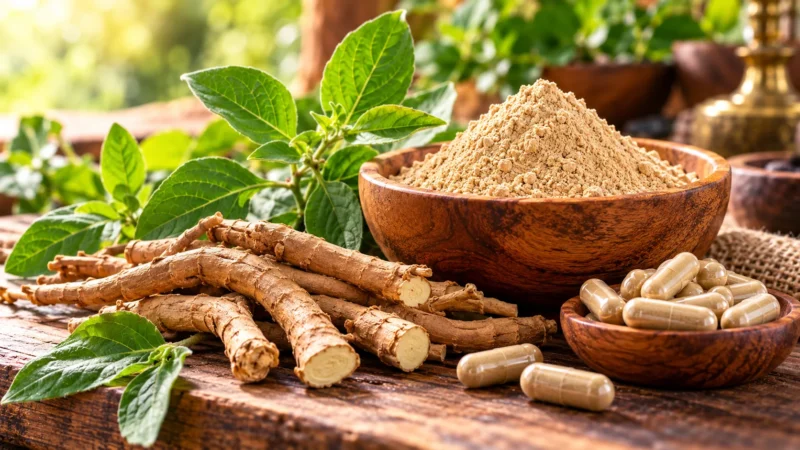
Ashwagandha (Withania somnifera) is an Ayurvedic medicinal shrub commonly sold as root powder or concentrated extracts and studied notably for stress and sleep.
Products vary by plant part, extraction and concentration. Human evidence is promising for some specific outcomes but limited or inconsistent for many broader claims.
Use this map to move through the concept in a clear order: meaning, mechanism, use, and wider context.
Ashwagandha (Withania somnifera) is an evergreen medicinal shrub used in Ayurvedic and Unani traditions and now widely sold as a dietary supplement. Modern research has focused especially on stress and sleep, but products differ substantially in plant part, extraction method and concentration. Evidence for one preparation should therefore not be generalized to every powder, capsule or extract.
Ashwagandha belongs to the nightshade family. Its root is the best-known traditional medicinal material, although some commercial extracts combine roots and leaves. The root and leaf do not have identical chemical profiles. Powders contain relatively unprocessed plant material, while extracts concentrate selected soluble constituents.
This distinction is practical rather than merely botanical. If a clinical trial studied a named root extract with a defined composition, its result cannot automatically establish the same effect for a root-and-leaf extract, loose powder, tea or multi-herb blend. When evaluating research, match the botanical name, plant part and preparation as closely as possible to the product being considered.
Traditional medical systems have used ashwagandha as a restorative herb within broader approaches to health. Contemporary supplements are promoted for stress, sleep, anxiety, exercise performance, cognition, reproductive health and other outcomes. Traditional use provides historical context and can generate research questions, but it does not by itself prove effectiveness for a modern clinical condition.
Stress and sleep are among the better-studied contemporary uses. Other claims range from preliminary to insufficiently supported. A product that combines several claims into a promise to “balance hormones,” “boost immunity” or treat disease is moving beyond what can be concluded from the evidence for a specific outcome.
NIH resources report that some ashwagandha preparations may help with stress and insomnia or sleep, while the evidence for anxiety and many other conditions remains uncertain. Several studies are small and use different preparations, doses and durations. Those differences make pooled conclusions less straightforward than a marketing summary may imply.
Research has also examined testosterone, sperm quality, athletic performance, cognition, diabetes, menopause and fertility. Limited positive findings in one area should not be converted into a general therapeutic claim. Laboratory and animal experiments can help explain possible mechanisms, but they do not establish that the same effect occurs meaningfully or safely in people.
For readers, the most reliable approach is claim-specific. Ask what outcome was measured, what exact extract was tested, who participated, how long the study lasted and whether results have been independently replicated. This prevents an interesting study from being stretched into a claim it never tested.
Ashwagandha is sold as loose powder, capsules, tablets, liquid preparations and standardized extracts. Extract labels may identify withanolide content or another manufacturing specification. “Standardized,” however, does not mean that every standardized product is clinically equivalent or proven effective.
Study doses belong to the individual study and formulation. They are not universal recommendations. A concentrated extract can differ greatly from whole-root powder, and two extracts may differ from one another. Combination formulas add another layer of uncertainty because both desired and adverse effects may come from another ingredient.
Commonly reported short-term effects include stomach upset, nausea, diarrhea or loose stools, vomiting and drowsiness. Available evidence is more informative for short-term than long-term use; NIH sources note that there is insufficient information to draw firm conclusions about longer-term safety.
Rare cases of liver injury have been linked to ashwagandha supplements. That does not mean liver injury is common, but it is clinically important. A person who develops jaundice, dark urine, severe itching, unusual fatigue or persistent upper-abdominal symptoms after starting a supplement should stop using it and seek medical assessment.
For a broader explanation of why adverse effects can still occur with botanicals, see Mayobook’s Are There Side Effects of Herbal Medicine? reference.
Ashwagandha may interact with medicines. NCCIH identifies concerns involving medicines for diabetes and high blood pressure, immunosuppressants, sedatives, anticonvulsants and thyroid hormone medicines. Preliminary evidence also raises concern about additive sedative effects with some anti-anxiety or sedating drugs.
Interaction data for herbal products are often incomplete, so absence from a generic interaction checker should not be treated as proof of safety. People using prescription medicines should give a pharmacist or clinician the exact supplement label. Ashwagandha is also not recommended around surgery; disclose all supplement use to the surgical team and follow its instructions about stopping products.
NCCIH advises avoiding ashwagandha during pregnancy and breastfeeding and does not recommend it for people about to have surgery or those with autoimmune or thyroid disorders. People with hormone-sensitive prostate cancer are also advised to avoid it because ashwagandha may affect testosterone levels. Children should not be given concentrated supplements simply by scaling down an adult product.
People with liver disease or a history of unexplained supplement-related liver symptoms deserve additional caution. Anyone taking medicines that affect sedation, seizures, immunity, thyroid function, blood pressure or blood glucose should obtain individualized guidance rather than assuming a natural product cannot interact.
Start with identity: look for Withania somnifera, the plant part and the amount per serving. For extracts, look for meaningful extraction or standardization information. Prefer transparent ingredient lists and credible independent quality testing. Be cautious when proprietary blends obscure individual ingredient amounts.
Marketing language is also informative. Claims to cure disease, guarantee hormone changes or work identically for everyone are warning signs. A responsible label cannot eliminate uncertainty, but it should make it possible to identify what you are actually taking.
Ashwagandha is a well-known medicinal herb with meaningful human research, particularly around stress and sleep, but the evidence remains preparation-specific. Short-term tolerability is reasonably described, while long-term safety is less certain. Pregnancy, breastfeeding, surgery, thyroid or autoimmune conditions, hormone-sensitive prostate cancer, medication use and possible liver symptoms materially change the safety decision.
The practical goal is to match a specific product and intended use to the evidence, recognize uncertainty and account for individual risk. Readers comparing ashwagandha with other botanicals can also review What Are the Most Popular Medicinal Herbs? for broader topic context.
Withanolides
Other constituents
Traditional use and evidence from one standardized extract do not prove that every ashwagandha product or promoted use is effective.
Use these connected pages for the next step.

Ashwagandha may have value for selected outcomes, but responsible use requires preparation-specific evidence, realistic expectations and individual safety review.