
Defining element
Milk Thistle contains multiple naturally occurring plant constituents; composition varies by plant part and preparation.
A practical evidence-aware reference to Milk Thistle (Silybum marianum).
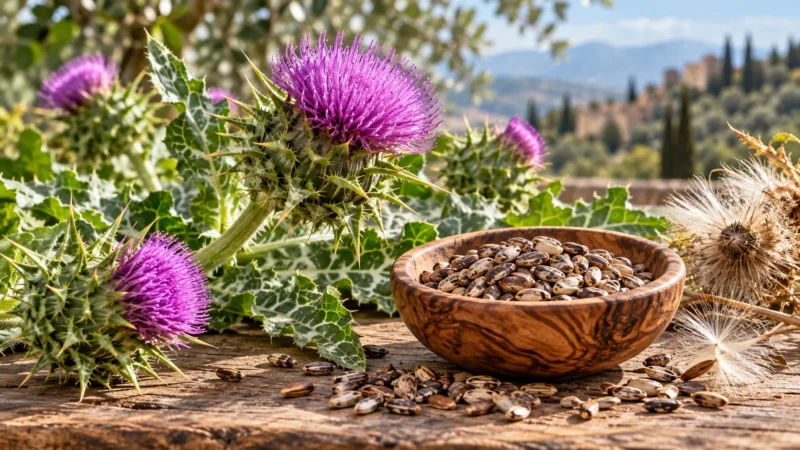
Milk Thistle (Silybum marianum) is a medicinal plant commonly prepared from fruits/seeds and used traditionally for liver-related support.
Traditional use is broader than the available clinical evidence. Preparation, plant part, concentration and individual health factors materially affect interpretation and safety.
Use this map to move through the concept in a clear order: meaning, mechanism, use, and wider context.
Milk thistle (Silybum marianum) is one of the most recognizable “liver herbs,” but that label can obscure more than it explains. Most modern research does not study a casual herbal tea. It studies extracts from the plant’s fruits, often described by their silymarin content. Silymarin itself is a mixture rather than one uniform substance, so two bottles can both say “milk thistle” while differing meaningfully in composition, dose and absorption.
The medicinal material is obtained mainly from the fruits, commonly called seeds. These contain flavonolignans including silybin and related compounds. Extracts are often standardized to a stated percentage of silymarin, but standardization does not make every product identical.
Whole seed, ground seed, tincture and enhanced-bioavailability extracts create different exposures. That is why a trial result belongs first to the exact product studied and only secondarily to “milk thistle” as a broad category.
Traditional European use focused on liver and gallbladder complaints. Modern marketing has expanded that history into “detox,” “cleanse,” alcohol protection and medication-protection claims. A liver, however, is not cleansed by a supplement in the way a filter is washed. A meaningful clinical claim must identify a specific condition and outcome.
People with abnormal liver tests may be especially vulnerable to marketing because they want a reversible, natural solution. That is precisely when diagnosis matters: fatty liver disease, viral hepatitis, medication injury, alcohol-related disease and biliary obstruction are not interchangeable problems.
Clinical studies have tested milk thistle or silymarin preparations in several liver conditions. Findings are inconsistent. Some trials report changes in liver enzymes or selected surrogate outcomes, while others do not show a clear clinical benefit.
Differences in diagnosis, disease severity, extract composition, dose and study quality make it difficult to combine the evidence into one simple conclusion. Laboratory antioxidant and anti-inflammatory effects support continued scientific interest, but they do not prove that an over-the-counter supplement prevents liver damage or reverses established disease.
A further complication is that liver-enzyme changes are not the same as hard clinical outcomes. An improvement in a laboratory marker can be interesting without proving that a person will avoid cirrhosis, hospitalization or another important consequence.
Standardized extracts dominate research, while whole or ground seed appears more often in traditional use. Some formulations are designed to increase absorption because silymarin compounds have limited oral bioavailability. A “high potency” label is not useful unless it explains what has been standardized and how much is present.
Combination liver formulas are harder to evaluate because they may include turmeric, artichoke, dandelion, N-acetylcysteine or other ingredients. Any effect or side effect may therefore have more than one possible cause.
Milk thistle is often tolerated reasonably well, with digestive upset among the more common complaints. It belongs to the daisy family, so people with strong ragweed or related plant allergies can react.
A reputation for “liver support” should never be used to dismiss symptoms of liver disease. Jaundice, confusion, abdominal swelling, vomiting blood or rapidly worsening illness require medical care. General context about botanical adverse effects is available in Mayobook’s Are There Side Effects of Herbal Medicine?.
Laboratory studies suggest milk thistle constituents can influence drug-metabolizing enzymes, but the clinical importance of many proposed interactions remains uncertain. Medication users should avoid both extremes: assuming every theoretical interaction is dangerous and assuming no interaction can matter.
A pharmacist can review the actual extract, dose and prescription list. That is more reliable than trying to generalize from a single in-vitro enzyme study or from a generic supplement-interaction chart.
People with significant liver disease should discuss supplements with the clinician managing the condition. Pregnancy and breastfeeding lack strong safety evidence for concentrated extracts. Those with serious ragweed-family allergies also deserve caution.
Look for Silybum marianum, the amount of extract and a clear statement of silymarin standardization if one is claimed. Quality testing can help with identity and contamination but cannot prove that the product treats liver disease.
Marketing phrases such as “flush toxins,” “repair the liver overnight” or “protect against drinking” should be treated as warning signs rather than evidence. A transparent product should explain its formulation without implying that it can erase the effects of alcohol, obesity, hepatitis or a potentially hepatotoxic medicine.
Milk thistle has more research than many liver-marketed herbs, yet the clinical evidence remains mixed. Formulation, diagnosis and outcome all matter. Readers comparing it with other botanicals can explore What Are the Most Popular Medicinal Herbs?, but serious liver questions should remain anchored to diagnosis and evidence rather than to the popularity of a supplement.
The most responsible expectation is modest: a defined extract may influence selected laboratory or clinical outcomes in some settings, but that is very different from proving that every milk thistle product “detoxes” the liver. The closer a product’s claim gets to treating disease, the more important it becomes to ask for direct human evidence rather than relying on the herb’s reputation.
Milk Thistle contains multiple naturally occurring plant constituents; composition varies by plant part and preparation.
A named constituent or laboratory mechanism does not by itself establish a clinical benefit.
Evidence for one Milk Thistle preparation or use should not be generalized to every product or health claim.
Use these connected pages for the next step.
A practical, evidence-aware introduction to herbal medicine: preparations,…
Read next
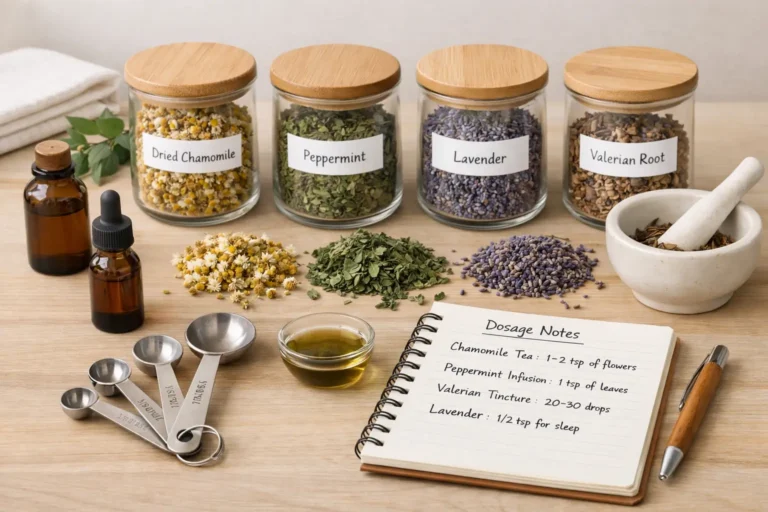
Milk Thistle is best approached as a specific botanical preparation with evidence limits and safety considerations, not as a universal natural remedy.