
Defining element
Mullein contains multiple naturally occurring plant constituents; composition varies by plant part and preparation.
A practical evidence-aware reference to Mullein (Verbascum thapsus).
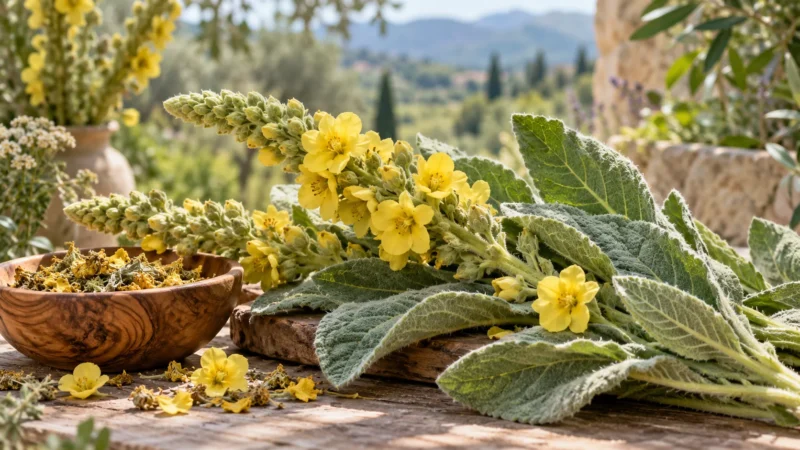
Mullein (Verbascum thapsus) is a medicinal plant commonly prepared from leaves and flowers and used traditionally for respiratory and throat comfort.
Traditional use is broader than the available clinical evidence. Preparation, plant part, concentration and individual health factors materially affect interpretation and safety.
Use this map to move through the concept in a clear order: meaning, mechanism, use, and wider context.
Mullein (Verbascum thapsus) is easy to recognize in the field: a tall flowering stalk rises from a rosette of soft, woolly leaves. That distinctive appearance has helped the plant become one of the best-known herbs in traditional respiratory remedies. Its popularity, however, is much broader than the modern clinical evidence. A useful way to evaluate mullein is to separate what is known about the plant itself, what comes from traditional practice, and what has actually been tested in people.
The leaves and flowers are the parts most often found in herbal preparations. Dried leaf is commonly sold for tea, while flowers may appear in infused oils or mixed respiratory formulas. The dense hairs on mullein leaves are a practical feature, not just a botanical curiosity: poorly filtered tea can feel irritating to the mouth or throat. Careful straining therefore matters when loose leaf is used.
Products labeled simply “mullein” should still identify the species and plant part. An oil infused with flowers is not interchangeable with a leaf tea, and neither should be assumed to behave like a concentrated extract.
Mullein has a long reputation as a soothing herb for cough, throat irritation and chest discomfort. Traditional formulas often paired it with other demulcent or aromatic plants. Those uses describe how the herb has been used; they do not establish that mullein treats pneumonia, asthma, bronchitis or another diagnosed respiratory condition.
Modern consumers also encounter mullein in ear oils, smoking blends and “lung cleanse” products. Those forms deserve extra skepticism because the route of use can introduce risks not present in ordinary tea. Inhaling burned plant material, for example, should not be framed as a health-promoting way to support the lungs.
Human clinical research on mullein is sparse. Laboratory studies have reported antimicrobial or anti-inflammatory activity in extracts, but a laboratory result does not demonstrate that drinking mullein tea will shorten an infection or improve lung function. The gap between traditional reputation and controlled human evidence is one of the most important facts for readers to understand.
Because strong clinical trials are lacking, mullein is better described as a traditional soothing herb than as a proven respiratory treatment. Persistent cough, breathing difficulty, fever, chest pain, coughing blood or worsening symptoms need medical evaluation rather than prolonged self-treatment.
Dried leaf tea is the most familiar preparation. Tinctures and capsules concentrate the plant differently, while flower-infused oils are usually marketed for external use. A dose taken from one product cannot be transferred automatically to another because extraction strength and plant part differ.
Quality matters with loose herbs. Leaves should be clean, correctly identified and free from visible contamination. Tea should be filtered through a fine strainer or cloth to remove the tiny hairs that can otherwise irritate.
Mullein is generally regarded as relatively mild in customary preparations, but high-quality safety data are limited. Contact dermatitis has been reported, and the leaf hairs can irritate sensitive tissue. The lack of extensive interaction reports should not be mistaken for proof that every concentrated product is safe.
Pregnancy, breastfeeding and pediatric use are areas where evidence is particularly thin. Mayobook’s Are There Side Effects of Herbal Medicine? explains why a long history of use does not eliminate the need to consider dose, preparation and individual susceptibility.
No large body of clinical interaction research exists for mullein. That uncertainty matters most when the herb appears in multi-ingredient products, because another component may be sedating, stimulant, anticoagulant or otherwise pharmacologically active. A pharmacist can review the entire label rather than considering only the word “mullein.”
People preparing for surgery or taking several prescription medicines should disclose herbal products during medication review, even when no specific interaction is listed.
Anyone who develops rash, swelling or significant irritation after using mullein should stop the product. People with chronic lung disease should not rely on the herb to manage a flare or new respiratory symptoms. Children, pregnant or breastfeeding people, and medically complex adults deserve a more conservative approach because evidence is limited.
A useful label identifies Verbascum thapsus, the plant part and the amount or extraction strength. For tea, clean dried leaf and good filtration matter. For infused oils, the intended route should be explicit; an external preparation should not be swallowed simply because the herb itself is sold in oral forms elsewhere.
Claims such as “cleanses the lungs,” “kills respiratory infections” or “repairs lung tissue” go beyond the available human evidence.
Mullein’s strongest story is one of traditional soothing use, not modern proof of disease treatment. Its leaf and flower preparations differ, human trials are limited, and quality and route of use matter. Readers comparing mullein with other familiar botanicals can use What Are the Most Popular Medicinal Herbs? for wider context, while keeping mullein’s own evidence limits in view.
One practical reason to keep expectations modest is that respiratory symptoms often have very different causes. A dry throat after talking, an uncomplicated viral cough, asthma, reflux, pneumonia and medication-related cough do not share one herbal solution. Mullein’s traditional soothing role may be relevant to comfort, but it cannot identify the cause of a symptom. That distinction is especially important when “lung detox” marketing encourages readers to treat persistent symptoms without assessment. A better decision is to use the herb, if at all, as a limited comfort measure while paying attention to duration, severity and red-flag symptoms.
Mullein is also a good example of why preparation technique belongs in a safety discussion. The plant is not famous for a potent toxin; instead, small physical details such as the fine leaf hairs can make a poorly prepared tea unpleasant. Correct straining, clear product labeling and avoiding unsupported routes such as smoking the herb are more useful safety steps than assuming that a higher-strength extract is automatically better.
Mullein contains multiple naturally occurring plant constituents; composition varies by plant part and preparation.
A named constituent or laboratory mechanism does not by itself establish a clinical benefit.
Evidence for one Mullein preparation or use should not be generalized to every product or health claim.
Use these connected pages for the next step.

Mullein is best approached as a specific botanical preparation with evidence limits and safety considerations, not as a universal natural remedy.