
Defining element
Marshmallow Root contains multiple naturally occurring constituents whose concentrations vary with plant part and processing.
An evidence-aware reference to Marshmallow Root (Althaea officinalis), including preparation differences and safety considerations.
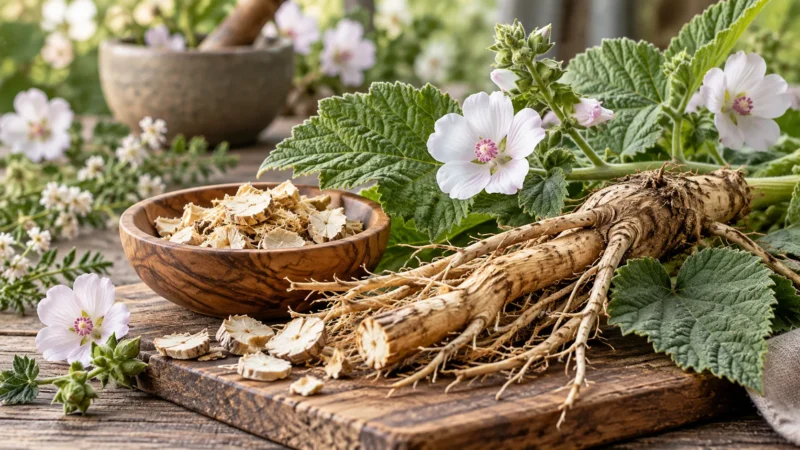
Marshmallow Root (Althaea officinalis) is a medicinal plant commonly prepared from roots, and sometimes leaves in other preparations and traditionally associated with soothing irritated throat and digestive tissues.
Traditional use, laboratory research and human clinical evidence should be distinguished rather than treated as equivalent.
Use this map to move through the concept in a clear order: meaning, mechanism, use, and wider context.
Marshmallow root (Althaea officinalis) is a classic mucilage-rich herb, unrelated to the modern confection that borrowed its name. When the root is mixed with water, it releases slippery polysaccharides that explain its long-standing use for dry, irritated tissues. That physical soothing action is easy to understand, but it should not be expanded into claims that marshmallow root treats every condition involving the throat or digestive tract.
The root is the principal medicinal material, although the leaves are also used in some traditions. Root contains abundant mucilage, which swells in water and creates a coating sensation. Cold-water preparations are often discussed because they emphasize mucilage extraction differently from hot infusions.
A capsule of dry powder, a syrup, a tea and a liquid extract are therefore not functionally identical even if they contain the same botanical species.
Traditional use focuses on dry cough, throat irritation and digestive discomfort. It is often described as a demulcent. That term is useful because it states the intended action—soothing contact—without claiming that the herb eradicates infection, heals ulcers or reverses inflammatory disease.
Modern digestive formulas may combine marshmallow root with slippery elm, licorice or aloe. Combination products can be reasonable from a formulation perspective, but they complicate evidence because the effect cannot be assigned to one ingredient.
Clinical research is limited compared with the herb’s traditional history. Some cough preparations and traditional-use assessments support a soothing role, but large, high-quality trials for specific diseases are sparse.
The strongest evidence-aware description is therefore modest: marshmallow root is a traditional mucilage herb used for local soothing. It should not be marketed as though that physical effect proves it treats asthma, pneumonia, reflux disease or inflammatory bowel disease.
A laboratory demonstration that polysaccharides coat or influence cells does not establish a clinically meaningful outcome in patients.
Root may be sold as cut herb for soaking, powder, capsule, syrup or extract. Preparations that allow the mucilage to hydrate may feel different from swallowing dry powder. Product labels should identify root rather than simply “marshmallow.”
Sweetened syrups deserve a separate nutritional look, especially for people managing blood glucose.
Marshmallow root is generally considered mild, but formal long-term safety data are limited. Its high mucilage content may change the timing of absorption for oral medicines, which is more relevant for drugs where consistent exposure matters.
General principles for herbal adverse effects and interaction uncertainty are discussed in Mayobook’s Are There Side Effects of Herbal Medicine?.
The main practical concern is not a known toxic metabolite but the possibility that mucilage may delay or reduce contact between medicines and the intestinal surface. Spacing the herb from oral medicines is a cautious strategy that can be discussed with a pharmacist.
Products containing added sugars, alcohol or other herbs bring additional considerations that do not come from marshmallow root itself.
Pregnancy, breastfeeding and regular use in young children lack extensive safety research. People with persistent trouble swallowing, gastrointestinal bleeding, severe abdominal pain or unexplained weight loss should seek evaluation rather than relying on a soothing preparation.
Look for Althaea officinalis root, the amount per serving and the form of preparation. Syrups should disclose sweeteners and alcohol. Claims to heal ulcers, cure reflux or eliminate respiratory infection exceed the evidence.
Marshmallow root is best understood as a traditional demulcent. Its mucilage explains why it may feel soothing, but that local physical action should not be confused with proof of disease treatment. Readers comparing it with other medicinal botanicals can explore What Are the Most Popular Medicinal Herbs? while keeping marshmallow root’s narrow, preparation-dependent role in perspective.
Practical use also depends on what the person wants from the product. A short-lived coating sensation for a dry throat is a different goal from treating recurrent reflux or persistent abdominal pain. If symptoms keep returning, become severe or interfere with eating and hydration, the limitation is not that the herb is “too weak”; it is that a soothing preparation cannot identify or correct the underlying cause.
Marshmallow Root contains multiple naturally occurring constituents whose concentrations vary with plant part and processing.
A constituent or laboratory mechanism does not by itself establish a clinical benefit.
Evidence for one Marshmallow Root preparation or outcome should not be generalized to every product or health claim.
Use these connected pages for the next step.
Marshmallow Root should be evaluated by preparation, evidence quality and individual risk rather than broad natural-health claims.