Herbal antimicrobials should not be assumed resistance-proof. Bacteria can adapt when they are repeatedly exposed to antimicrobial pressures. However, the evidence base is not symmetrical: antibiotic resistance is a major, well-documented public-health problem, while the clinical evidence on resistance to complex herbal preparations is much more limited and heterogeneous.
Can Herbal Antibiotics Cause Antibiotic Resistance?
The careful answer is microbial adaptation is possible, but the real-world resistance effects of many herbal products are not well defined. It is therefore inaccurate to claim either that herbal antimicrobials inevitably create the same resistance patterns as prescription antibiotics or that they cannot contribute to resistance because they contain multiple natural compounds.
What Antibiotic Resistance Actually Means
Antibiotic resistance means bacteria change—or resistant bacteria are selected—so that an antibiotic becomes less effective against them. The person’s body does not “become resistant.” Resistance is a property of microorganisms and populations of microorganisms.
Resistance is also different from a side effect or treatment failure. A treatment can fail because the diagnosis was wrong, the dose or exposure was inadequate, the infection site was difficult to reach, the organism was not susceptible, or the chosen product never had meaningful clinical activity in the first place.
Can Bacteria Adapt to Plant Antimicrobials?
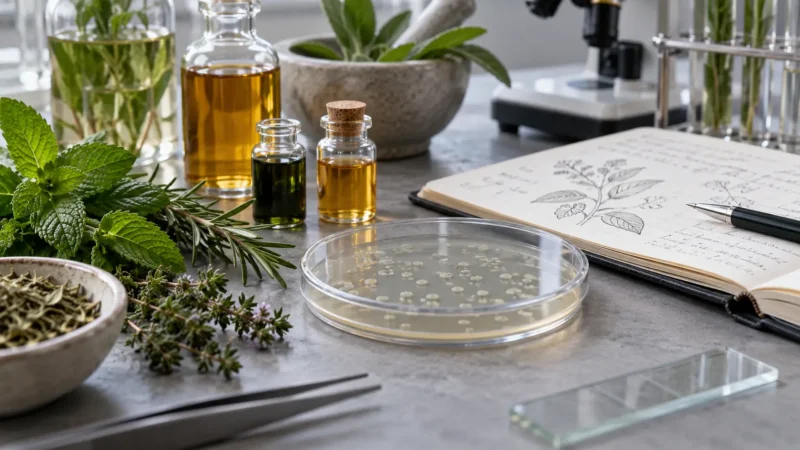
Laboratory studies show that bacteria can respond to many kinds of antimicrobial stress, including plant-derived compounds. Those findings support the biological possibility of adaptation, but they do not automatically tell us how a particular herbal product will influence resistance in patients or communities.
The exact preparation matters. A purified compound, essential oil, standardized extract, tea, and multi-herb mixture can expose bacteria to very different concentrations and combinations of substances. Laboratory adaptation under controlled conditions may not reproduce the exposure pattern of real-world use.
Mayobook’s guide to how herbal antibiotics work explains why evidence level and exposure matter when interpreting antimicrobial claims.
Why Complex Plant Mixtures Are Not Automatically Resistance-Proof
A common claim is that bacteria cannot become resistant to herbs because plants contain many active compounds. Multiple compounds may create a more complex selective environment, but complexity is not a guarantee that adaptation cannot occur.
Other uncertainties matter too: inconsistent concentration, repeated low-level exposure, product variability, and use of an ineffective preparation. A complex mixture can still be used at an exposure that is too low to treat an infection yet high enough to exert some biological pressure.
That does not prove a specific herbal formula will drive clinically important resistance. It means “natural mixtures prevent resistance” is too strong a claim for the available evidence.
Resistance, Treatment Failure, and Stewardship Are Different Problems
These ideas are often mixed together:
- Resistance means the microorganism becomes less susceptible to an antimicrobial.
- Treatment failure means the person does not improve for any of several possible reasons, including ineffective therapy or inadequate exposure.
- Stewardship means using antimicrobial treatments appropriately—avoiding unnecessary use while still giving effective treatment when it is indicated.
Good stewardship does not mean refusing antibiotics whenever a natural option exists. Unnecessary antibiotics should be avoided, but withholding indicated treatment can also cause harm.
For a broader comparison, see Herbal Antibiotics vs Antibiotics.
How to Use Antimicrobial Products More Responsibly
- Do not self-treat a serious suspected infection solely because a product is marketed as natural.
- Do not stop, shorten, or replace prescribed antibiotics without clinician guidance.
- Judge herbal claims by the exact preparation and evidence, not by the phrase “resistance-proof.”
- Avoid repeatedly cycling through multiple antimicrobials when symptoms are worsening or unexplained.
- Use a pharmacist or clinician to review concentrated herbal products when medicines, pregnancy, chronic disease, or significant illness are involved.
Responsible use begins with matching the intervention to the problem, not simply choosing the product perceived to have the lowest resistance risk.
Bottom Line
Bacteria can adapt to antimicrobial pressures, including plant-derived substances in some experimental settings. But the clinical resistance profile of many herbal preparations is not well established. The safest conclusion is that herbal products are not automatically resistance-proof and should not be used as an excuse to avoid indicated treatment or to use antimicrobial products indiscriminately.
For broader context, see Mayobook’s Herbal Antibiotics resource and the Herbal Medicine topic hub.