
Defining element
Slippery Elm contains multiple naturally occurring constituents whose concentrations vary with plant part and processing.
An evidence-aware reference to Slippery Elm (Ulmus rubra), including preparation differences and safety considerations.
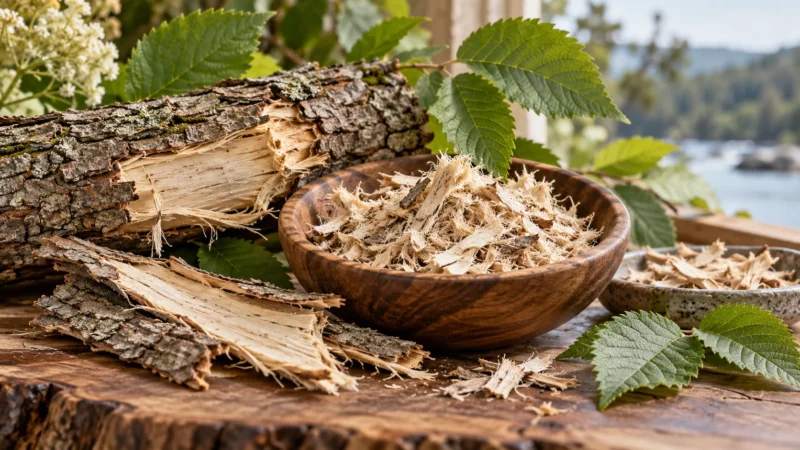
Slippery Elm (Ulmus rubra) is a medicinal plant commonly prepared from inner bark and traditionally associated with soothing the throat and digestive tract.
Traditional use, laboratory research and human clinical evidence should be distinguished rather than treated as equivalent.
Use this map to move through the concept in a clear order: meaning, mechanism, use, and wider context.
Slippery elm (Ulmus rubra) is named for what happens when its inner bark meets water: it becomes slick and mucilaginous. That physical property explains much of the herb’s traditional appeal. Rather than acting like a concentrated stimulant or sedative, slippery elm is used chiefly as a demulcent—a material intended to coat and soothe irritated tissue. The simplicity of that mechanism can be useful, but it also makes it easy for marketers to stretch a soothing effect into unsupported disease claims.
The medicinal material is the inner bark, not the rough outer bark. When powdered bark is mixed with liquid, soluble fibers and mucilage form a gel-like texture. Historically, this material was prepared as gruel, lozenges or drinks.
Sustainability and correct sourcing matter because removing inner bark can damage or kill a tree. A reputable product should identify Ulmus rubra and use responsibly sourced material.
Traditional uses focus on sore throat, cough-related irritation and digestive discomfort. The herb is often described as “coating” or “soothing,” which is a more defensible description than claiming it heals ulcers, treats reflux disease or repairs inflammatory bowel disease.
Modern products include throat lozenges, powders and digestive formulas. Some are combined with marshmallow root, licorice or other mucilage-rich herbs, which makes it harder to identify the contribution of slippery elm itself.
Robust clinical trials of slippery elm alone are limited. Much of its use is supported by traditional practice and the known physical behavior of mucilage rather than by large randomized studies.
That distinction matters. A soothing coating effect can be plausible without proving that the herb changes the underlying disease process. Symptom comfort and disease modification are different outcomes.
Because the evidence base is small, claims about treating irritable bowel syndrome, inflammatory bowel disease or respiratory infections should be approached cautiously unless they are tied to direct human research.
Powdered inner bark is mixed with water, added to lozenges or placed in capsules. The amount of mucilage a person encounters depends on preparation and hydration. A dry capsule swallowed quickly is not the same practical experience as hydrated bark powder.
Combination gastrointestinal products can contain several demulcent herbs. The finished formula should be evaluated as a whole.
Slippery elm is usually considered mild, but long-term clinical safety data are limited. The most relevant practical issue is that mucilage can alter how quickly other substances move through or contact the digestive tract.
That does not prove a dangerous drug interaction, but it supports a cautious approach to timing oral medicines. Mayobook’s Are There Side Effects of Herbal Medicine? provides a wider framework for interpreting uncertainty rather than equating “few reports” with “proven safe.”
Because of the coating effect, some clinicians recommend separating slippery elm from oral medicines so that absorption is not unnecessarily complicated. The exact clinical impact has not been well quantified.
People taking medicines where consistent absorption is especially important should ask a pharmacist about timing rather than improvising.
Pregnancy and breastfeeding safety data for medicinal amounts are limited. People with persistent difficulty swallowing, gastrointestinal bleeding, unexplained weight loss or severe abdominal symptoms should seek evaluation instead of relying on a coating herb.
Look for Ulmus rubra inner bark, not a vague “elm bark” description. Powder should be clean and clearly labeled. Products making strong claims about healing ulcers, curing colitis or eliminating reflux are moving beyond the evidence.
Slippery elm’s best-supported role is conceptual and traditional: its mucilage can create a soothing texture. That does not establish it as a treatment for serious gastrointestinal or respiratory disease. Readers comparing slippery elm with other commonly used medicinal plants can explore What Are the Most Popular Medicinal Herbs? while keeping the distinction between symptom soothing and disease treatment clear.
The herb is also a useful example of how “mechanism” can be physical rather than biochemical. Hydrated mucilage changes texture and contact with tissue, which may help explain why people perceive soothing. That local effect does not require claims about detoxification, immune stimulation or systemic healing. For consumers, this narrower explanation is actually more useful because it clarifies what the product might reasonably do and what persistent symptoms still require assessment.
Slippery Elm contains multiple naturally occurring constituents whose concentrations vary with plant part and processing.
A constituent or laboratory mechanism does not by itself establish a clinical benefit.
Evidence for one Slippery Elm preparation or outcome should not be generalized to every product or health claim.
Use these connected pages for the next step.
Slippery Elm should be evaluated by preparation, evidence quality and individual risk rather than broad natural-health claims.