
Defining element
Passionflower contains multiple naturally occurring constituents whose concentrations vary with plant part and processing.
An evidence-aware reference to Passionflower (Passiflora incarnata), including preparation differences and safety considerations.
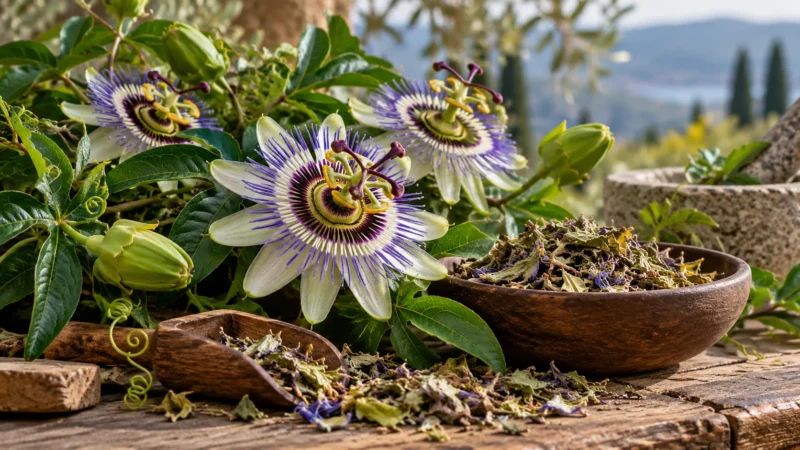
Passionflower (Passiflora incarnata) is a medicinal plant commonly prepared from aerial parts, including leaves, stems and flowers and traditionally associated with calm, nervous tension and sleep.
Traditional use, laboratory research and human clinical evidence should be distinguished rather than treated as equivalent.
Use this map to move through the concept in a clear order: meaning, mechanism, use, and wider context.
Passionflower (Passiflora incarnata) is a climbing vine whose elaborate flowers have made it visually famous, but medicinal use focuses mainly on the aerial parts. It is commonly sold as a “calming” herb for nervous tension, anxiety and sleep. Those labels sound simple, yet the evidence depends heavily on whether the product is tea, tincture, extract or a multi-herb formula.
The leaves, stems and flowers are the material typically used in herbal preparations. Passionflower contains flavonoids and other constituents that have been investigated for effects on the nervous system. The chemistry varies with harvest and extraction, so a tea and a concentrated capsule should not be assumed to deliver the same exposure.
Botanical identity matters because the genus Passiflora contains many species. A supplement should identify Passiflora incarnata rather than relying only on the common name.
Traditional use has centered on restlessness, nervous tension and difficulty sleeping. Modern products extend that reputation into anxiety, stress and sleep support. Some are sold alone, while others combine passionflower with valerian, lemon balm, hops or melatonin.
Combination formulas are difficult to interpret because both benefit and drowsiness can come from another ingredient. A positive result from a blend is not proof that passionflower alone produced the effect.
Small human studies have explored passionflower for anxiety-related outcomes and sleep. Some findings are promising, including trials using specific extracts or tea preparations, but sample sizes are often limited and treatment periods short.
That means the evidence is better described as preliminary than definitive. Passionflower should not be framed as a proven replacement for psychotherapy, prescription anxiety treatment or evaluation of persistent insomnia.
Laboratory work suggests GABA-related mechanisms may contribute to calming effects, but a plausible mechanism cannot predict the exact strength of a retail product.
Dried aerial parts can be brewed as tea. Tinctures and fluid extracts use solvents that concentrate compounds differently, while capsules may contain powder or extract. A serving size written in milligrams does not reveal extract strength unless the label provides more detail.
Multi-ingredient nighttime products deserve a full-label review because several sedating ingredients can add together.
Drowsiness, dizziness and confusion are the most relevant potential adverse effects. A person trying passionflower for the first time should consider whether driving, operating machinery or working at height could become unsafe if sedation occurs.
Pregnancy deserves particular caution because safety is not established and traditional concerns about uterine effects exist. Broader principles for evaluating herbal adverse effects are covered in Mayobook’s Are There Side Effects of Herbal Medicine?.
Alcohol, benzodiazepines, sleep medicines, sedating antihistamines and other calming supplements can amplify drowsiness. The interaction evidence is not complete enough to predict every combination, so people taking sedatives should seek individualized review rather than relying on a generic “natural sleep aid” label.
All supplements should be disclosed before anesthesia or surgery.
Pregnant people should avoid unsupervised medicinal use. Breastfeeding and pediatric safety data are limited. People already affected by excessive daytime sleepiness, falls or several sedating medicines should also be cautious.
Look for Passiflora incarnata, the aerial part, amount per serving and whether the product is tea, tincture, powder or extract. In blends, identify every other calming ingredient and its amount.
Claims to “cure anxiety” or provide prescription-strength sleep without impairment go beyond the evidence.
Passionflower has a credible traditional calming role and some human research, but the evidence is still small and preparation-specific. Its main practical risk is sedation, especially in combinations. Readers comparing passionflower with other commonly used herbs can browse What Are the Most Popular Medicinal Herbs? while keeping the herb’s own evidence limits and interaction profile in view.
A sensible decision starts with the outcome: occasional relaxation is a different goal from treating persistent anxiety or chronic insomnia. The more serious or long-lasting the symptom, the less appropriate it is to rely on an herbal trial alone. It is also useful to define what success would look like before taking the product—less time awake at night, fewer stress-related symptoms, or another measurable change—because vague expectations make it easy to continue an ineffective supplement indefinitely. If there is no meaningful benefit, increasing the dose simply because the product is herbal may add sedation without solving the underlying problem.
Passionflower also illustrates why “calming” should not be treated as a single pharmacologic endpoint. A person who feels less tense may still have unchanged sleep duration, and a person who falls asleep faster may not experience less daytime anxiety. Product reviews often collapse those outcomes into one impression, whereas clinical research separates them. That distinction matters when deciding whether a trial of the herb is actually helping.
Product quality is especially relevant in combination formulas. If a nighttime blend contains several sedating botanicals, increasing the serving because the first dose “did not work” can increase impairment from the whole formula. A more cautious approach is to use a clearly identified product, avoid combining it with alcohol or other sedatives without review, and stop rather than escalate when benefit is absent or adverse effects appear.
Passionflower contains multiple naturally occurring constituents whose concentrations vary with plant part and processing.
A constituent or laboratory mechanism does not by itself establish a clinical benefit.
Evidence for one Passionflower preparation or outcome should not be generalized to every product or health claim.
Use these connected pages for the next step.
Passionflower should be evaluated by preparation, evidence quality and individual risk rather than broad natural-health claims.