Money is one of those words people use every day, but economists use it in a more specific way to explain how economies actually work. In everyday terms, money helps you buy things and pay bills; in economics, it’s defined by the roles it plays in exchange. Understanding what money is in economics can make budgeting, saving, and even business decisions feel clearer.
What money means in economics
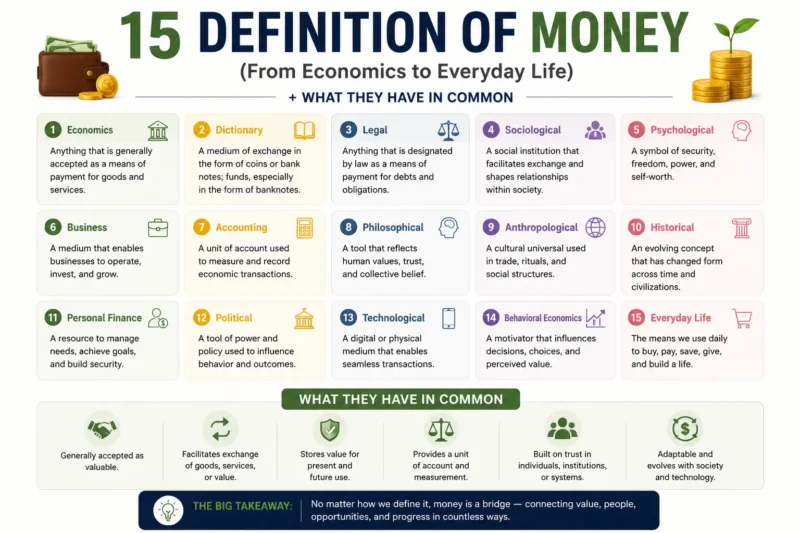
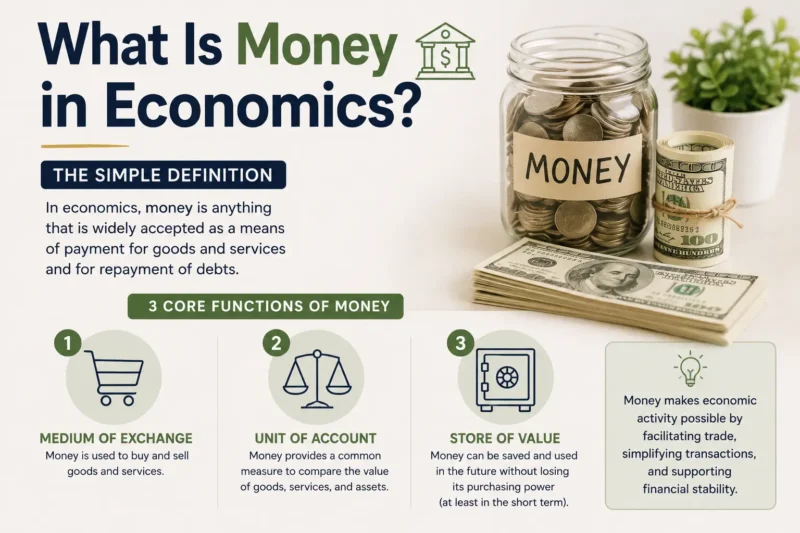
Money in economics is anything that’s widely accepted as payment for goods and services. The definition isn’t only about whether it’s a coin or a banknote. It’s about whether people treat it as a reliable way to settle transactions. If most sellers accept it, and buyers can use it later, it functions as money.
Economists also emphasize that money is a “system,” not just an object. That system includes trust, rules, and payment infrastructure. When those pieces are stable, money becomes easier to use for daily exchange. When they’re not, money’s ability to coordinate trade can weaken.
The three core functions of money
A helpful way to remember money is to focus on its functions. Economists often summarize them as a medium of exchange, a unit of account, and a store of value.
Medium of exchange: This is what lets you trade without barter. You sell or earn value, then use money to buy what you need.
Unit of account: This is the measuring stick for prices, wages, and debts. When everything is quoted in the same currency, it’s easier to compare options and plan.
Store of value: This is how money can be held for later spending. If money holds purchasing power reasonably well, people are more willing to save it.
These functions reinforce each other. If money is accepted and easy to use, it becomes a stronger medium of exchange. If prices are stable enough, it becomes a better unit of account and a more trustworthy store of value.
How money differs from wealth
A common confusion is mixing up money with wealth. Wealth includes assets you own that have value, such as a home, shares, a business, or collectibles. Money is a specific way that value can be held and used for transactions.
You can be “wealthy” but short on money if most of your value is tied up in assets you can’t quickly spend. You can also have money but not much wealth if you’re living on income without meaningful assets.
This distinction matters because it changes the advice you need. If you’re cash-poor but asset-rich, your challenge might be liquidity and timing. If you’re money-rich but asset-poor, your focus might be saving and building long-term value. Money’s economic functions are the bridge between these realities.
Types of money in economics (and why it’s not only cash)
When people hear “money,” they often think of physical cash. In economics, “types of money” can include several forms that serve similar roles.
- Commodity money
This is money with intrinsic value—something that can be used for purposes other than payment. Historically, certain metals were used this way. The downside is that commodity money can be expensive to store and may be harder to manage consistently.
- Representative money
Representative money is backed by a claim on another asset. For example, older systems used notes that could be exchanged for something of value. The point is that the note’s value comes from the promise behind it.
- Fiat money
Fiat money has value because the government and the public use it for payment. Coins and banknotes are the common examples. Fiat money works when people trust the system and when institutions support stable pricing and payment.
- Bank deposits and electronic money
In modern economies, money often exists as bank balances. You might not hold cash, but you can transfer deposit money electronically. For most practical purposes, deposits can function as money because they are widely accepted for payment.
A useful boundary: “money” can mean different things depending on what an economist is measuring. Some definitions focus on what people use for payment; others use broader categories to track liquidity in the economy. If you’re reading research or news, pay attention to the definition used.
When money’s functions get weaker
Money is most useful when all three functions work well. In real life, they can weaken—sometimes gradually, sometimes quickly.
If inflation rises, money’s store-of-value function can deteriorate. People may spend faster or look for alternatives that better preserve purchasing power.
If trust drops, money may become less accepted. Sellers might demand payment in different forms, or contracts may become harder to denominate.
If payment systems fail, money’s medium-of-exchange role becomes less reliable. Even a stable currency can feel unstable if transfers are delayed or costly.
These changes don’t happen in a vacuum. They often connect to expectations about the future, the credibility of institutions, and the stability of economic policy. That’s why economists watch not just prices today, but also what people expect prices to do tomorrow.
What money looks like in real life
You can see money’s functions in small moments.
When you check your paycheck and see it in a currency amount, that’s a unit of account in action.
When you pay for groceries with a card or a transfer, that’s a medium of exchange.
When you set aside savings for rent next month, that’s a store of value—though the “quality” of that function depends on inflation and interest.
Even your debt payments reflect money’s functions. Loans are measured in the unit of account, and repayment relies on money being a dependable medium of exchange. If the currency loses stability, the real burden of fixed debt can change significantly.
Money and personal growth: a practical mindset
Understanding money in economics can help with personal growth because it reframes money from “a number” to a tool with specific jobs. When you treat money as a tool, you tend to ask better questions.
Instead of only asking, “Do I have enough money?” you also ask, “Is my money stable enough to plan with?” and “Am I using it in ways that match my time horizon?”
For example, it’s reasonable to keep emergency funds in accessible accounts because you need the medium-of-exchange function. For longer-term goals, you may consider options that aim to preserve value better than cash alone, because you’re relying more on the store-of-value function.
This doesn’t require perfect predictions. It just requires matching your strategy to what the function needs to do for you.
How to apply the definition when you’re comparing advice
You’ll hear many “money rules” online, but not all of them are talking about the same thing. Some advice focuses on saving, which relates to a store of value. Other advice focuses on budgeting and pricing, which relates to units of account. Other advice focuses on payment timing and liquidity, which relates to the medium of exchange.
Before you follow a recommendation, check what function it’s really addressing. If someone tells you to “just hold cash,” they’re implicitly betting that cash will remain a good store of value. If someone tells you to “avoid cash entirely,” they may be ignoring how useful cash or deposits are for medium-of-exchange needs.
A balanced approach is usually best: keep enough liquidity for your obligations, and choose longer-term strategies that fit your risk tolerance and time horizon.