
Medium of exchange
How people trade without direct barter
Money is anything people generally accept in exchange for goods and services, and it works because it reliably stores and transfers value.
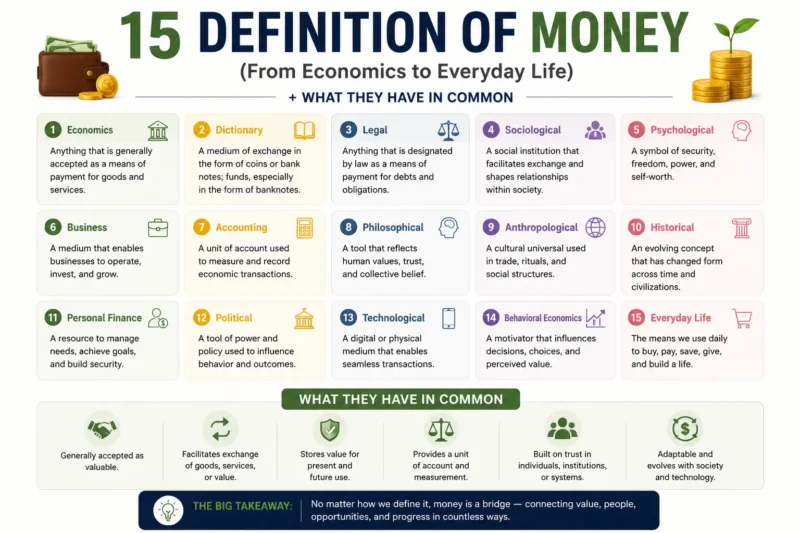
The 15 definition of money is a set of descriptions from economics and everyday usage that point to the same core idea: money is a widely accepted way to pay, measure value, and settle transactions. In economics, money is defined by what it does—facilitating exchange, acting as a unit of account, and often supporting saving. In daily life, it’s what you use to buy things and plan future spending.
When you search for a “definition of money,” you’re usually trying to answer two questions at once: what money is in theory, and what it is in real life. Some sources emphasize money as a social agreement; others focus on functions like pricing, payment, and saving. This reference page collects multiple common definitions (including how different authors frame them) and then synthesizes the overlap so you can quickly understand the concept without getting stuck in jargon. You’ll also see why the boundaries matter—for example, why some items can be valuable but still not work as money.
Use this map to move through the concept in a clear order: meaning, mechanism, use, and wider context.
If you’ve ever tried to pin down what money “really is,” you’ve probably noticed something frustrating: different sources define it differently, and some are full of economics jargon. That’s normal. Money is one of those concepts where authors choose different entry points—sometimes they start with what money does, sometimes they start with what people do with it. This page gives you a reference-style synthesis of 15 definitions of money perspectives, then distills the overlap so you can use the idea confidently in everyday conversations, budgeting, and learning.
Across many of the 15 definitions of money framings, the shared core is consistent: money is widely accepted and used to settle exchanges. In other words, it’s not just something you personally value; it’s something other people reliably accept in return for goods, services, and obligations. Economists often express this through functions—money makes trade easier, helps set prices, and supports saving. Everyday definitions tend to describe the lived experience: money is what you hand over (or approve through a payment system) to get what you need.
When you look for “the” definition, you’re really looking for the conditions that make money work. Those conditions include acceptance, convenience, and enough stability that people are willing to use it again and again. Without acceptance, you can have value—but not usability as money.
Different authors and textbooks emphasize different pieces of the same puzzle. Here are 15 common definition angles you’ll see in economics and personal finance discussions, written in plain language so you can compare them:
Money is what you use to buy and sell without needing barter.
Money is the standard used to quote prices and measure value.
Money helps you carry purchasing power into the future.
Money is accepted by most people in a community or economy.
Money is what people use to repay obligations.
Money exists because people coordinate around acceptance.
Using money is cheaper and faster than direct barter.
Money is useful because it can be spent or exchanged easily.
Money helps people compare different goods and services.
Legal tender rules, banking systems, and enforcement strengthen usage.
Money-related numbers help track production, trade, and growth.
Money moves value from one person or business to another.
Instead of finding a double coincidence of wants, you use money.
Some assets act like money when they’re commonly accepted for payments.
In practice, money is the thing people actually accept at the store, online, or through payments.
Notice how many of these angles sound different, but they overlap. That overlap is what you want when you’re studying or explaining money.
Economics definitions often sound abstract because they focus on functions. For example, a textbook might say money is what serves as a medium of exchange, unit of account, and store of value. That’s a practical framework: it tells you what to look for.
Everyday definitions usually focus on behavior. People say money is what they use to buy things, pay rent, or get paid for work. That’s also practical, but it can hide the “why.” When you connect everyday behavior to economic functions, you get a clearer picture. For instance, if a payment method is widely accepted and easy to spend, it’s doing the medium-of-exchange job. If it’s used to quote prices, it’s acting as a unit of account. If people are comfortable holding it for later purchases, it’s doing the store-of-value job.
One common misunderstanding is assuming that “valuable” equals “money.” Valuable items can fail as money if they’re not widely accepted or if using them is inconvenient. Imagine a collectible that might be worth a lot in the long run. If only a few people accept it for groceries, it doesn’t function like money for everyday trade.
The same boundary applies to credit. Credit can help you buy now and pay later, but it doesn’t always replace money’s core functions. Credit requires trust in repayment and usually depends on established institutions. Money, by contrast, is designed to be accepted broadly for settlement.
If you’re trying to decide whether something counts as money, ask two questions: Do people generally accept it for payments? And can you use it easily and predictably to settle transactions?
To make the functions feel less theoretical, here’s how they show up in daily routines.
Medium of exchange: You can sell your labor or products and use the proceeds to buy what you need. This avoids barter’s complexity.
Unit of account: Prices in a market use a common reference so you can compare costs quickly. Even when you don’t calculate deeply, you rely on the consistency.
Store of value: You hold money today so you can spend later. If inflation is high or purchasing power falls, that store-of-value role becomes harder, and people may shift toward other assets or faster spending.
When these functions work smoothly, money feels invisible. When they break through instability, lack of acceptance, or restrictions, money becomes more noticeable and stressful.
15 definitions of money in economics: what “money” includes
In economics, “money” often refers to specific assets used for payments and short-term holding. Different models may include different categories depending on liquidity and how broadly the asset is used in transactions. The point isn’t to memorize one list forever; it’s to understand that economists are tracking money because it affects exchange and spending.
This is also where you’ll see why definitions vary. One author may emphasize what’s used for everyday payments, while another may include broader “money-like” assets. The definitions aren’t always contradictory—they’re choosing different scopes based on the question they’re trying to answer.
If you’re studying, a smart approach is to treat definitions as lenses rather than battles. Pick one lens—functions, acceptance, or everyday usage—and use it to interpret the others. For example:
If your question is “Why does money make trade easier?” focus on transaction costs and the medium of exchange.
If your question is, “How do prices become comparable?” focus on the unit of account.
If your question is “Why can people plan for the future?” focus on store of value and stability.
This approach also helps with personal understanding. When your budget feels tight, it’s often about the store-of-value function (purchasing power) and the unit-of-account function (how costs are measured). When payments are confusing—fees, delays, or limited acceptance—it’s a medium-of-exchange and liquidity issue.
Definitions are useful, but they can’t answer every question. For one, money’s role can change during economic stress. Acceptance may shift, prices may become less stable, and the store-of-value function may weaken. Also, definitions that emphasize the “ideal” functions may not reflect what’s true for every group or location.
Another limitation is scope. Some definitions in popular writing treat money as “any asset people can hold,” which can blur the distinction between money, credit, savings, and investments. If you want clarity, always connect the definition to the function you care about.
If you’re using these ideas to make financial decisions, remember that definitions won’t tell you what will happen to purchasing power in the future. They help you understand how money works, not how markets will behave. For practical planning, it’s often more useful to combine conceptual clarity with your own context: your income timing, your expenses, the stability of your local economy, and how reliable your payment methods are.
Here’s the synthesis you can carry forward: money is widely accepted and used to make exchange easier. It provides a shared way to measure value and, when stable enough, helps people hold purchasing power for later. Most “15 definitions of money” lists differ in wording, but they converge on those functions and conditions.
If you can explain money using acceptance plus functions, you can connect economics to everyday life without confusion.
| Attribute | Summary |
|---|---|
| Core idea | Widely accepted medium for exchanging value |
| Main functions | Medium of exchange, unit of account, store of value |
| What makes it “money” | General acceptance and practical use in transactions |
| What it isn’t (usually) | Anything valuable that no one consistently accepts |
| Why definitions differ | Different authors emphasize different functions or contexts |
| Attribute | Summary |
|---|---|
| Core idea | Widely accepted medium for exchanging value |
| Main functions | Medium of exchange, unit of account, store of value |
| What makes it “money” | General acceptance and practical use in transactions |
| What it isn’t (usually) | Anything valuable that no one consistently accepts |
| Why definitions differ | Different authors emphasize different functions or contexts |
How people trade without direct barter
How prices get measured and compared
How purchasing power can be carried forward
The social condition that makes money usable
A useful way to separate definitions is to notice the “lens” each one uses. Economics definitions often start with functions: money helps people trade, provides a common unit for prices, and supports storing purchasing power. Everyday definitions often start with behavior: money is what people accept for purchases and use to settle debts. The key distinction is that these aren’t competing ideas—they’re two angles on the same mechanism. Money becomes money when it’s widely accepted and consistently used to make transactions simpler and more predictable.
Use these connected pages for the next step.

Learn how to find legitimate free grant money…
Read next

Money shapes your daily choices, stress level, and…
Read nextMoney isn’t just a thing you hold—it’s a system of acceptance and functions that makes exchange predictable. When you compare multiple definitions, the differences usually come from which function an author wants to highlight: medium of exchange, unit of account, or store of value. That’s good news, because it means you can build a clear mental model instead of memorizing conflicting statements. Use this synthesis to explain money in plain language, spot why certain items don’t function as money, and connect economic ideas to real budgeting and payment experiences.