

Guide
Free Grant Money for Bills and Personal Use: A Safe Step-by-Step Search & Apply Plan
Learn how to find legitimate free grant money for bills and personal use. Follow a safe checklist, spot scams fast,…
Read nextSee where money and love overlap, where they clash, and how to make decisions that protect both.
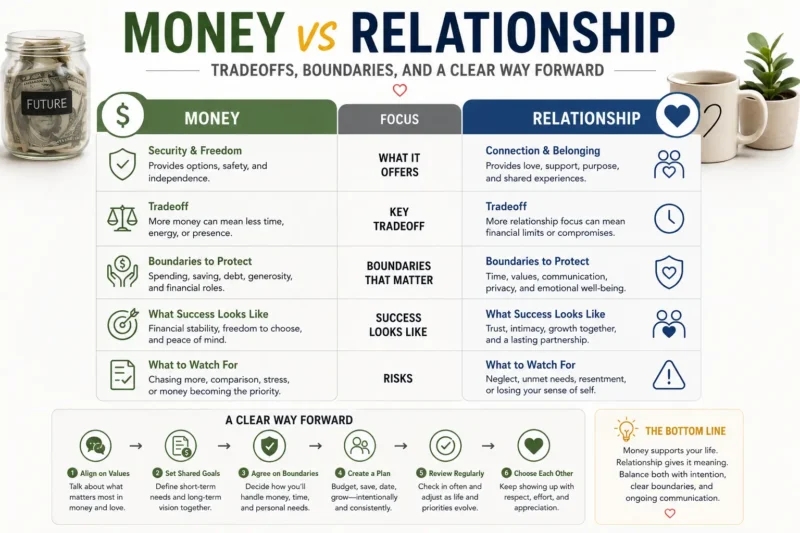
If you want fewer fights and more steadiness, treat money as a shared system, not a personal scorecard. Money works best in relationships when it’s tied to shared goals, clear roles, and communication about money that feels safe. But relationships also need protection: if financial stress keeps pushing aside trust, time together, and emotional support, the “money problem” is often a relationship priorities problem. The healthiest path is balance with boundaries—decide what money decisions require teamwork, what can be individual, and what conversations you won’t avoid. That approach reduces financial stress without turning love into a spreadsheet.
When people say “money vs relationship,” they usually mean something deeper: who gets to decide, what happens when priorities collide, and whether the relationship feels safe enough to talk about money honestly. In real life, financial compatibility isn’t just about income—it’s about money mindset, habits, and the ability to align on shared goals. At the same time, relationship priorities matter because love can’t be measured only in budgets. If one person feels controlled, dismissed, or constantly stressed, the relationship can start to erode even when the numbers look fine. This comparison helps you sort out the tradeoffs: how to use budgeting as a couple to reduce uncertainty, when to set money boundaries to protect autonomy, and how to spot the early signs of financial stress turning into resentment. By the end, you’ll have a clearer decision framework for what to change first—your plan, your communication, or your expectations.
Money vs. relationship sounds dramatic, but most couples aren’t actually debating love. They’re debating safety: whether decisions will be fair, whether stress will be handled with care, and whether both people’s needs will be heard. The tricky part is that money and relationships react to each other. When money feels uncertain, it can make communication about money harder and emotional intimacy thinner. When relationship trust is low, even a reasonable budget can feel like criticism. A better way to think about this isn’t “money or feelings,” but “what tradeoffs are you making, and are they working for both of you?”
A lot of conflict begins with mismatched expectations. One person may assume money decisions are shared by default, while the other assumes certain choices are personal. Another common issue is different money mindsets: some people plan early and prefer predictability, while others focus on flexibility and “figure it out later.” Neither approach is automatically wrong, but they create friction when they’re treated like moral judgments.
Then there’s the language problem. If budgeting becomes a report card (“Why didn’t you track this?”), it turns into blame. If relationship needs become a demand (“We need to stop talking about money”), it can turn into avoidance. Money boundaries get blurred, and suddenly you’re not discussing spending—you’re discussing respect.
Financial stress often shows up in small behaviors first. You might see rushed conversations, last-minute surprises, or one partner taking over everything to “fix it.” You might also notice emotional patterns: irritation during otherwise normal moments, less patience, or fewer check-ins. When money becomes a constant background worry, it can crowd out relationship priorities like listening, affection, and teamwork.
Another sign is asymmetry. If one person carries the emotional labor of worrying and the other carries the practical labor of managing, resentment can build even when the budget is “fine.” The relationship isn’t just reacting to numbers; it’s reacting to perceived imbalance.
If you’re noticing secrecy—hidden accounts, unexplained charges, or avoided statements—that’s a serious trust signal. You can’t budget your way out of secrecy. You need clarity, accountability, and a plan to rebuild safety.
Sometimes the direction is the opposite. If you feel emotionally disconnected, money conversations can become proxies for deeper needs. Maybe one partner craves reassurance and time, but the other only shows care through problem-solving. Or maybe someone feels criticized for their spending habits, so they shut down during budgeting as a couple.
In these cases, the “money problem” may be a communication and trust problem. You might see patterns like one person turning every conversation into an argument about intentions or one person avoiding money talks because they fear being judged. The result is the same: shared goals stay unspoken, and financial stress grows quietly.
This is where money boundaries matter. Boundaries aren’t cold. They’re what makes conversations possible. For example: “We can disagree about spending, but we won’t raise our voices or bring up old mistakes.” Or: “We’ll talk about big purchases in advance, but we won’t scrutinize every small expense.”
If you want to reduce fights, change the format before you change the numbers. Start with a short purpose statement: “I’m not trying to blame you. I want us to feel secure and aligned.” Then ask one clarifying question before proposing solutions.
Try questions that invite teamwork, not defensiveness. “What part of money conversations feels hardest for you?” “When you think about shared goals, what matters most?” “What would money boundaries look like that feel fair to you?”
When emotions are high, pause. A practical boundary is to agree on a time limit: “We can talk for 20 minutes, then we’ll revisit tomorrow once we’re calmer.” This prevents the conversation from becoming a long debate where nobody hears the other person.
Also, avoid using money talk as a threat. “If you loved me, you’d spend less” or “If you cared, you’d handle the bills” turns money into a test. Instead, connect decisions to the relationship you want: “This plan helps us get to the trip we both want,” or “This rule protects our ability to save without resentment.”
Budgeting as a couple is most effective when it’s designed to support your real life, not to create perfect control. That means starting with shared goals. Are you saving for a home, building an emergency fund, paying down debt, or funding education? Pick a few priorities so you’re not trying to solve everything at once.
Next, make the system understandable. If a budget requires spreadsheets no one can maintain, it will fail quietly. Use categories that match your reality, and decide what’s negotiable versus non-negotiable.
A simple structure can look like this: shared bills and savings are joint, personal discretionary spending has clear limits, and major purchases follow an agreed approval process. The key is that money boundaries should reduce anxiety, not remove autonomy.
Finally, include breathing room. Many couples underestimate how much financial stress comes from tightness. Even a modest buffer can change the tone of conversations because you’re less likely to panic when something unexpected happens.
Money boundaries are the difference between “teamwork” and “control.” If one partner feels micromanaged, they may hide spending or stop participating. If one partner feels unprotected, they may become hyper-vigilant. Boundaries prevent both.
You can set boundaries around three areas:
First, decision boundaries: define what must be discussed together (for example, debt decisions, moving expenses, and large purchases) and what doesn’t.
Second, transparency boundaries: decide what information is shared routinely (balances, statements, and upcoming bills) without turning every receipt into an interrogation.
Third, communication boundaries: agree on how to talk when you disagree. You can’t eliminate conflict, but you can reduce harm.
A helpful rule of thumb is to match the boundary to the impact. Big-impact decisions need more alignment. Low-impact spending needs less friction. This keeps communication about money focused on what truly matters.
Let’s make this practical. Imagine one partner wants to upgrade a car now, while the other wants to prioritize savings for shared goals. A money-first approach might focus on affordability and the budget impact, while a relationship-first approach might focus on how the decision affects time, stress, and feeling heard. The balanced decision process combines both.
Step one: confirm the values behind each position. Why does the car upgrade feel important? Is it about reliability, safety, convenience, or status? Why does saving feel urgent? Is it about fear of financial stress or a timeline for a major goal?
Step two: translate values into numbers. Estimate the cost, identify tradeoffs, and decide what you can afford without creating panic.
Step three: agree on a boundary for future decisions. If you can’t decide on this one item, decide on a rule for similar decisions going forward.
Another example: one partner wants to handle all bill payments to “keep things simple.” That can reduce short-term stress, but it may also create resentment if the other person feels left out. In that case, set a boundary: the bill manager can still manage, but the other partner gets regular visibility and a say in shared goals.
Money vs. relationship becomes a better conversation when you treat it like an ongoing agreement. Not a one-time debate.
Use a quick check-in to decide what to address first.
If the main problem is uncertainty—missed bills, unclear responsibilities, or recurring surprises—start with money mindset and planning. Build a small, workable budget and define money boundaries.
If the main problem is emotional disconnection—stonewalling, frequent tension, or feeling unsafe to talk—start with relationship priorities. Rebuild communication, then introduce budgeting as a couple in a way that feels supportive.
If both are present, do both, but not at the same time in one conversation. Schedule a short emotional check-in first, then a separate planning session. This respects the fact that stress affects attention.
Finally, remember that financial compatibility is not a static trait. It’s a set of behaviors you can practice: transparency, follow-through, and respectful communication about money. When you treat it as a skill, you stop seeing conflict as proof that love is failing—and you start seeing it as a signal to adjust the system.
| Factor | Option A | Option B |
|---|---|---|
| Primary focus | Money plans and stability | Emotional connection and relationship priorities |
| How decisions are made | Joint rules and budgeting as a couple | Values-first choices with room for individual needs |
| What reduces conflict | Communication about money with numbers and timelines | Trust-building conversations and time/attention agreements |
| Risk if neglected | Financial stress becomes avoidance or control | Shared goals stay vague and money resentment grows |
| Best starting point | Clarify shared goals, then build a system | Clarify relationship priorities, then set money boundaries |
| Criteria | Option A | Option B | Best fit |
|---|---|---|---|
| Goal alignment | Shared goals translate into a budget and milestones | Relationship priorities translate into time, support, and trust agreements | If goals are unclear, use the approach that starts with what you both want most right now |
| Communication style | Money mindset is discussed with specifics and next steps | Communication centers on feelings, needs, and boundaries first | Use the style that your relationship can tolerate without defensiveness |
| Decision ownership | Defined roles (who pays, who tracks, who approves big purchases) | Defined autonomy (what each person can decide independently) | Best fit depends on whether control or uncertainty is the bigger problem |
| Handling financial stress | Stress is managed through planning, buffers, and routines | Stress is managed through reassurance, prioritizing connection, and reducing emotional distance | Choose a plan plus connection when both are slipping |
| Long-term sustainability | Systems prevent recurring “same fight, different month” cycles | Values prevent money decisions from overriding care and respect | The healthiest outcome combines both in a consistent rhythm |
Start by naming what’s actually happening, not what you fear. If your fights revolve around surprises, unclear responsibility, or money decisions that land without agreement, prioritize financial compatibility through structure. Begin with a simple budgeting as a couple approach: list shared goals, estimate monthly costs, and set rules for “joint decisions” (often big purchases, debt changes, and savings targets). Then add money boundaries so it’s not all joint control—define what each person can spend without negotiation and what requires a conversation.
If your fights revolve around emotional distance, feeling unsupported, or resentment that money is taking time away from each other, prioritize relationship priorities first. Have a communication about money conversation that starts with impact: how money topics make each person feel, what they need to feel safe, and what you will do when stress spikes. Agree on a short “connection cadence” (for example, a weekly check-in that includes feelings, not just numbers, and a protected date or shared activity).
When you’re choosing the order, think about timing. If you’re too upset to hear numbers, do connection first. If you’re too anxious to move on, do planning first. In both cases, keep shared goals visible so the relationship doesn’t become a series of reactive debates. Finally, watch for escalation patterns: contempt, stonewalling, or secrecy. Those are signals to slow down, reset the conversation, and consider outside support if trust is breaking down.
The goal isn’t to prove which side “wins.” The goal is a system that protects love and protects your future.
Use these connected pages to deepen context, compare alternatives, and move confidently toward the right next step.
Learn how to find legitimate free grant money for bills and personal use. Follow a safe checklist, spot scams fast,…
Read next
Want better money habits without overwhelm? Try this simple 7–30 day system: track spending, set goals, build a realistic budget,…
Read next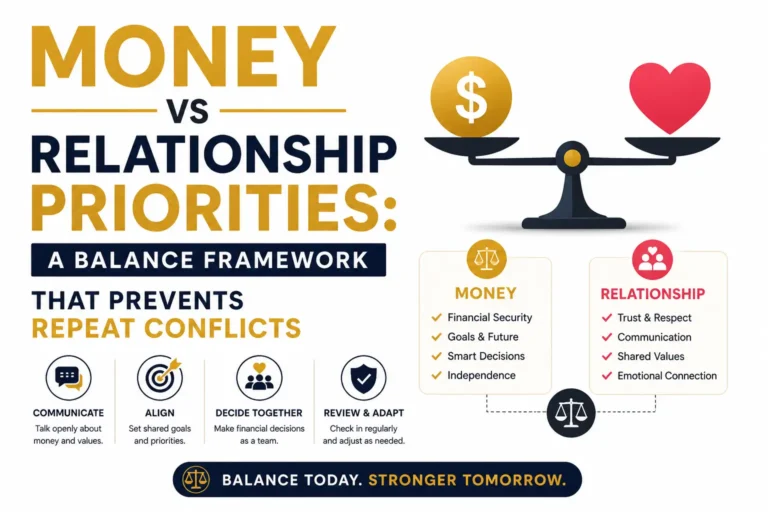
Compare money vs relationship priorities with a clear alignment framework. Learn how to balance values, communication, and shared goals to…
Read next
Money shapes your daily choices, stress level, and sense of security. Here’s why it matters, what it really does, and…
Read nextIncome matters, but financial compatibility is usually about behavior: money mindset, spending habits, and how you respond under financial stress. Two people with similar earnings can clash if one plans and the other avoids, or if communication about money is inconsistent. Look for patterns in transparency, follow-through, and willingness to agree on shared goals—not just the paycheck size.
Start with impact, not accusations. Use “I” statements about what you’re feeling and what you need, then ask for understanding before solutions. Agree to basic communication boundaries like no yelling and no bringing up old mistakes. When you do discuss numbers, keep it forward-looking: “Here’s the plan for next month,” rather than “Here’s what you did wrong.”
There’s no single right setup. What matters is clarity and money boundaries. Some couples keep accounts separate but share a joint plan for bills and shared goals. Others combine fully, with agreed rules for personal spending. Choose the structure that reduces uncertainty for both people and makes communication about money predictable.
Reduce uncertainty first. Make a simple snapshot of income, essential bills, debt obligations, and a realistic savings target. Add a small buffer if possible, even if it’s modest. Then agree on who tracks what and when you review. This turns financial stress into a system you both understand, instead of a vague worry.
Yes—when budgeting supports the relationship instead of replacing it. Relationship priorities like time, emotional support, and trust need protected space. You can build budgeting as a couple around shared goals while also scheduling connection time and respectful check-ins. The goal is balance: a plan that lowers stress and a communication rhythm that preserves intimacy.
Consider support if conflict includes secrecy, contempt, repeated stonewalling, or ongoing financial stress that never improves despite agreed rules. If one partner feels controlled or the other feels unheard, counseling or coaching can help you rebuild money boundaries and communication patterns. Outside help is especially useful when trust has been damaged or cycles repeat.
Money vs relationship isn’t a contest; it’s a coordination challenge. The healthiest couples don’t avoid financial stress or ignore feelings—they build budgeting as a couple around shared goals, then protect trust with clear money boundaries. If your conversations feel unsafe, start with relationship priorities and communication, even if it means delaying the “numbers talk” briefly. If anxiety is driving avoidance, start with a simple plan and predictable decision rules. With the right order and clear agreements, you can reduce conflict and still grow together.