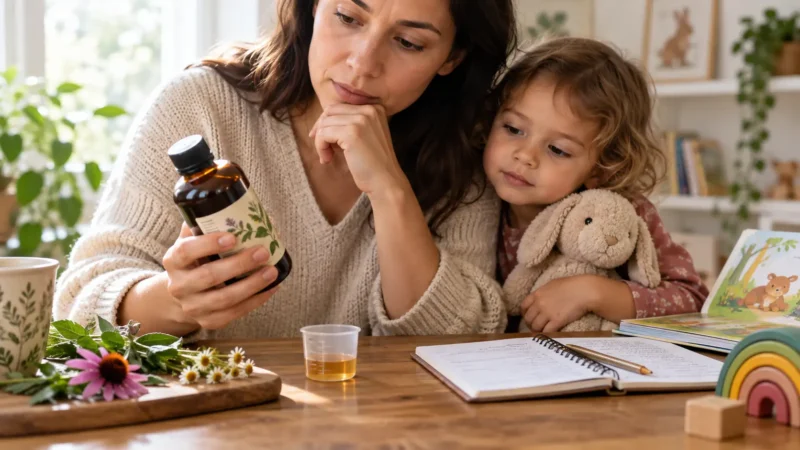
Herbal antibiotics cannot be assumed safe for children. A product that an adult tolerates may not be appropriate for a child, and a familiar culinary herb can have a very different risk profile when concentrated into an extract, tincture, capsule, or essential oil. Pediatric safety depends on the exact product, preparation, concentration, age, health condition, medicines, allergies, and evidence.
Are Herbal Antibiotics Safe for Children?
The safest general answer is not automatically. Children are not simply smaller adults, so adult herbal evidence and adult serving sizes should not be scaled down casually. Some products have age-specific labeling or limited pediatric research; many do not.
A universal “safe herbal antibiotic for children” list would therefore be misleading. The exact preparation and reason for use matter more than the herb name alone.
Why Children Are Not Small Adults
Body size is only one difference. Absorption, metabolism, organ maturity, hydration status, and the ability to communicate adverse effects can vary with age. Pediatric studies are also less common, leaving uncertainty about effective exposure and safety for many supplements.
That means a product used by adults cannot be assumed safe after a simple weight-based dose reduction. This is especially important for concentrated products and multi-ingredient supplements.
Culinary Herbs, Teas, Extracts, and Essential Oils Have Different Risk Profiles
Preparation changes exposure dramatically.
- Culinary use: small amounts in food are very different from medicinal dosing.
- Tea: concentration varies with plant material and preparation.
- Tincture or extract: can deliver a more concentrated and repeatable exposure.
- Capsule: may contain standardized extracts or multiple ingredients.
- Essential oil: is highly concentrated and should never be treated as equivalent to the whole herb in food or tea.
Essential oils deserve particular caution because inappropriate ingestion or concentrated topical exposure can cause irritation, toxicity, or accidental poisoning.
What the Evidence Says About Natural Products in Children
Pediatric evidence is product- and condition-specific. A study of one standardized preparation for one symptom cannot support every product containing the same herb. Even when a natural product has been studied in children, the result may concern symptom relief rather than infection treatment.
Caregivers should therefore ask what exact product was studied, in what age group, for what outcome, and for how long. Broad claims such as “safe for kids” or “natural antibiotic” do not answer those questions.
For broader evidence context, see Mayobook’s guide to how herbal antibiotics work.
When a Child’s Infection Symptoms Need Medical Care
Children—especially infants and younger children—deserve a lower threshold for professional assessment when illness is significant or worsening. Seek prompt care for difficulty breathing, severe weakness or unusual sleepiness, dehydration, persistent vomiting, rapidly worsening fever or illness, spreading skin redness or swelling, significant dental or facial swelling, or urinary symptoms with fever or back/flank pain.
Very young infants, immunocompromised children, and children with significant chronic disease may need earlier evaluation. Herbal products should not delay indicated testing, antibiotics, or other treatment when a serious bacterial infection is suspected.
A Safer Product-Review Checklist for Parents and Caregivers
Before giving a child a concentrated herbal product, check:
- the exact product and manufacturer;
- all ingredients and concentration;
- the labeled age range and directions;
- all prescription medicines and supplements;
- allergies and previous reactions;
- kidney, liver, heart, respiratory, neurologic, or other chronic conditions;
- why the product is being used and what evidence supports that purpose.
When the child takes medicines or the product is concentrated, a pediatric clinician or pharmacist is a better source of interaction guidance than a generic herbal dosing chart.
Do not stop or modify prescribed antibiotics because a herbal product appears to be helping. Mayobook’s answer to whether herbal antibiotics work explains why symptom change and proven infection treatment are different outcomes.
Bottom Line
Herbal antibiotics are not a single pediatric-safe category. Food-level exposure, teas, extracts, capsules, tinctures, and essential oils can create very different risks. Use product-specific pediatric evidence where it exists, avoid improvising adult doses, and seek medical assessment promptly when a child’s illness is severe, worsening, or high-risk.
For broader context, see Mayobook’s Herbal Antibiotics resource and the Herbal Medicine topic hub.