
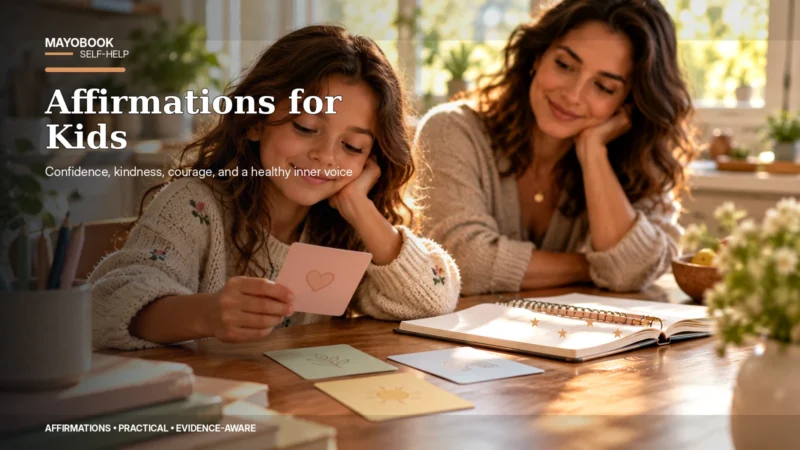
Affirmations for kids work best when they are simple, concrete, believable, and connected to everyday situations. A child should not be forced to repeat a sentence that feels strange or untrue. The goal is to help children build a healthier inner voice around learning, courage, kindness, emotions, and boundaries—not to teach them that difficult feelings are wrong.
Positive Affirmations for Kids
- I can try even when something feels hard.
- I can ask for help.
- Mistakes help me learn what to try next.
- I can be kind without letting people treat me badly.
- I can calm down one step at a time.
- I can try again after a difficult day.
Children often benefit from language that describes what they can do rather than grand identity claims. “I can practice” may feel more natural than “I am the best.” “I can ask for help” is more useful than “I can do everything alone.”
What Makes an Affirmation Age-Appropriate?
Use simple vocabulary, short sentences, and familiar situations. A younger child may use “I can try again.” An older child may prefer “I can take my time and ask a question when I am confused.” The wording should match the child’s actual language rather than sounding like an adult motivational poster.
Choice matters. Offer two or three options and let the child pick or rewrite one. Adults can also model realistic self-talk aloud: “I made a mistake, and I can fix what I can.” Modeling often teaches more than insisting on repetition.
Affirmations for Confidence, Trying New Things, and Learning
- I can be new at something and still belong here.
- I do not have to get it right the first time.
- I can practice one small part.
- I can tell an adult when I do not understand.
- I can be proud of effort and learning, not only winning.
- I can try something once before deciding I cannot do it.
For school, pair the phrase with behavior: “I can ask for help” becomes raising a hand, writing a question, or telling the teacher which part is confusing. For hobbies or sports, “I can practice one part” becomes a short practice rather than an expectation of instant skill.
Affirmations for Big Feelings Without Telling Kids to ‘Just Be Positive’
Children need permission to feel sad, angry, scared, jealous, or disappointed. An affirmation should not erase the feeling. Try: “I can be upset and still be safe.” “I can tell someone what I need.” “This feeling is strong, and I can wait before I act.” “I can take space and come back.”
Avoid “I am happy” when the child is clearly distressed. A more supportive adult response is to listen first, name the feeling, and offer a grounded phrase only if it helps.
Affirmations for Kindness, Friendship, and Boundaries
- I can be kind and still say no.
- I can ask before touching someone else’s things.
- I can tell someone when I need space.
- I can apologize when I hurt someone.
- I deserve respectful treatment, and so do other people.
- I can choose friends who are kind to me.
These statements teach that kindness is not the same as people-pleasing. A child can be caring while still having personal space, preferences, and boundaries.
How to Use Affirmations With Kids
Keep the routine brief. A child might choose one phrase before school, write one sentence on a card, or reflect at bedtime on something they handled well. Avoid turning the practice into homework. If the child does not want to say a phrase aloud, let them read it silently, draw it, or choose a different sentence.
In classrooms, affirmations can be optional prompts rather than required declarations. At home, connect them to real behavior: “I can try again” before practicing; “I can ask for help” before homework; “I can say no kindly” before a social situation.
How Affirmations Can Change With Age
For younger children, keep the statement concrete and immediate: “I can take turns,” “I can ask for help,” or “I can try one more time.” School-age children can handle more context: “I can be nervous about the test and still use what I practiced.” Older children may want more privacy and may prefer writing their own statements.
The affirmation should mature with the child. A phrase that feels comforting at age six may feel embarrassing at age eleven. Adults can ask, “How would you say this in your own words?” rather than assuming one script fits every stage.
Turn the Affirmation Into Evidence
After the situation, help the child notice what happened. “You said you could ask for help, and you did.” “You tried again after the first attempt did not work.” The point is not to praise every outcome; it is to connect the statement to observable behavior.
This helps children understand that confidence can come from what they practice, not only from saying positive things about themselves. It also gives adults a chance to revise a statement that did not fit.
What Adults Should Avoid
Do not force a child to repeat “I am happy,” “I love myself,” or any statement they reject. Do not use affirmations to dismiss bullying, fear, grief, family stress, learning difficulties, or mental-health concerns. Do not praise only perfection, appearance, grades, or winning while calling that confidence-building.
Affirmations are one small communication tool. Children still need listening, safety, instruction, boundaries, medical or mental-health support when appropriate, and adults who take their concerns seriously.
For a broader framework for believable affirmations and limiting-belief work, see Mayobook’s The Magic of Positive Affirmation. You can also explore related resources in Self-Help, Habits & Life Mastery.