
Quick definition
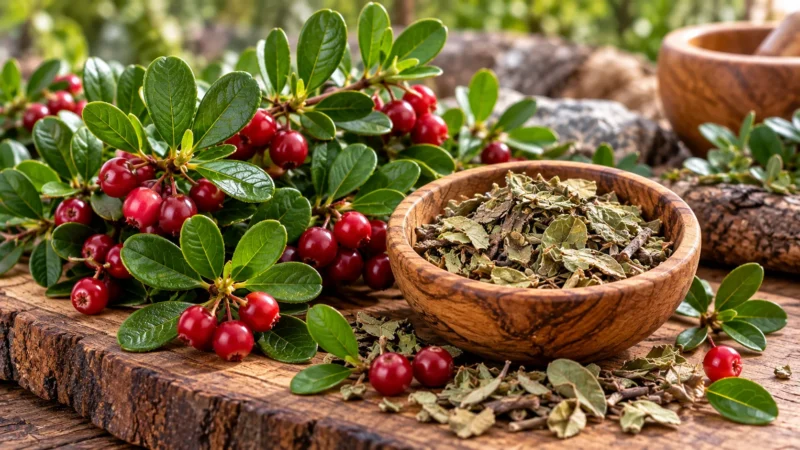
Uva Ursi (Arctostaphylos uva-ursi) is a medicinal botanical commonly prepared from leaves and traditionally associated with short-term traditional urinary-tract use.
Quick context
Traditional use, laboratory research and human clinical evidence should be distinguished rather than treated as equivalent.
Reference snapshot
- Botanical name
- Arctostaphylos uva-ursi
- Common name
- Uva Ursi
- Commonly used material
- leaves
- Evidence context
- Uva ursi has traditional use for urinary symptoms, but modern clinical evidence is limited and it should not be used to delay assessment of fever, flank pain, recurrent infection or persistent urinary symptoms.
- Safety context
- Uva ursi contains arbutin-related compounds that can yield hydroquinone metabolites. Prolonged or repeated self-treatment is not appropriate; pregnancy, breastfeeding, children and people with kidney or liver disease require particular caution.
Uva ursi (Arctostaphylos uva-ursi), also called bearberry, has a traditional reputation for short-term urinary complaints. Its leaves contain arbutin-related compounds that can be converted into hydroquinone derivatives, which helps explain both the historical interest and the safety concerns. This is not an herb for indefinite “urinary maintenance,” and it should not be used to postpone evaluation of recurrent or severe urinary symptoms.
What Uva Ursi Is and Which Parts Are Used
The leaves are the medicinal material. They contain arbutin, tannins and related compounds. Commercial products may use powdered leaf, tea, tincture or standardized extract. The amount of arbutin can vary considerably across preparations.
Because the active chemistry is tied to metabolites of arbutin, product strength matters. A loosely prepared tea and a concentrated extract should not be assumed to carry the same exposure or risk. The plant’s traditional use is also narrower than modern marketing often suggests.
Traditional and Modern Uses of Uva Ursi
Traditional herbal use centers on short-term urinary discomfort. Modern products are sometimes marketed for “urinary cleansing,” recurrent bladder health or routine prevention.
That framing can be misleading because urinary burning, urgency or frequency can result from infection, irritation, stones, sexually transmitted infections, prostate problems or other causes. Uva ursi cannot identify which cause is present, and symptom relief would not prove that an infection has cleared.
What the Research Says About Uva Ursi
Modern clinical evidence is limited. Some research has explored whether uva ursi-containing preparations can reduce antibiotic use or help with uncomplicated urinary symptoms, but the evidence is not strong enough to recommend the herb as a substitute for indicated treatment.
Laboratory antimicrobial activity related to hydroquinone metabolites does not establish that a self-selected dose will eradicate a urinary infection safely in a person. Laboratory conditions can produce concentrations and exposures that are not reproduced by ordinary supplement use.
The most defensible interpretation is that uva ursi has a traditional short-term role, not that it is a proven treatment for cystitis or a preventive strategy for recurrent infections.
Common Uva Ursi Preparations and How They Differ
Products include dried leaf tea, tinctures, capsules and standardized extracts. Some formulas combine uva ursi with cranberry, juniper or other urinary herbs, which adds complexity to both evidence and safety.
Because prolonged exposure to hydroquinone-related metabolites raises concern, stronger or longer use is not automatically better. A product that encourages months of daily use should be viewed more critically than one framed for limited short-term use.
Side Effects and Safety of Uva Ursi
Uva ursi can cause nausea, vomiting and gastrointestinal irritation. More importantly, repeated or prolonged use is not appropriate because of concern about hydroquinone exposure and limited long-term safety data.
Pregnancy, breastfeeding, childhood, liver disease and kidney disease are settings where medicinal use should be avoided or professionally reviewed. Mayobook’s Are There Side Effects of Herbal Medicine? explains why short traditional use does not justify assuming chronic use is safe.
Urinary symptoms themselves can become dangerous if they are accompanied by systemic illness. Fever, chills, flank pain, vomiting or worsening weakness may indicate a problem that requires timely medical care rather than another herbal dose.
Uva Ursi Drug Interactions and Contraindications
High-quality interaction data are sparse, but people using medicines that affect the liver or kidneys should be especially cautious because those organs are relevant to handling and eliminating metabolites. Multi-herb urinary products may introduce additional interactions through other ingredients.
Prescription antibiotics should not be stopped or delayed in favor of uva ursi when a clinician has determined they are needed. People taking several medicines should have the entire product reviewed rather than searching for a single herb name in isolation.
Who Should Avoid Uva Ursi or Get Medical Advice First
Pregnant or breastfeeding people, children and people with liver or kidney disease should avoid unsupervised medicinal use. Fever, flank pain, vomiting, blood in urine, pregnancy-associated urinary symptoms, symptoms in men, or recurrent infections deserve prompt medical evaluation.
Repeated episodes also deserve investigation because recurrent urinary symptoms can have causes that are not solved by repeated antimicrobial-style herbal use.
How to Evaluate a Uva Ursi Product
Look for Arctostaphylos uva-ursi, leaf as the plant part, serving amount and any arbutin standardization. A responsible product should not encourage indefinite daily use or claim to replace antibiotics.
Claims of “kidney detox,” guaranteed infection clearance or lifelong urinary prevention go beyond the evidence and can encourage dangerous delay in care.
Uva Ursi: Evidence-Aware Takeaways
Uva ursi is a traditional urinary herb with a narrow practical window: short-term use, limited clinical evidence and important safety constraints. Its chemistry is exactly why duration and dose matter.
Readers comparing uva ursi with other medicinal plants can explore What Are the Most Popular Medicinal Herbs?, but persistent urinary symptoms should be evaluated rather than repeatedly self-treated. The most important question is not whether the herb has antimicrobial chemistry; it is whether the person’s symptoms have been correctly identified and whether delaying effective care would create risk.
Key compounds or defining elements
Defining element
Uva Ursi contains multiple naturally occurring constituents whose concentrations vary with plant part and preparation.
Defining element
A named constituent or laboratory mechanism does not by itself establish clinical effectiveness.
When this is most useful
- Traditional context includes short-term traditional urinary-tract use.
- Modern use should be evaluated claim by claim against human evidence.
Limits, warnings, and safe use
- Use cautionHuman evidence may be limited, mixed, short-term or preparation-specific.
- Use cautionTraditional use and laboratory findings cannot establish clinical effectiveness on their own.
When this helps most and when it is not enough
When it works best
- Match research to the same species, plant part and preparation being considered.
- Use transparent products and review medicine combinations with a pharmacist or clinician.
When it is not enough
- Traditional use alone is not proof of effectiveness.
- A plausible mechanism alone is not proof of a human benefit.
- Natural origin alone is not proof of safety.
Key distinction
Evidence for one Uva Ursi preparation or outcome should not be generalized to every product or health claim.
Final thought
Uva Ursi should be evaluated by preparation, evidence quality and individual risk rather than broad natural-health claims.