
Defining element
Schisandra contains multiple naturally occurring constituents whose concentrations vary with plant part and processing.
An evidence-aware reference to Schisandra (Schisandra chinensis) and its preparation and safety considerations.
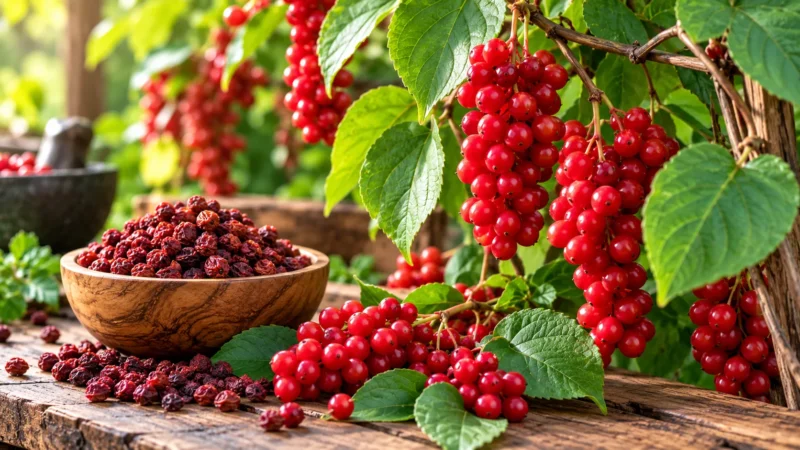
Schisandra (Schisandra chinensis) is a medicinal plant commonly prepared from berries and berry extracts and traditionally associated with fatigue, stress adaptation and liver-related support in traditional systems.
Traditional use, laboratory research and human clinical evidence should be distinguished rather than treated as equivalent.
Use this map to move through the concept in a clear order: meaning, mechanism, use, and wider context.
Schisandra (Schisandra chinensis) is a climbing vine whose red berries are known in traditional Chinese medicine for their unusual combination of sour, sweet, bitter, salty and pungent tastes. Modern supplements often present schisandra as an “adaptogen” or liver-support herb, but those broad labels hide important distinctions. The berry, its lignan-rich extracts and multi-herb traditional formulas do not have the same evidence base or the same interaction profile.
The ripe berry is the principal medicinal material. It contains lignans such as schisandrin-related compounds, along with organic acids and other plant constituents. Extracts can be standardized to particular lignans, while traditional preparations may use dried fruit, powders, decoctions or combinations with other herbs.
This chemical variability matters because liver-enzyme and transporter effects are concentration-dependent. A small amount of dried berry in a traditional formula should not automatically be equated with a concentrated extract designed to deliver a specific lignan level.
Traditional Chinese use has included fatigue, cough, excessive sweating and support during prolonged weakness. Modern marketing often shifts toward stress adaptation, exercise performance, mental stamina and “liver detox.” These claims should be separated because the human evidence differs for each one.
The concept of an adaptogen is particularly easy to overstate. If a product claims to improve resilience, the relevant question is what changed in the study: fatigue scores, exercise time, attention, stress ratings or another measurable outcome. A vague feeling of “balance” cannot be evaluated in the same way.
Schisandra has been investigated for fatigue, cognitive performance and liver-related outcomes, but much of the literature is small, region-specific, older or based on combination formulas. Some studies suggest potential effects on physical or mental performance, yet they do not establish a predictable benefit for every healthy user.
Liver research is complicated by the fact that schisandra can influence drug-metabolizing enzymes and transporters. A compound that changes liver enzyme activity in a laboratory may be scientifically interesting, but that does not mean the herb “cleanses” the liver or protects it from every medication, toxin or disease.
When a traditional multi-herb formula performs well, it is also difficult to assign the result to schisandra alone. That limitation should remain visible rather than disappearing in supplement marketing.
Dried berries can be brewed or decocted, while powders and tinctures provide other traditional-style forms. Modern capsules often contain concentrated extracts and may specify a lignan percentage. Extract ratios and standardization are more informative than the total milligram number alone.
Combination “adaptogen” products may pair schisandra with rhodiola, ginseng, eleuthero or stimulants. These formulas can create a very different experience from schisandra by itself, especially if another ingredient affects blood pressure, alertness or sleep.
Reported adverse effects can include heartburn, reduced appetite, stomach discomfort or skin reactions. The most important safety issue, however, is not a characteristic side effect but the possibility of clinically meaningful drug interactions through metabolic enzymes and transport proteins.
That makes schisandra less suitable for casual experimentation in people taking medicines whose blood levels need to remain stable. Mayobook’s Are There Side Effects of Herbal Medicine? provides a broader framework for understanding why a botanical can be well tolerated on its own yet still matter when medicines are added.
Schisandra constituents can affect CYP enzymes and P-glycoprotein in laboratory and clinical contexts. Depending on the medicine, that can theoretically raise or lower drug exposure. The direction and clinical importance are not identical for every product, which is why a generic “avoid all medicines” warning is no more useful than assuming there is no interaction.
People using medicines with a narrow therapeutic range, transplant medicines, some anticoagulants, seizure medicines or other drugs strongly dependent on metabolism should ask a pharmacist to review the exact supplement. The label matters because a concentrated extract may create greater interaction potential than a traditional berry preparation.
Pregnancy and breastfeeding lack strong safety data for concentrated extracts. People with complex medication regimens, liver disease being medically managed, or medicines whose blood levels are monitored should seek professional review before use.
Persistent fatigue also deserves context. Fatigue from anemia, thyroid disease, sleep apnea, infection, depression or medication effects is not appropriately managed by simply escalating an “adaptogen.”
Look for Schisandra chinensis, the berry as the stated plant part, and clear information about powder versus extract. If the product is standardized, the label should identify the constituent and amount. Multi-herb formulas should disclose every ingredient instead of hiding them behind a proprietary blend.
Claims to “detox the liver,” permanently increase energy or make medication side effects harmless are not supported by the available evidence. A transparent product should be easier to identify than to advertise.
Schisandra is a distinctive berry with a meaningful traditional history and a scientifically interesting effect on drug metabolism. That same metabolic activity is a reason for caution, not proof of superior liver support. The strongest approach is to match a specific preparation to a specific goal and review medicines when interaction risk matters.
Readers comparing schisandra with other commonly used botanicals can explore What Are the Most Popular Medicinal Herbs?, while keeping its drug-metabolism profile separate from other “adaptogens.” A useful outcome should be measurable, and a supplement should be stopped rather than continually intensified when the expected benefit does not appear.
Schisandra contains multiple naturally occurring constituents whose concentrations vary with plant part and processing.
A constituent or laboratory mechanism does not by itself establish clinical effectiveness.
Evidence for one Schisandra preparation or outcome should not be generalized to every product or health claim.
Use these connected pages for the next step.
Schisandra should be evaluated by preparation, evidence quality and individual risk rather than broad natural-health claims.