
Defining element
Maca contains multiple naturally occurring constituents whose concentrations vary with plant part and preparation.
An evidence-aware reference to Maca (Lepidium meyenii) and its preparation and safety considerations.
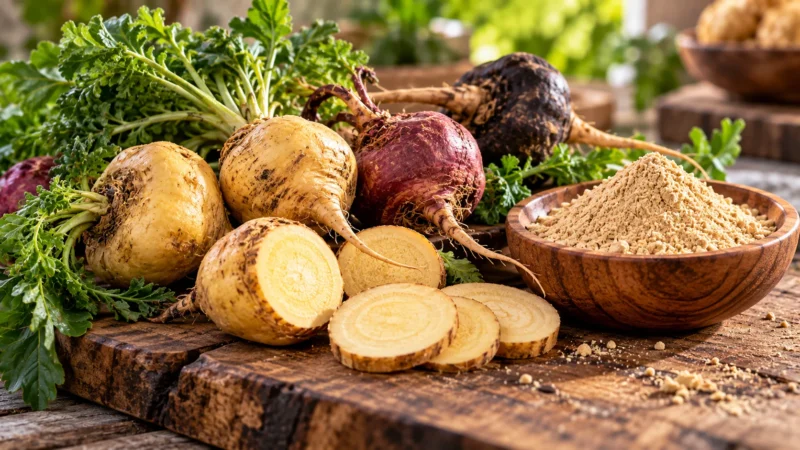
Maca (Lepidium meyenii) is a medicinal botanical commonly prepared from the edible hypocotyl/root-like storage organ and traditionally associated with food use, fertility traditions, libido and energy.
Traditional use, laboratory research and human clinical evidence should be distinguished rather than treated as equivalent.
Use this map to move through the concept in a clear order: meaning, mechanism, use, and wider context.
Maca (Lepidium meyenii) is a high-altitude Andean crop that is both food and herbal supplement. Its edible underground storage organ is dried, powdered and increasingly concentrated into extracts marketed for libido, fertility, energy and hormone balance. The food history is genuine, but it does not make every concentrated maca product clinically proven or equally appropriate for people with reproductive or endocrine concerns.
The edible hypocotyl, often described loosely as a root, is the main material used. Maca comes in different color varieties and can be consumed cooked, gelatinized, powdered or extracted. Processing changes starch content and concentration, so a spoonful of food powder is not identical to a concentrated capsule.
Maca contains macamides, sterols, polyphenols and other compounds that have attracted research interest. No single compound, however, explains all of the claims attached to the plant.
In the Andes, maca has a long history as food and as a traditional aid for stamina and fertility. Modern supplements emphasize sexual desire, testosterone, menopause, sperm quality and exercise energy.
Those claims should remain separate. An increase in self-reported sexual desire does not prove that testosterone increased, and an improvement in one semen parameter does not guarantee fertility or pregnancy.
Small human studies have explored sexual function, libido, mood, menopausal symptoms and semen quality. Some findings are positive, but sample sizes are generally modest and products vary.
One notable feature is that reported sexual effects do not consistently correspond with large changes in circulating testosterone. That makes simplistic “testosterone booster” marketing especially misleading.
Evidence for fertility is also preliminary. Fertility depends on many male and female factors, and maca should not delay evaluation when conception is difficult.
Maca is sold as food powder, gelatinized powder, capsules, liquid extracts and concentrated formulations. “Gelatinized” refers to processing that removes much of the starch; it does not mean the product contains gelatin.
Color varieties such as black, red and yellow maca are sometimes marketed for different outcomes, but human evidence is not strong enough to support many color-specific claims.
Maca is generally well tolerated as food and in short-term studies, but concentrated supplement safety is less established for pregnancy, breastfeeding and hormone-sensitive conditions.
Because maca is a cruciferous plant, people with significant thyroid disease sometimes ask about glucosinolate-related concerns. Ordinary food use is not automatically problematic, but concentrated products deserve individualized discussion when thyroid function is unstable or treatment is being adjusted.
Mayobook’s Are There Side Effects of Herbal Medicine? provides a broader framework for separating a food history from the safety of high-dose supplementation.
Well-characterized drug interactions are not a dominant feature of the maca literature, but absence of strong interaction data is not proof of zero risk. Combination sexual-health or energy products may contain stimulants, hormone-active ingredients or other botanicals with clearer interactions.
People using fertility medicines, hormone therapy or thyroid medicines should review concentrated products with a clinician if maca is being taken for a related goal.
Pregnancy and breastfeeding lack strong safety evidence for medicinal amounts. People being evaluated for infertility, hormone-sensitive conditions or significant thyroid disease should avoid using maca as a substitute for diagnosis.
Look for Lepidium meyenii, the form—food powder, gelatinized powder or extract—and the amount per serving. A reputable product should not need to promise guaranteed testosterone increases, pregnancy or permanent libido changes.
Maca is a legitimate Andean food with an interesting but still limited clinical literature around libido, sexual function and reproductive outcomes. Its most common marketing error is turning preliminary findings into hormone claims the studies did not demonstrate.
Readers comparing maca with other widely used botanicals can explore What Are the Most Popular Medicinal Herbs?. The best use of the evidence is specific: define the outcome, identify the preparation and avoid treating a traditional food as a guaranteed fertility or testosterone supplement.
For someone using maca for sexual concerns, it is also worth separating desire from performance and fertility. Those outcomes can be affected by stress, relationships, cardiovascular health, medicines and endocrine conditions. A supplement trial cannot substitute for identifying the actual problem, and a lack of benefit is not a reason to assume that a different color of maca will necessarily solve it.
Maca’s food history does provide useful context: it shows the plant can be part of ordinary diets, but it does not answer whether a concentrated extract produces a clinically important reproductive effect. Keeping those questions separate prevents familiar food use from being converted into a guarantee of medicinal benefit.
Maca contains multiple naturally occurring constituents whose concentrations vary with plant part and preparation.
A named constituent or laboratory mechanism does not by itself establish clinical effectiveness.
Evidence for one Maca preparation or outcome should not be generalized to every product or health claim.
Use these connected pages for the next step.

Maca should be evaluated by preparation, evidence quality and individual risk rather than broad natural-health claims.