
Defining element
Holy Basil contains multiple naturally occurring constituents whose concentrations vary with plant part and processing.
An evidence-aware reference to Holy Basil (Ocimum tenuiflorum) and its preparation and safety considerations.
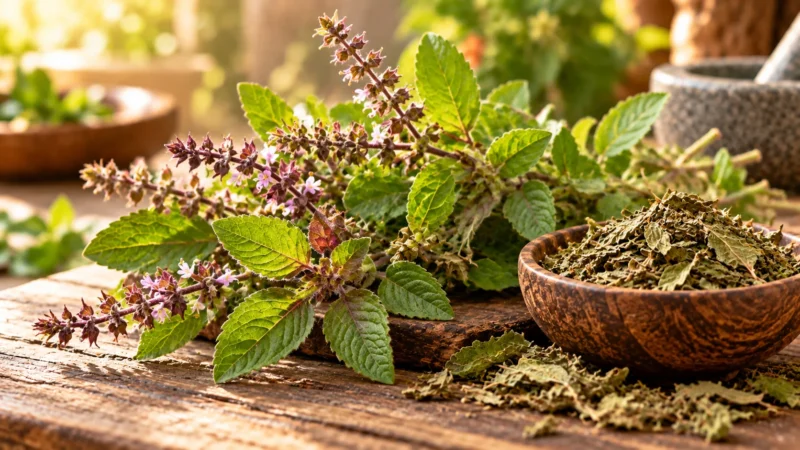
Holy Basil (Ocimum tenuiflorum) is a medicinal plant commonly prepared from leaves and flowering aerial parts and traditionally associated with stress resilience, respiratory comfort and metabolic wellness.
Traditional use, laboratory research and human clinical evidence should be distinguished rather than treated as equivalent.
Use this map to move through the concept in a clear order: meaning, mechanism, use, and wider context.
Holy basil, or tulsi (Ocimum tenuiflorum), is more than a commercial “adaptogen.” In South Asia it has religious, household and Ayurvedic significance, and several cultivars are grown for tea and traditional remedies. Modern supplement marketing often compresses that complex history into a promise of generalized stress protection. A better evaluation asks which outcome is being targeted, which tulsi preparation is used, and whether the evidence comes from people rather than from laboratory assays.
The leaves and flowering aerial parts are the principal medicinal material. Tulsi is related to culinary basil but is not the same species. Its volatile-oil profile can include eugenol and other aromatic compounds, while polyphenols contribute additional chemical diversity. Different cultivars and growing conditions can shift that profile.
Tea made from dried leaves is one of the gentlest forms. Capsules, tinctures and standardized extracts can be more concentrated. When a clinical study uses a defined extract, the result should not automatically be assigned to every tulsi tea or powder.
Ayurvedic traditions use tulsi in settings that include respiratory complaints, digestion, general vitality and resilience during stress. Modern products emphasize “adaptogenic” effects, mood, blood sugar and immunity.
The word adaptogen is broad. It does not tell a reader whether a product improves perceived stress, sleep, cortisol, exercise tolerance or something else. Translating the label into a measurable outcome is the first step toward evaluating the evidence.
Small human studies have investigated stress-related symptoms, metabolic measures and several other outcomes. Some report favorable changes, but the trials are generally modest in size and differ in extract, duration and participant population. The evidence is interesting without being strong enough to support claims that tulsi “balances” all stress hormones or prevents chronic disease.
Research on glucose-related outcomes is similarly preliminary. A change in fasting glucose in a small study is not the same as proving that holy basil treats diabetes or prevents its complications.
Laboratory antioxidant, antimicrobial and immune findings help explain scientific interest, but they do not establish that drinking tulsi tea treats an infection or meaningfully “boosts” immunity in a healthy person.
Tulsi is available as tea, dried leaf powder, tincture, liquid extract and capsules. Many products blend several tulsi cultivars; others combine holy basil with ashwagandha, mushrooms, rhodiola or stimulants. A blend should be evaluated as a blend, because both benefit and adverse effects may come from another ingredient.
Tea strength can vary with steeping time and leaf quantity, while extracts may concentrate selected compounds. Milligram numbers therefore cannot be compared meaningfully without knowing the form.
Holy basil is generally described as well tolerated in short-term use, but safety questions become more important with concentrated products. It may influence blood glucose, which can matter for people already using diabetes medicines. Preclinical and traditional concerns also raise questions about fertility and pregnancy.
Potential effects on platelet function mean bleeding risk deserves attention for people taking anticoagulant or antiplatelet medicines. Mayobook’s Are There Side Effects of Herbal Medicine? provides broader context for additive effects and why “natural” is not the same as interaction-free.
Glucose-lowering medicines are a practical interaction concern. If both the medicine and a concentrated tulsi product lower glucose, the combined effect may be greater than expected. Medicines that influence clotting deserve similar consideration if the product has antiplatelet activity.
People preparing for surgery should disclose holy basil along with all supplements. Stopping or continuing it should follow the surgical team’s plan rather than a generic online timetable.
Pregnancy, fertility treatment, bleeding disorders and complex diabetes management are situations where concentrated medicinal use should be reviewed professionally. Breastfeeding and routine pediatric supplementation also lack strong safety evidence.
Anyone who develops recurrent low-glucose symptoms, unusual bleeding, significant dizziness or an allergic reaction should stop the product and seek appropriate advice rather than simply reducing the dose on their own.
Look for Ocimum tenuiflorum or the accepted synonym Ocimum sanctum, the plant part and the form. Tea, powder and extract should be clearly distinguished. If the label says “adaptogen blend,” every ingredient and amount should be visible.
Quality claims are more useful when they describe identity, testing and extract specifications than when they promise “total hormone balance,” “immune supercharging” or drug-like glucose control.
Holy basil combines deep traditional significance with a small but growing clinical literature. Selected stress and metabolic findings are promising, but the evidence is not comprehensive. Its glucose, bleeding and pregnancy considerations also make concentrated products more consequential than a casual cup of tea.
Readers comparing tulsi with other widely used botanicals can explore What Are the Most Popular Medicinal Herbs?, while keeping tulsi’s own evidence separate. The most useful question is not whether holy basil is “an adaptogen,” but whether a defined preparation has evidence for the specific outcome a reader cares about and fits safely with that person’s medicines and health context.
This narrower approach preserves what is meaningful about the herb without reducing a complex traditional plant to a marketing category. It also makes it easier to stop an ineffective product instead of escalating the dose because an undefined promise of “balance” is impossible to measure.
Holy Basil contains multiple naturally occurring constituents whose concentrations vary with plant part and processing.
A constituent or laboratory mechanism does not by itself establish clinical effectiveness.
Evidence for one Holy Basil preparation or outcome should not be generalized to every product or health claim.
Use these connected pages for the next step.
Holy Basil should be evaluated by preparation, evidence quality and individual risk rather than broad natural-health claims.