
Defining element
Gotu Kola contains multiple naturally occurring constituents whose concentrations vary with plant part and processing.
An evidence-aware reference to Gotu Kola (Centella asiatica) and its preparation and safety considerations.
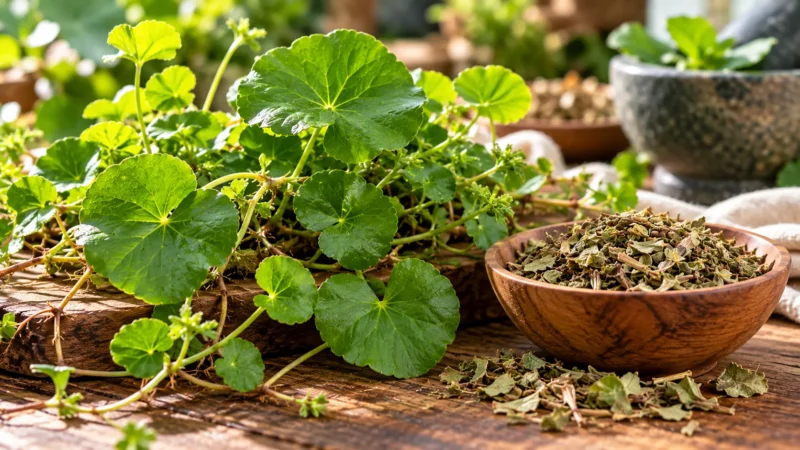
Gotu Kola (Centella asiatica) is a medicinal plant commonly prepared from leaves and aerial parts and traditionally associated with wound care, circulation and cognitive or calming uses.
Traditional use, laboratory research and human clinical evidence should be distinguished rather than treated as equivalent.
Use this map to move through the concept in a clear order: meaning, mechanism, use, and wider context.
Gotu kola (Centella asiatica) is a creeping wetland plant used in several Asian medical traditions. It is sometimes confused with kola nut because of the name, but the plants are unrelated and gotu kola does not naturally function as a caffeine stimulant. Modern interest ranges from wound-related products and venous circulation to memory and anxiety. Those uses involve different routes, preparations and evidence, making gotu kola a good example of why topical and oral claims should not be blended together.
The leaves and other aerial parts are the main medicinal material. Centella contains triterpenoid compounds, including asiaticoside-related constituents, that have been studied for effects on connective tissue and wound processes. Extract composition varies widely, and some topical products are standardized differently from oral supplements.
Because Centella asiatica is also eaten as a leafy herb in some cuisines, ordinary food exposure should be distinguished from concentrated medicinal extracts. A plant’s food history can be relevant to familiarity without establishing the safety of every high-dose supplement.
Traditional systems have used gotu kola for wounds, skin conditions, memory, mental clarity and general rejuvenation. Modern products emphasize scar care, venous circulation, cognition and calm. A topical scar cream and an oral cognition capsule are different interventions and should not borrow evidence from one another.
The “brain herb” reputation is especially vulnerable to overstatement. Supporting memory in a small study is not the same as preventing dementia, reversing cognitive decline or treating a neurologic disorder.
Centella extracts have been investigated for chronic venous insufficiency, wound healing and scar-related outcomes, with some studies reporting improvement in selected measures. Product standardization matters because many trials use specific triterpene fractions rather than generic leaf powder.
Research on cognition, anxiety and mood is less established. Small studies can suggest possible effects, but they do not justify broad claims that gotu kola enhances intelligence or protects the brain from neurodegenerative disease.
Topical research and oral research should be kept separate. A cream acting locally on skin does not establish the safety or effectiveness of swallowing a concentrated extract.
Gotu kola is sold as fresh or dried herb, tea, powders, tinctures, capsules and standardized extracts. Topical products may contain purified or standardized triterpene fractions. Oral supplement labels should identify the extract rather than presenting a topical evidence base as support for an unrelated capsule.
Combination “circulation” or “memory” formulas make attribution difficult because another ingredient may be responsible for the effect.
Oral products can cause gastrointestinal discomfort, headache or dizziness. Topical products can irritate sensitive skin. More importantly, rare cases of liver injury have been reported in association with oral gotu kola products, making unexplained jaundice, dark urine, severe fatigue or persistent upper-abdominal symptoms reasons to stop use and seek assessment.
Rare does not mean inevitable, but it does mean that a product promoted as a gentle “brain tonic” should not be treated as biologically inert. Mayobook’s Are There Side Effects of Herbal Medicine? gives additional context for interpreting uncommon but important reactions.
People taking medicines that can affect the liver should discuss oral gotu kola with a clinician because overlapping liver risk can complicate interpretation if symptoms or abnormal tests develop. Sedating effects are also sometimes reported, so combinations with other sedatives deserve caution.
Topical use has a different interaction profile, but damaged skin can change absorption and irritation risk. Product route should always be part of the safety discussion.
People with active liver disease or a history of supplement-related liver injury should avoid casual oral use. Pregnancy, breastfeeding and routine medicinal use in children lack strong safety data. Anyone using several potentially hepatotoxic medicines should obtain individualized advice.
Look for Centella asiatica, the plant part, route and extract information. A topical scar product should not be evaluated using the same standards as an oral cognition supplement. Standardized triterpene content can be useful when it matches the evidence being cited.
Claims to regrow brain cells, cure anxiety or reverse dementia exceed the available human evidence. Likewise, “natural scar remover” language should not imply that every scar can be eliminated.
Gotu kola has several distinct evidence streams: topical and connective-tissue research, venous-circulation studies and much smaller cognition-related literature. Keeping those streams separate makes the herb easier to understand and prevents a positive finding in one route from being used to sell another.
Readers comparing gotu kola with other medicinal botanicals can use What Are the Most Popular Medicinal Herbs? for discovery. The practical safety takeaway is to respect the difference between food, topical and concentrated oral use, and to take liver symptoms seriously even when they are uncommon.
Gotu Kola contains multiple naturally occurring constituents whose concentrations vary with plant part and processing.
A constituent or laboratory mechanism does not by itself establish clinical effectiveness.
Evidence for one Gotu Kola preparation or outcome should not be generalized to every product or health claim.
Use these connected pages for the next step.
Gotu Kola should be evaluated by preparation, evidence quality and individual risk rather than broad natural-health claims.