
Berberine
Berberine
What goldenseal evidence can support, why berberine research is not interchangeable with the whole herb, and where interactions and safety matter most
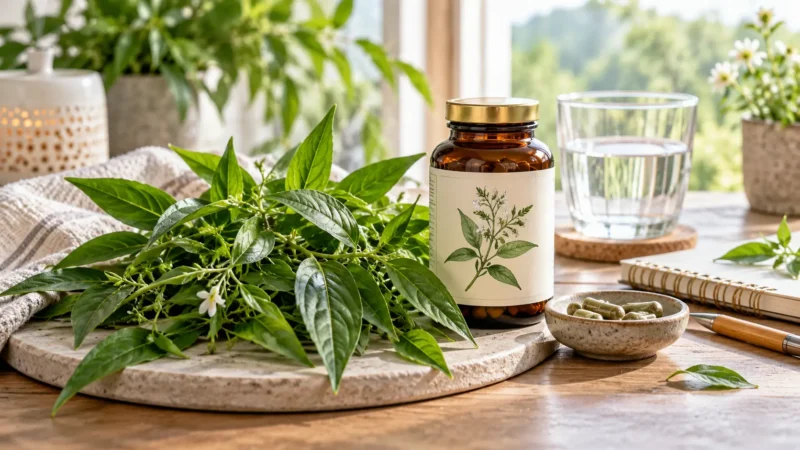
Goldenseal is a North American medicinal herb containing alkaloids such as berberine and hydrastine. Laboratory findings and constituent research have generated antimicrobial claims, but rigorous human studies have not established goldenseal as an effective treatment for a specific health condition.
Goldenseal is often marketed for colds, infections, digestive complaints, and immune support, but popular use is not the same as demonstrated benefit. Its medication-interaction potential is clinically relevant, and evidence from isolated berberine should not be substituted for evidence on whole-herb goldenseal.
Use this map to move through the concept in a clear order: meaning, mechanism, use, and wider context.
Goldenseal has a powerful reputation in herbal medicine, especially for colds, digestive complaints, and infections, but its reputation is much stronger than the human evidence. The most important fact for readers is simple: rigorous clinical studies have not established goldenseal as an effective treatment for any specific health condition. Laboratory findings and research on one of its major constituents, berberine, are often used to support much broader claims than the evidence allows.
Goldenseal (Hydrastis canadensis) is a North American herb traditionally used for a variety of purposes and now commonly sold in capsules, tinctures, combination products, and extracts. Modern marketing often frames it as an antimicrobial or immune-support herb. According to the National Center for Complementary and Integrative Health, however, there is not enough evidence to determine whether goldenseal is useful for any health condition, and rigorous human trials are lacking.
That does not mean every biological claim is meaningless. Goldenseal contains alkaloids that show measurable activity in laboratory systems. What it means is that a laboratory signal should not be converted into a clinical promise. A substance can inhibit microbes in a test tube and still fail to reach an effective concentration in human tissues, fail to improve symptoms, or create safety problems at the doses required.
Berberine is one of the best-known constituents of goldenseal, and it has been studied separately for metabolic, gastrointestinal, antimicrobial, and other outcomes. This often creates an evidence shortcut: a study of isolated berberine is cited as though it proves that whole-herb goldenseal produces the same effect.
That inference is unreliable. Goldenseal is a complex botanical product containing several alkaloids and other constituents. The amount of berberine in a goldenseal product can vary, and oral absorption of berberine from goldenseal may be limited. NCCIH specifically notes that results from berberine studies may not apply to goldenseal.
The distinction matters because readers often encounter statements such as “goldenseal kills bacteria because berberine is antimicrobial.” That sentence skips several steps: the product must contain a relevant amount of the active constituent, the constituent must be absorbed or reach the target site, the exposure must be safe, and the intervention must improve a meaningful human outcome. Without those steps, constituent evidence remains supportive background rather than proof of clinical efficacy.
Laboratory research has examined goldenseal extracts and isolated alkaloids against different microorganisms. These studies can identify antimicrobial mechanisms or potential leads for future drug development. They cannot establish that an oral goldenseal supplement can clear a bacterial infection in a person.
A critical review of goldenseal and its constituents concluded that stronger randomized, double-blind clinical studies are needed to establish efficacy and safety. That gap is central to responsible interpretation. The evidence hierarchy looks very different depending on the question:
| Evidence level | What it can show | What it cannot prove |
|---|---|---|
| Laboratory studies | Whether extracts or constituents affect microorganisms under controlled conditions | That an oral supplement cures infection in humans |
| Pharmacology studies | How constituents may influence enzymes, transporters, or drug exposure | That goldenseal improves a disease outcome |
| Human clinical trials | Whether people actually experience benefit or harm | Nothing meaningful if good trials have not been done |
For bacterial infections that require treatment, prescription antibiotics are chosen because they have evidence for specific organisms, sites of infection, dosing, tissue exposure, and clinical outcomes. Goldenseal does not have an equivalent evidence base.
Goldenseal is promoted for colds, respiratory complaints, diarrhea, digestive symptoms, skin problems, and “immune support.” Those uses reflect traditional practice and modern supplement marketing more than established clinical benefit.
A useful way to judge a claim is to ask what was actually studied. Was the research on whole goldenseal, an isolated constituent, a cell culture, an animal model, or a human trial? Was the outcome laboratory inhibition, symptom relief, disease resolution, or prevention? Those details determine how far a conclusion can reasonably go.
The interaction profile is one of the strongest reasons to approach concentrated goldenseal supplements cautiously. Human studies have shown that goldenseal can influence drug-metabolizing enzymes, including CYP3A and CYP2D6, and can affect transport pathways involved in medication exposure.
NCCIH highlights clinically relevant interaction concerns and advises people who take medicines to discuss goldenseal with a health professional. One clinical study found a reduction in metformin exposure when healthy adults received goldenseal with metformin. Later research suggests the magnitude of that interaction may depend on the metformin dose and patient context, which is another reason not to reduce the issue to a simple “safe” or “unsafe” label.
The practical lesson is broader than any single drug. If a person uses prescription medicine, especially a medicine where changes in blood level could matter, goldenseal should be reviewed with a pharmacist or clinician before use. A supplement can change drug exposure even when it does not cause an immediate symptom.
Goldenseal should not be treated as a routine pregnancy or breastfeeding supplement. NCCIH advises against use during pregnancy and breastfeeding, and it should not be given to infants. Berberine exposure is a particular concern in newborns because of the potential for serious bilirubin-related complications.
Long-term safety is also uncertain. Small short-term studies have not identified major problems at some studied doses, but that does not establish safety for prolonged use. Product quality adds another layer of uncertainty: investigations have found commercial products containing ingredients that were not listed accurately or that did not contain the expected amount of goldenseal.
People with chronic illness, those taking several medicines, and anyone considering concentrated or prolonged use should therefore avoid assuming that “natural” means low-risk.
Goldenseal is not an evidence-based substitute for antibiotics when a bacterial infection requires antibiotic treatment. Delaying diagnosis can allow infections to worsen or spread, and symptoms alone cannot always distinguish a self-limited illness from one that needs targeted care.
Seek prompt medical assessment for severe or rapidly worsening symptoms, difficulty breathing, chest pain, confusion, severe dehydration, persistent high fever, spreading redness or swelling, severe localized pain, or symptoms that improve and then deteriorate again. People who are pregnant, immunocompromised, very young, frail, or living with serious chronic disease may need a lower threshold for evaluation.
Herbal research can still be useful. It can help identify compounds and mechanisms worth studying. But until clinical evidence shows that a preparation is safe and effective for a specific infection, that research should not be presented as a treatment equivalent.
If someone is considering goldenseal despite the evidence limitations, the safest approach is to focus on the exact product and personal risk factors rather than the herb’s reputation. Check the ingredient list, avoid combination products with unclear amounts, verify whether the manufacturer provides quality information, and review medications before use.
For broader context on how laboratory antimicrobial findings differ from clinical infection treatment, see Mayobook’s Herbal Antibiotics resource and the Herbal Medicine topic hub.
Goldenseal is a good example of why evidence boundaries matter in herbal medicine. It contains biologically active compounds and has a long history of use, yet rigorous human evidence has not established that the whole herb treats infection or another health condition. At the same time, its interaction potential and pregnancy and infant cautions are meaningful. The most responsible position is therefore neither to dismiss the herb entirely nor to treat laboratory antimicrobial activity as clinical proof.
Berberine
Hydrastine
Canadine
Goldenseal is not equivalent to berberine. A finding from isolated berberine or a laboratory extract does not automatically establish that an oral goldenseal product reaches the same exposure, produces the same effect, or safely treats infection in humans.
Use these connected pages for the next step.
Goldenseal has real pharmacologic activity, but that is not the same as proven clinical benefit. Its most responsible use in evidence-based herbal discussion is as a case study in separating laboratory findings and constituent research from whole-herb outcomes, while taking interaction and reproductive-safety concerns seriously.