
Defining element
Eleuthero contains multiple naturally occurring constituents whose concentrations vary with plant part and preparation.
An evidence-aware reference to Eleuthero (Eleutherococcus senticosus) and its preparation and safety considerations.
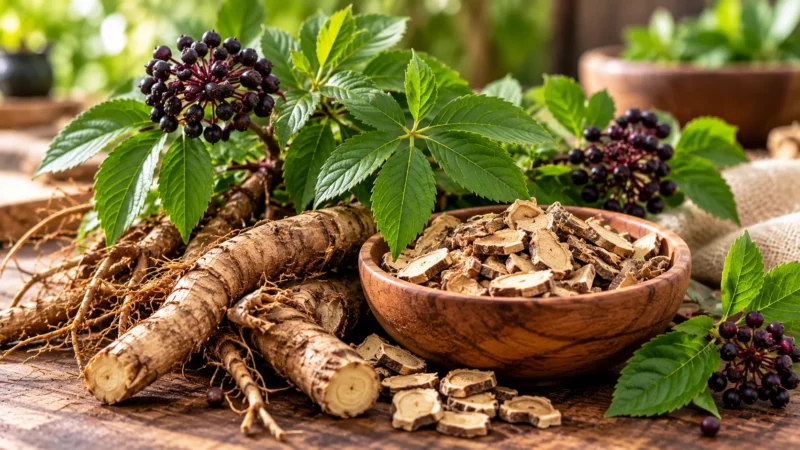
Eleuthero (Eleutherococcus senticosus) is a medicinal botanical commonly prepared from root and root extracts and traditionally associated with fatigue, stamina and stress adaptation.
Traditional use, laboratory research and human clinical evidence should be distinguished rather than treated as equivalent.
Use this map to move through the concept in a clear order: meaning, mechanism, use, and wider context.
Eleuthero (Eleutherococcus senticosus) was once widely marketed as “Siberian ginseng,” even though it is not true ginseng and does not belong to the genus Panax. That naming history still creates confusion. Eleuthero has its own traditional use and chemistry, and evidence from Korean, Asian or American ginseng should not be transferred to it simply because the word “ginseng” appeared on older labels.
The root is the principal medicinal material. Extracts may be standardized to eleutherosides, a group of compounds used as chemical markers rather than proof of a specific clinical effect. The plant grows in northeastern Asia and has been used traditionally for fatigue, endurance and recovery from stress.
A precise label should state Eleutherococcus senticosus clearly and avoid implying equivalence with Panax ginseng.
Eleuthero is commonly classified as an adaptogen and promoted for energy, stamina, immune support and resilience under physical or mental stress. Those broad categories can hide the fact that different trials measure different outcomes.
A claim about reduced fatigue is not the same as improved athletic performance. A laboratory immune effect is not the same as fewer infections. Each claim requires its own evidence.
Human studies have explored fatigue, exercise performance, cognition and immune-related outcomes. Results are mixed, and many studies are small, older or methodologically limited. Some suggest benefit in selected contexts, but there is no strong basis for assuming that eleuthero reliably increases energy in healthy adults.
The “adaptogen” concept itself should not substitute for an outcome. If a person wants more stamina, the relevant question is whether a defined extract improves measurable performance or fatigue compared with placebo—not whether a product claims to help the body “adapt.”
Persistent fatigue can result from anemia, sleep disorders, infection, thyroid disease, depression or medicine effects. Eleuthero does not rule out those causes.
Root is sold as tincture, dried powder, tea and standardized extract. Extracts may list an eleutheroside content, but standardization mainly helps identify consistency; it does not prove effectiveness.
Energy blends may combine eleuthero with caffeine, rhodiola, ginseng or other stimulatory ingredients. Those products can affect sleep or blood pressure in ways that eleuthero alone might not.
Reported adverse effects can include insomnia, headache, nervousness or changes in blood pressure. The risk of sleep disruption is especially relevant when the herb is taken late in the day or combined with stimulants.
Product identity has historically been a concern in this category, making reputable sourcing important. Mayobook’s Are There Side Effects of Herbal Medicine? offers broader guidance on why labeling and product quality matter in addition to the herb itself.
People taking blood-pressure medicines, glucose-lowering medicines, stimulants or medicines sensitive to changes in alertness should discuss concentrated use with a clinician. Interaction evidence is not complete enough to produce a universal list.
Because eleuthero is often included in multi-ingredient energy products, the full formula should be reviewed rather than focusing on the herb name alone.
People with poorly controlled hypertension, significant arrhythmias, severe insomnia or stimulant sensitivity should be cautious with concentrated or blended products. Pregnancy, breastfeeding and routine medicinal use in children lack strong safety evidence.
Look for Eleutherococcus senticosus, root as the plant part, and clear extract information. A label using only “Siberian ginseng” is less precise and can encourage mistaken comparisons with true ginseng.
Claims that the product guarantees energy, boosts immunity against infection or replaces sleep and recovery are not supported by strong evidence.
Eleuthero is a distinct medicinal root with a long “adaptogen” history, not a form of true ginseng. Human evidence for fatigue and performance is mixed, and product identity plus stimulant combinations are practical considerations.
Readers comparing eleuthero with other medicinal plants can explore What Are the Most Popular Medicinal Herbs?. The most useful question is whether a specific, well-identified extract helps a clearly defined problem without worsening sleep, blood pressure or medication interactions.
Energy is also an outcome that can be distorted by stimulant combinations. If an “adaptogen” blend feels powerful because it contains caffeine or another stimulating ingredient, that response should not be attributed automatically to eleuthero. Reading the entire ingredient panel is therefore part of interpreting both benefit and side effects.
A practical trial should also have a stopping rule. If energy, fatigue or exercise tolerance does not meaningfully change, increasing the dose may simply worsen insomnia or nervousness. Persistent unexplained fatigue deserves assessment rather than repeated escalation of stimulating supplements.
Eleuthero contains multiple naturally occurring constituents whose concentrations vary with plant part and preparation.
A named constituent or laboratory mechanism does not by itself establish clinical effectiveness.
Evidence for one Eleuthero preparation or outcome should not be generalized to every product or health claim.
Use these connected pages for the next step.
Eleuthero should be evaluated by preparation, evidence quality and individual risk rather than broad natural-health claims.