
Defining element
Burdock Root contains multiple naturally occurring constituents whose concentrations vary with plant part and processing.
An evidence-aware reference to Burdock Root (Arctium lappa) and its preparation and safety considerations.
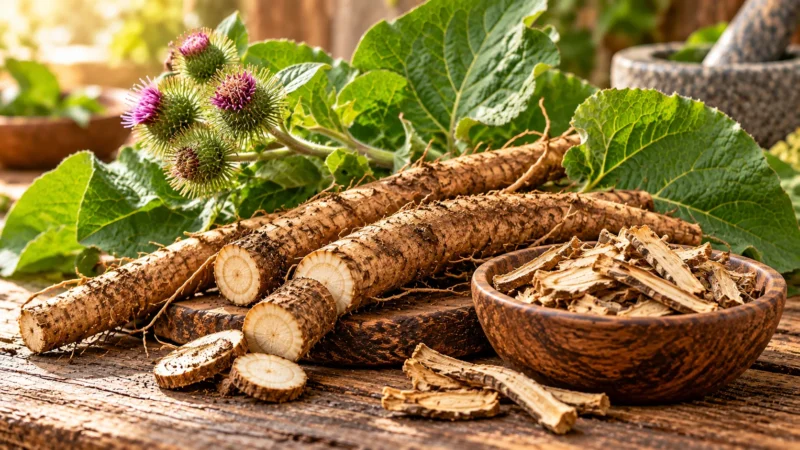
Burdock Root (Arctium lappa) is a medicinal plant commonly prepared from root and traditionally associated with digestive, skin and general tonic uses.
Traditional use, laboratory research and human clinical evidence should be distinguished rather than treated as equivalent.
Use this map to move through the concept in a clear order: meaning, mechanism, use, and wider context.
Burdock root (Arctium lappa) is both food and medicine in parts of Asia and Europe. That dual identity is important because ordinary culinary use is not the same as taking a concentrated supplement marketed for “detox,” skin health or blood purification. Burdock’s reputation is much broader than its human clinical evidence, so a useful reference has to separate traditional practice, food use and modern therapeutic claims.
The root is the main part used in food and herbal preparations. It contains inulin-type fibers, polyphenols and other plant compounds, while the seed and leaf have separate traditional uses. A product that says only “burdock” should identify the plant part because the chemistry and intended use can differ substantially.
Fresh root is cooked as a vegetable in some cuisines. Dried root appears in teas, tinctures and capsules. A concentrated extract should not borrow its safety assumptions automatically from food use.
Traditional herbal systems have used burdock for digestive complaints, skin problems and as a general “alterative” or cleansing herb. Modern marketing often translates that history into claims about detoxification, lymphatic drainage, acne, inflammation or blood sugar.
The language of “cleansing the blood” is historical rather than a modern physiological description. The kidneys and liver perform the body’s main waste-processing functions, and burdock has not been shown to replace or meaningfully enhance those organs in a general healthy population.
Human clinical evidence is limited. Laboratory studies report antioxidant, anti-inflammatory and antimicrobial activity, but those findings do not establish that burdock treats skin disease, infection or metabolic disorders in people.
A small amount of clinical research has explored topical or combined herbal products for selected skin or inflammatory outcomes, yet the contribution of burdock itself is difficult to isolate. Food history and preclinical data make the plant scientifically interesting without providing strong support for broad therapeutic claims.
For readers, the practical conclusion is modest: burdock may be a nutritious food and a traditional herbal ingredient, but claims of systemic detoxification or disease treatment are not supported by a robust body of human trials.
Fresh root can be eaten as food. Dried slices may be simmered as a decoction. Tinctures and capsules provide more concentrated or convenient forms. Extract strength varies, and combination “detox” formulas may contain dandelion, yellow dock, milk thistle or laxative herbs that change both the intended effect and safety profile.
Because burdock resembles some other plants when harvested, correct botanical identification and sourcing are especially important in wildcrafted products.
Burdock can cause allergic reactions in people sensitive to related plants in the daisy family. Concentrated preparations may also affect blood glucose or fluid balance in ways that matter for some medicine users.
Contamination and substitution are practical concerns. Herbal products have historically been reported to contain unintended species, and root products gathered from uncertain sources deserve extra scrutiny. Mayobook’s Are There Side Effects of Herbal Medicine? provides a broader framework for understanding why botanical identity and product quality are part of safety.
People taking diabetes medicines should be cautious with concentrated burdock because additive glucose-lowering effects are possible even though the clinical interaction evidence is limited. Products marketed as diuretic or “water-clearing” blends can also complicate medicines that affect fluid balance or blood pressure.
Medication users should have the entire formula reviewed rather than assuming that every ingredient in a traditional cleansing blend is mild.
Pregnancy and breastfeeding lack strong medicinal-use safety data. People with significant plant allergies, diabetes treated with medication, kidney disease or complex diuretic regimens should obtain individualized guidance before concentrated use.
Persistent skin lesions, unexplained swelling, severe digestive symptoms or signs of infection deserve medical evaluation rather than repeated “detox” treatment.
Look for Arctium lappa, root as the plant part, and a clear statement of whether the product is food, tea, tincture or extract. Products should have traceable sourcing and should not rely on vague “blood purifier” or “toxin remover” language as proof of effectiveness.
Combination formulas should disclose every ingredient and amount. If a product contains laxatives, diuretics or multiple glucose-lowering herbs, its safety profile is no longer the same as burdock root alone.
Burdock root has a legitimate food tradition and a long herbal history, but strong human evidence for detoxification, acne treatment or broad metabolic benefits is lacking. The most useful distinctions are food versus extract, root versus other plant parts, and traditional rationale versus demonstrated clinical outcome.
Readers comparing burdock with other popular botanicals can explore What Are the Most Popular Medicinal Herbs? while keeping its food-based context in view. A product does not become more evidence-based because it uses stronger “cleanse” language.
Burdock is also a useful reminder that a food tradition and a supplement claim answer different questions. Eating cooked root as part of a meal provides fiber and nutrients in a familiar dietary context; taking an extract specifically to lower glucose, “cleanse” the liver or treat acne is a therapeutic claim that needs direct evidence. When those categories are blurred, a long food history can be used to imply effectiveness that has never been demonstrated.
For readers considering burdock for skin concerns, the appearance of a rash, boil or persistent lesion matters more than the popularity of a detox formula. Acne, eczema, infection and inflammatory conditions have different causes and treatments. A delayed diagnosis cannot be corrected by choosing a stronger tea or extract.
Burdock Root contains multiple naturally occurring constituents whose concentrations vary with plant part and processing.
A constituent or laboratory mechanism does not by itself establish clinical effectiveness.
Evidence for one Burdock Root preparation or outcome should not be generalized to every product or health claim.
Use these connected pages for the next step.
Burdock Root should be evaluated by preparation, evidence quality and individual risk rather than broad natural-health claims.