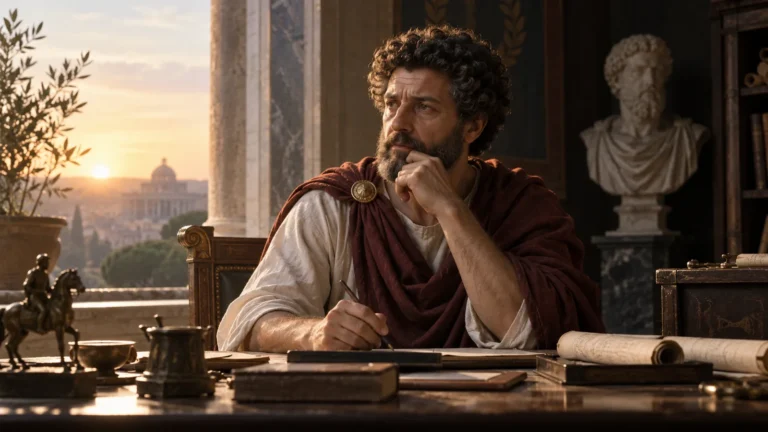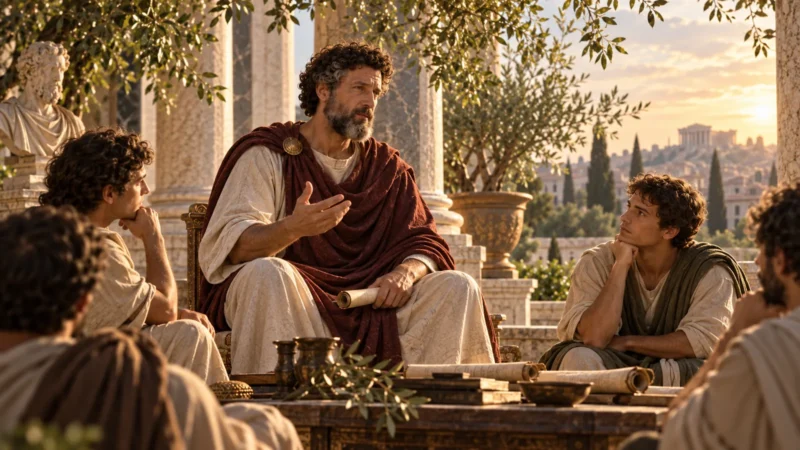
His strongest immediate influence was Epictetus, whose teachings reached him through Junius Rusticus. But Marcus belongs to a longer tradition stretching back through Roman and Greek Stoics to Zeno, Cleanthes, and Chrysippus.
Judgment: The Mind’s Role in Disturbance and Freedom
Stoicism distinguishes an initial impression from the judgment we add to it. Someone insults you. That is the event. “I have been diminished and must retaliate” is an interpretation. A plan fails. That is the event. “My life is ruined” is another claim.
Marcus repeatedly tells himself to examine appearances before assenting to them. This is not denial. An injustice should still be called unjust; illness should not be imagined away. The discipline is to distinguish what happened from the value judgment that may be amplifying it.
Freedom, in this sense, is not control over the world. It is greater ownership of the judgments and actions through which you meet it.
Virtue Is the Good; Externals Are Not the Measure of a Life
Stoic ethics places wisdom, courage, justice, and temperance at the center of the good life. Health, money, influence, comfort, friendship, and reputation can be naturally preferred, but they are not enough to make someone morally good.
This distinction explains Marcus’s suspicion of praise and status. As emperor, he possessed the very externals people commonly confuse with success. Stoicism asks what he does with them.
| Category | Examples | Stoic significance |
|---|---|---|
| Virtue | Wisdom, courage, justice, temperance | The moral good |
| Preferred externals | Health, friendship, sufficient resources, useful reputation | Reasonably selectable but not moral worth |
| Dispreferred externals | Illness, pain, poverty, obscurity | Reasonably avoidable when possible, but not moral evil |
Living According to Nature
“Nature” in Stoicism does not mean retreating to forests, eating a particular diet, or following impulse. It refers to the rational order of the cosmos and to the nature of human beings as rational, social creatures.
For Marcus, living according to nature means seeing change as normal, using reason rather than appetite as the governing faculty, and performing social roles responsibly. Human function is not isolated self-preservation; it includes cooperation.
Humans Are Made for Cooperation
Marcus repeatedly returns to the idea that humans are made to work together. This makes justice central, not optional. A calm person who exploits others is not a Stoic success. A disciplined leader who lies for personal advantage has failed the ethical test even if the strategy works.
The social dimension also shapes his approach to difficult people. Wrongdoing should be understood as error about good and bad, but understanding does not remove accountability. Justice can require correction, boundaries, and consequences.
The Cosmopolitan Horizon
Stoicism develops a cosmopolitan idea: human beings participate in a shared rational community larger than family, city, or empire. Marcus’s language about common nature and common good belongs to this tradition.
This does not erase specific roles. A parent has duties that differ from a stranger’s. A ruler has responsibilities that differ from a private citizen’s. The wider human community provides the ethical horizon within which those roles are judged.
Fate, Change, and Consent to Reality
Marcus treats events as part of a larger causal order. Once something has occurred, insisting that it should not have occurred cannot reverse it. Stoic acceptance begins with factual non-resistance: this is now part of reality.
That is not the same as moral approval. An injustice can be accepted as a fact and opposed as an injustice. A mistake can be acknowledged and repaired. Fate does not cancel agency; it defines the material upon which agency now works.
The later phrase amor fati should not be presented as a Marcus Aurelius quotation. It captures a family resemblance to his acceptance of reality, but the wording belongs to a different history.
Mortality, Fame, and the Shortness of Human Perspective
Death appears constantly in Meditations. Marcus observes that emperors, critics, admirers, and entire generations disappear. The point is not nihilism. Mortality is used to test value.
If praise and the people giving it are temporary, why sacrifice justice for fame? If time is finite, why postpone every meaningful action? The View From Above performs similar work by changing spatial and temporal scale until ego regains proportion.
Stoic Emotion Is About Judgment, Not Becoming a Stone
The stereotype of the emotionless Stoic misses ancient theory. Stoics distinguish first reactions from passions sustained by mistaken judgments. They also recognize healthy rational affective states.
Marcus does not write like a man who feels nothing. He writes because anger, fear, fatigue, desire, disappointment, and grief keep requiring philosophical work. The goal is not less humanity; it is less automatic surrender to judgments that have not been examined.
The Dichotomy of Control Is an Epictetan Inheritance
The formal language of what is and is not “up to us” is associated especially with Epictetus. Marcus repeatedly practices the principle even when he does not state it as a slogan. Other people’s opinions, bodily events, and external outcomes cannot be commanded in the same way as one’s own aims and choices.
Modern readers often expand this into three practical zones: direct agency, influence, and external outcome. That can be useful so long as the Stoic distinction remains clear: influence is not control.
Philosophy as Rehearsal, Correction, and Daily Work
Meditations is philosophy in rehearsal. Marcus prepares for difficult people, argues himself out of bed, reminds himself of death, attacks his attachment to praise, and repeatedly returns to social duty.
The repetition shows imperfection. If a lesson had been permanently mastered, it would not need to be written again. The notebook therefore preserves something more useful than a flawless sage: a practitioner returning to principles after distraction.
The Four Virtues Work Together
Wisdom without justice can become clever self-interest. Courage without wisdom can become recklessness. Temperance without justice can become private purity while others bear harm. Justice without courage may remain only an intention.
For Marcus, ethics is integrated. A hard decision is not solved by asking whether it shows discipline. It must also be true, fair, proportionate, and brave enough to be enacted.
What Marcus’s Philosophy Cannot Prove About His Reign
Private ethical aspiration should not be treated as proof that every public policy was virtuous. Marcus ruled an empire through war and hierarchy. Christians were persecuted in some regions during his reign, though his direct involvement in particular episodes is debated. His choice of Commodus as successor remains historically consequential.
The gap between principle and record is not a reason to dismiss Meditations. It is a reason to read it honestly. Philosophy can guide a person without guaranteeing infallible judgment.
For the wider practical framework behind Marcus Aurelius’s philosophy, read Think Like Marcus Aurelius. For adjacent material on habits, resilience, relationships, leadership, and practical life mastery, explore Mayobook’s Self-Help, Habits & Life Mastery topic hub.
The Philosophy Is a Way of Choosing, Not a Collection of Quotes
Marcus Aurelius’s philosophy can be summarized as disciplined moral agency inside a world that cannot be commanded: examine judgments, prefer virtue over status, accept reality without surrendering responsibility, remember mortality, cooperate with other people, and keep returning to the next action that wisdom, courage, justice, and temperance require.
Read that way, Stoicism becomes less about looking unbothered and more about choosing well when being bothered is unavoidable.