Who Was Marcus Aurelius?
Marcus Aurelius Antoninus was born in Rome in 121 and became Roman emperor in 161. He shared imperial power initially with Lucius Verus and later elevated his son Commodus as co-emperor. Marcus belonged to the Stoic philosophical tradition and studied the teachings of earlier Stoics, especially Epictetus. He died in 180 while the empire was still engaged in major northern wars.
He is often grouped among the so-called “Five Good Emperors,” a later historical label that celebrates the relative stability of the dynasty from Nerva through Marcus. The label is useful as shorthand but can hide controversy, imperial violence, and the disastrous reputation of Marcus’s successor.
A Roman Aristocrat Raised for Responsibility
Marcus was born Marcus Annius Verus into a wealthy senatorial family. His father died while Marcus was young, and relatives played a large role in his upbringing. Ancient biographical sources describe an unusually serious child favored by the emperor Hadrian, though anecdotes from later sources require caution.
What is certain is that Marcus received the elite education expected of a future Roman statesman: literature, rhetoric, law, public speaking, and philosophy. He was not raised outside politics and later pulled into power accidentally. His formation increasingly prepared him for imperial responsibility.
How Hadrian’s Succession Plan Made Marcus an Heir
The succession was determined by a chain of adoption. In 138, the aging Hadrian adopted Antoninus Pius on the condition that Antoninus adopt Marcus and Lucius Verus. Hadrian died that year, and Antoninus became emperor.
Marcus was therefore brought formally into the imperial family and positioned as a future ruler. Over Antoninus’s long reign he received titles, public responsibilities, and dynastic visibility. The process lasted decades, giving Marcus far more preparation than emperors who reached power through sudden military crisis.
Teachers, Fronto, Rusticus, and the Turn Toward Stoicism
Marcus’s education left an unusually personal record. His correspondence with Marcus Cornelius Fronto reveals an affectionate relationship with one of the leading rhetoricians of the age. Fronto trained him in Latin eloquence and the demands of public speech.
Philosophy gradually became more central. In Book 1 of Meditations, Marcus credits Junius Rusticus with moral seriousness and with giving him access to the teachings of Epictetus. He also praises Apollonius, Sextus, and other teachers for steadiness, kindness, simplicity, and philosophical conduct.
Marcus did not invent Stoicism. He became a practitioner inside a school already centuries old.
Marriage, Children, and the Imperial Household
In 145 Marcus married Faustina the Younger, daughter of Antoninus Pius. Their marriage was dynastically important and produced numerous children, many of whom died young—a reminder of the mortality conditions of the ancient world even for imperial families.
Among the surviving children were Lucilla and Commodus. Later gossip about Faustina in ancient sources should be treated carefully because imperial women were frequent targets of moralized rumor. The historically important point is that the marriage linked Marcus’s household directly to succession and produced a surviving male heir.
Accession in 161 and Co-Rule With Lucius Verus
Antoninus Pius died in 161. Marcus became emperor and shared the title of Augustus with Lucius Verus. Ancient accounts often emphasize Marcus’s seniority, but Lucius was formally co-emperor.
The new reign immediately faced major external pressure. War with the Parthian Empire demanded extensive eastern campaigns. Lucius Verus traveled east while generals conducted much of the military work. Rome eventually prevailed, but soldiers returning west were linked in ancient accounts to the spread of the epidemic now called the Antonine Plague.
Plague, War, and the Burden of Empire
The Antonine Plague became one of the defining crises of the reign. Its exact pathogen is uncertain, though smallpox is a leading hypothesis. Whatever the diagnosis, epidemic disease placed additional strain on military recruitment, population, administration, and finance.
Soon the northern frontier became the dominant problem. The Marcomannic Wars involved the Marcomanni, Quadi, Sarmatian groups, and others beyond the Danube. Invaders at times penetrated Roman territory deeply enough to threaten northern Italy.
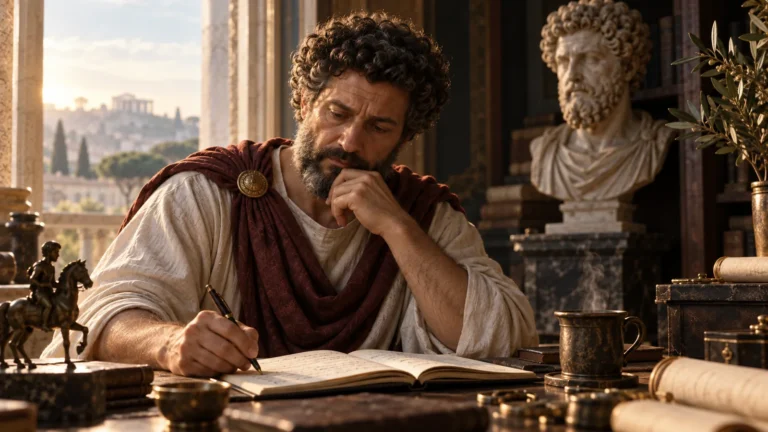
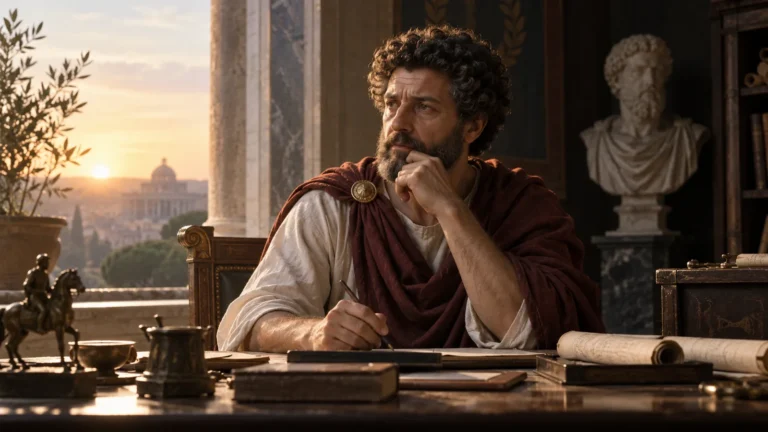
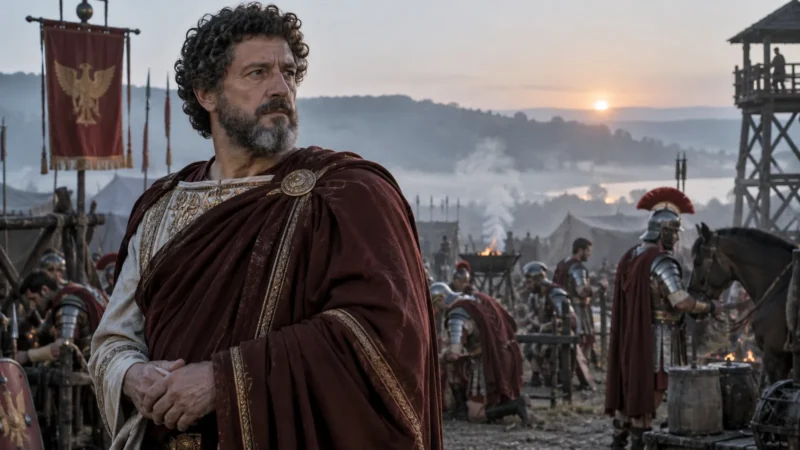
Marcus spent years near the frontier overseeing campaigns, diplomacy, recruitment, and imperial administration. The image of a philosopher writing peacefully in Rome therefore fits only part of his life.
Lucius Verus Dies and Marcus Rules Alone
Lucius Verus died in 169. Marcus became the sole senior emperor and carried the northern war effort forward. Roman forces gradually recovered strategic initiative, but the conflict remained prolonged and costly.
Marcus’s reign was not simply a story of military victory. It was one of repeated adaptation under pressure, with disease, finance, manpower, and frontier strategy interacting.
The Revolt of Avidius Cassius
In 175, the eastern commander Avidius Cassius was proclaimed emperor. Ancient sources connect the revolt with a false or premature report that Marcus had died, though details remain uncertain. Cassius was killed within months, and the conflict ended before developing into a long civil war.
The episode exposed a permanent truth of Roman imperial politics: even a respected emperor’s authority depended on military and elite loyalty that could fracture.
Meditations Was Written Inside This Life, Not Outside It
Meditations appears to have been composed substantially in the later reign. Internal headings associate portions with places connected to the northern campaigns, including Carnuntum and territory among the Quadi. Exact dating of individual entries is impossible.
The context nevertheless changes the reading. Marcus’s reminders about death, difficult people, exhaustion, work, reputation, bodily vulnerability, and present action were written by a man managing real political and military responsibilities.
The work was private. It was not designed as a polished manual for later readers, which helps explain its repetition and abrupt changes of subject.
Commodus and the Decision That Shadows His Legacy
Marcus’s surviving son Commodus was prepared for succession from childhood and became co-emperor in 177. This was not the fictional crisis shown in Gladiator, where Marcus plans to bypass Commodus for Maximus.
The real historical problem is harder. Marcus had a biological son with a strong dynastic claim, and excluding him could have created legitimacy and civil-war risks. Yet Commodus’s later reign became so controversial that the choice appears, in hindsight, as one of Marcus’s greatest failures of judgment.
Both sides belong in the biography: the constraints and the consequences.
Death in 180 and the End of a Reign
Marcus died in March 180 while the imperial court was operating in the northern campaigning region. Ancient traditions differ over the precise location, and the exact cause of death is not securely known.
Commodus succeeded him without a contested transfer of power and soon pursued a different course in the northern war. Marcus’s death therefore ended not only a reign but a particular strategy at the frontier.
How an Emperor Became a Modern Stoic Icon
Ancient historians already contrasted Marcus’s reputation with Commodus’s. But Marcus’s modern fame depends above all on Meditations. The work survived manuscript transmission and gradually became one of the most widely read texts associated with Stoicism.
In the modern revival of Stoic philosophy, Marcus is often transformed into a symbol of discipline, resilience, emotional control, and leadership. Popular culture, especially Gladiator, has further simplified the image.
The historical Marcus is more complicated and more useful: a privileged Roman ruler with enormous power, a serious philosophical practitioner who repeatedly needed correction, a wartime emperor, a husband and father, and a man whose private ethical aspirations did not exempt his public choices from scrutiny.
For the broader practical framework connecting this biography to Marcus Aurelius’s Stoic ethics, read Think Like Marcus Aurelius. For adjacent material on habits, resilience, leadership, and practical life mastery, explore Mayobook’s Self-Help, Habits & Life Mastery topic hub.
The Philosopher-Emperor Without the Halo
Marcus Aurelius remains compelling because the documents do not show perfection. Meditations shows practice. The historical record shows consequence. Together they make him neither saint nor fraud, but a rare case in which the inner discipline of a powerful person survives beside the history of how that power was actually used.