
Marcus Aurelius’ Accomplishments: Emperor, Philosopher, and Stoic
Marcus Aurelius is remembered for Meditations and the ideal of the philosopher-emperor, but his record also includes frontier defense, administration through plague and revolt, and difficult choices that complicate the legend.
Keep Learning—Listen Free
Short, practical audiobooks for your next step.

Imposter Syndrome: Why Success Still Makes You Feel Like a Fraud | Full Audiobook
Imposter syndrome can make real success feel undeserved and every new achievement…

How to Stop Catastrophizing: Break the Worst-Case Thinking Loop | Full Audiobook
Learn how to stop catastrophizing and break the worst-case thinking loop that…

Emotionally Immature Parents: How Their Patterns Shape Your Adult Life | Full Audiobook
Emotionally immature parents can shape adult relationships, boundaries, self-worth and the way…

High-Functioning Anxiety: Why You Look Fine but Never Feel at Peace | Full Audiobook
High-functioning anxiety can make you look calm, capable and successful while constant…

The Art of War Explained: Sun Tzu’s Strategy for Winning Without Fighting | Full Audiobook
The Art of War, Sun Tzu, Art of War explained, strategy, winning…

Arthur Schopenhauer: Why You’re Never Satisfied — The Psychology of Desire | Full Audiobook
Arthur Schopenhauer, Schopenhauer philosophy, the psychology of desire, hedonic adaptation, the hedonic…

Friedrich Nietzsche: What “God Is Dead” Really Means — And How to Create Meaning | Full Audiobook
Friedrich Nietzsche, “God is dead,” Nietzsche philosophy, nihilism, existentialism, the meaning of…

High Agency: How to Become the Person Who Always Finds a Way | Full Audiobook
High agency is the psychology of becoming resourceful, taking initiative, and creating…

How to Find Your Purpose When You Feel Lost: Build a Life That Actually Means Something
Learn how to find your purpose when you feel lost, discover what…
Marcus Aurelius’s reputation rests on an unusual combination: he ruled the Roman Empire from 161 to 180 and left private philosophical notes that later became one of the most widely read works of Stoicism. His accomplishments therefore belong to two very different histories—the political and military history of the second-century empire, and the intellectual afterlife of Meditations. A balanced account has to keep both while resisting the temptation to turn success into sainthood.
Marcus Aurelius’ Major Accomplishments at a Glance
| Area | Accomplishment | Important qualification |
|---|---|---|
| Imperial government | Maintained administration through prolonged crises | He ruled through a large bureaucracy, Senate, governors, jurists, and military commanders |
| Frontier defense | Recovered from serious northern invasions and sustained counteroffensives | The Marcomannic conflict was unfinished at his death |
| Crisis management | Governed during plague, war, and the revolt of Avidius Cassius | Ancient evidence does not support modern-style heroic crisis narratives |
| Philosophy | Produced the private reflections later known as Meditations | He did not write it as a modern self-help book or necessarily for publication |
| Legacy | Became a lasting model of the philosopher-ruler | Later admiration can obscure imperial violence and succession problems |
Governing a Vast Empire Under Continuous Pressure
Marcus inherited a sophisticated imperial system rather than governing alone. His accomplishment was partly one of continuity under pressure. The reign dealt with legal administration, provincial government, imperial finances, military appointments, petitions, and the normal machinery of empire while major crises competed for resources.
Ancient evidence and later legal compilations associate his reign with extensive judicial and administrative activity. It is difficult to convert that material into a simple modern score because imperial decisions were collective products of advisers, jurists, governors, and institutional practice. Still, Marcus was not an absentee philosopher. Government consumed his adult life.
Holding the Danube Frontier Through the Marcomannic Wars
The Marcomannic Wars presented one of the most serious military problems of the high empire. Northern groups broke through frontier defenses, and fighting reached areas close to Italy. Marcus spent much of his later reign near the Danube and oversaw a Roman recovery that pushed operations back across the frontier.
Calling this an accomplishment does not require romanticizing conquest. The campaigns caused substantial human suffering on all sides, and Marcus’s plans at the time of his death remain debated. What is clear is that Rome survived a dangerous military crisis and restored enough strategic initiative for Marcus to campaign offensively in the late 170s.
Leading Through Plague, War, and Internal Revolt
The Antonine Plague overlapped with military pressure and likely worsened manpower and economic problems. In 175, another danger emerged when Avidius Cassius, a powerful eastern commander, was proclaimed emperor. The revolt collapsed quickly after Cassius was killed, avoiding a prolonged civil war.
Later accounts often emphasize Marcus’s clemency toward Cassius’s supporters. Such stories fit his philosophical image and may preserve real policy, but ancient narratives should not be treated as transparent transcripts of motive. The broader accomplishment is that the regime survived simultaneous external and internal challenges without the empire fragmenting.
Meditations: His Most Enduring Intellectual Legacy
No Roman administrative decision explains Marcus’s modern fame as strongly as Meditations. The work’s achievement is unusual because it was not constructed as a polished public treatise. It preserves a ruler’s repeated efforts to recall Stoic principles about judgment, virtue, death, social duty, reputation, and self-command.
Its later preservation and readership were not achievements Marcus could have planned in the modern sense. Yet the writing itself is his. It remains valuable precisely because it shows philosophical practice rather than a triumphant system: Marcus forgets, repeats, corrects, argues with himself, and tries again. Readers who want that philosophy connected to the broader pressures of his life can continue with Think Like Marcus Aurelius.
Trying to Reconcile Power With Stoic Duty
Marcus repeatedly tells himself that humans exist for cooperation, that justice matters, and that praise and rank are externals. The tension between those ideals and his imperial office is historically significant. It gives us rare evidence of how a ruler at the top of a hierarchical system tried to conceptualize self-restraint and service.
We should not assume that every policy was caused by Stoic doctrine or that private aspiration proves public virtue. The more defensible accomplishment is intellectual honesty: Meditations does not read like a man who thinks holding power has solved the problem of character.
What Complicates the ‘Five Good Emperors’ Reputation
The phrase “Five Good Emperors” belongs to a later evaluative tradition, not an objective ancient certification. Marcus’s record contains serious complications. His wars served an imperial system built on coercion. Christians were persecuted in some provinces during his reign, though his personal role in specific persecutions is contested. Most consequentially for his posthumous reputation, he elevated his son Commodus, who became co-emperor before Marcus died and later ruled disastrously enough to make the succession look like a major failure in hindsight.
These issues do not erase competence or philosophy. They prevent competence and philosophy from becoming exemption from historical scrutiny.
Why Marcus Aurelius Still Matters
As a Roman ruler, Marcus represents the strengths and limits of second-century imperial government under pressure. As a writer, he offers a direct window into Stoic self-training. As a modern cultural figure, he has become a symbol onto which people project leadership, discipline, emotional control, and resilience.
His most durable accomplishment may be the friction between those identities. The emperor reminds us that philosophy can be practiced inside power; the historical record reminds us that practicing philosophy does not automatically make power innocent or judgment infallible.
Want the complete system?
Explore the full book for a deeper, structured guide.
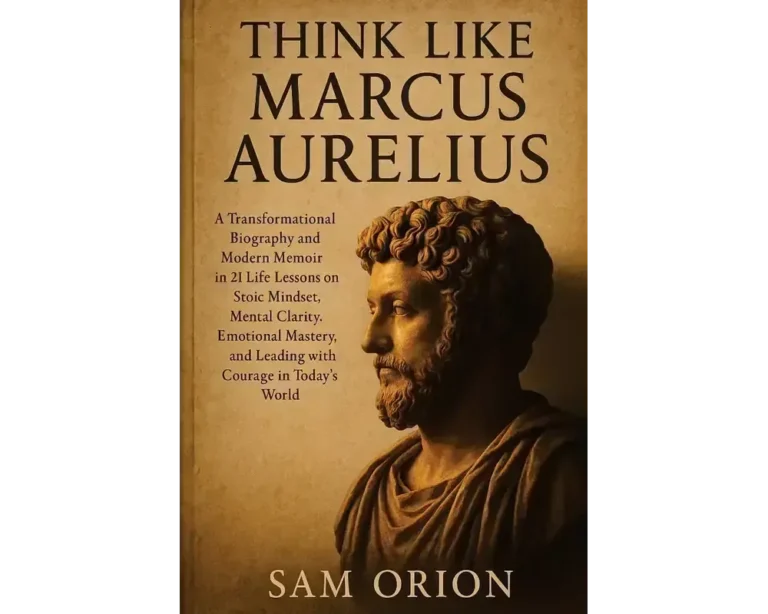
Think Like Marcus Aurelius
Discover timeless Stoic wisdom reimagined for the modern world. Think Like Marcus Aurelius blends biography and memoir to deliver 21 powerful life lessons on…
View the BookKeep exploring

Money, Business & Personal Growth
See the wider Mayobook topic hub with guides, answers, comparisons, and books.
Explore the topic
Stoic Journaling Like Marcus Aurelius: A Practical Guide to Daily Reflection
Go deeper with a longer structured guide connected to this topic.
View guide