
Dating Meaning in Relationship Psychology: What “Dating” Usually Signals Emotionally
Dating meaning in relationship psychology isn’t just labels. It’s often a mix of intent, attachment patterns, and emotional pacing—so you can interpret actions more clearly.
Keep Learning—Listen Free
Short, practical audiobooks for your next step.

Mastering Digital Marketing Through Human Psychology | Full Audiobook
Mastering Digital Marketing Through Human Psychology audiobook teaches digital marketing, digital marketing…

Why Your Brain Says Yes Before You Do | The Psychology of Decision Making (Audiobook)
Why Your Brain Says Yes Before You Do audiobook explores the psychology…

Why People Buy | The Psychology of Digital Marketing
Why People Buy is an in-depth audiobook on the psychology of digital…

The Psychology of Money | Why Smart People Stay Broke
7 Psychological Reasons You Can't Escape Being Broke audiobook reveals the hidden…

How Rich People Think | 10 Mindset Shifts That Build Wealth
Mindset hacks rich people use can completely change the way you think…

7 Human Skills AI Can’t Replace | Stay Indispensable
7 AI-Resistant Skills That Will Make You Indispensable ,7 Skills That Will…

Daily Habits of Successful People | 5 Habits That Build Success
5 daily habits that separate winners from the rest can completely change…

5 Signs He’s Cheating | Red Flags You Shouldn’t Ignore
5 signs a man is cheating can be difficult to recognize until…

How to Overcome Failure | The Growth Mindset That Changes Everything
Learn how to turn failure into growth by changing the way you…
Dating Meaning in Relationship Psychology: What “Dating” Usually Signals Emotionally
Why the label “dating” can mean different things
In psychology terms, “dating” is a social category people use to communicate where they are on the intimacy spectrum. The problem is that the category is flexible. Some people use it to signal openness: “I’m interested, and I’m getting to know you.” Others use it to signal distance: “I like you, but I’m not ready to define anything.”
That flexibility is why two people can both say “we’re dating” and mean different emotional realities. One person might be moving toward exclusivity, while the other is still testing compatibility, managing fear of loss, or trying to avoid the pressure that comes with labels.
So rather than asking only what “dating meaning in relationship” is, it helps to ask what it’s doing for that person. Is the word protecting them from expectations? Is it giving them permission to hope while staying in control? Or is it simply a neutral description of what you’re doing right now? When you start tracking the function of the label, confusion tends to shrink.
Motives behind dating: closeness, curiosity, and control
People date for different psychological reasons, and those reasons show up in patterns. A common motive is closeness: dating as a step toward emotional bonding. In this case, you often see consistent attention, follow-through, and a willingness to talk about what the connection could become.
Another motive is curiosity—dating as exploration. Here, chemistry matters, but clarity may lag. You might get great dates and good conversations, yet the relationship timeline feels blurry. That doesn’t automatically mean someone is lying; it may mean they’re prioritizing information over commitment.
A third motive is control. Some people date to manage vulnerability. They may keep things comfortably “in motion” without ever fully landing. If you notice they avoid defining terms, disappear when the relationship starts to feel real, or redirect when you ask gentle questions, control may be the hidden driver.
Understanding motives also helps with the recurring online question, “i’m dating someone meaning.” The meaning may be genuine—but it can still be incomplete. It’s not only about whether they feel something; it’s about how they handle the emotional risk of naming it.
Attachment style and emotional pacing
Attachment psychology offers a useful lens for dating meaning in relationship psychology because it focuses on how people regulate closeness. Securely attached people tend to communicate more directly and can tolerate uncertainty without panicking. When they say they’re dating, they usually mean they’re building something while staying open to adjustment.
Anxious attachment can look like intensity with inconsistency. Someone may move quickly emotionally, then struggle with uncertainty. They might want reassurance, interpret delays as rejection, or feel relief when you engage and distress when you don’t. In these situations, the word “dating” can become a bridge to closeness that they hope will calm their nervous system.
Avoidant attachment can look like steadier independence with slower definition. They might enjoy the connection but feel threatened by labels that increase expectations. When you ask, “Does dating someone mean you are boyfriend and girlfriend?” an avoidant person may respond with ambiguity—not necessarily to be cruel, but because definition can feel like a trap.
None of these patterns are moral judgments. They’re ways nervous systems learned to protect themselves. The key is to notice how the person handles emotional proximity over time: Do they close the gap when things feel good, or do they pull away when closeness increases?
What actions usually reveal more than words
If you’re trying to interpret dating meaning in relationship reddit-style debates or conflicting advice from friends, remember: online comments often focus on labels, not behavior. Psychology points you back to observable patterns.
Consistency is one of the clearest signals. Does he follow through with plans, respond with reasonable timing, and show up in ways that match the energy he brings? If he’s warm one week and absent the next, the connection may be more about mood than intention.
Clarity is another signal. When you ask a simple question—like what “dating” means to him—does he engage in a respectful, thoughtful way, or does he dodge, joke it off, or make you feel like you’re asking for too much?
Integration matters too. Are you being gradually included in his life—friends, routines, future talk—or is the connection kept in a narrow lane that protects him from deeper involvement?
A practical way to assess is to compare his words to his timeline. If he says he’s interested but avoids any conversation about exclusivity, boundaries, or what you both want, his behavior may be saying, “I like you enough to keep things open.” That’s not automatically wrong, but it is information you deserve.
So does dating automatically mean boyfriend and girlfriend?
Not automatically. “Dating” is often a middle step, not a final label. Some couples choose to become boyfriend and girlfriend quickly, while others prefer to stay in the “dating” space longer to build trust, observe conflict styles, or confirm life compatibility.
That said, psychology recognizes that ambiguity can be a strategy. If someone benefits from the benefits of a relationship while avoiding the responsibilities of one—like exclusivity expectations, public commitment, or accountability—then “dating” can function as a protective buffer.
A helpful question is: what does he do when the relationship starts to feel emotionally demanding? If commitment feels like pressure to him, he may blur definitions. If commitment feels like a natural next step, you’ll likely see willingness to talk, plan, and align.
You can also use a gentle reality check: “What would make this feel like boyfriend and girlfriend to you?” This shifts the conversation from “Are we there yet?” to “How do we get there?” It’s clearer, less accusatory, and it reveals whether he’s building toward something or keeping things indefinitely flexible.
How to ask for clarity without turning it into pressure
Clarity conversations go better when they’re framed around your needs, not his flaws. Aim for calm timing—when you’re connected, not after a conflict or a long silence. Then ask for his definition and share yours.
A psychologically effective approach is to use specific, observable questions. Instead of “What are we?” try: “When you say we’re dating, what does that include for you—exclusivity, frequency, and where you see this going?” This invites a concrete answer.
If he responds with vague reassurance like “Let’s just see,” you can follow with a boundary-based question: “I’m good going slow, but I also need to know what we’re building. Are you dating other people, and are you open to exclusivity at some point?”
If he’s avoidant or anxious, your tone matters. Keep it steady and kind. Avoid ultimatums, but don’t abandon your needs. Clarity is not pressure—it’s compatibility work.
If you’re also wondering about broader patterns, you may have seen mentions of “3 meaning of dating” or “7 types of dating.” Treat those lists as helpful language, not rules. Your job is to translate his specific behavior into the specific meaning it carries for you.
When the signs become clearer: green flags and red flags
Green flags usually look like emotional reliability. The person is consistent with communication, respects your time, and makes space for honest conversations. They can talk about exclusivity without making you feel unreasonable. They also adapt: if you share what you need, they try.
Green flags also include congruence. His actions match his words. If he says he wants something real, he behaves in ways that build toward it—planning beyond the next date, introducing you naturally, and showing up during imperfect moments.
Red flags tend to cluster around avoidance of definition and disrespect for boundaries. If he repeatedly dodges questions about what dating means to him, keeps you in a cycle of closeness and withdrawal, or acts differently in private versus public, the label may be masking emotional inconsistency.
Another red flag is emotional exploitation of uncertainty. If you feel anxious every time you want basic clarity, and he benefits from that anxiety—by enjoying access while delaying commitment—that pattern can become emotionally costly.
The clearest sign is whether he’s willing to do repair and alignment. Healthy dating conversations don’t eliminate discomfort; they reduce confusion.
More in Relationships & Communication
View category
What Does Dating Mean to a Guy (Psychology)? Signals of Serious vs Casual
Dating can mean many things, and guys often signal it indirectly. Learn the psychology behind his behavior, common misreads, and how to clarify without pressure.
Dating Meaning in Relationship Psychology: Why It Feels Ambiguous (and How to Read It)
“Dating” can mean anything from casual getting-to-know to an actual relationship. Learn the psychology behind the ambiguity and how to spot consistent emotional signals.

Money Pic: What Money Imagery Signals About Your Money Mindset
Wondering what a money pic really means? This behavioral guide explains how money imagery affects motivation, spending choices, and goal setting—without guilt or hype.

Keep exploring

Dating, Relationships & Social Skills
See the wider Mayobook topic hub with guides, answers, comparisons, and books.
Explore the topic
How to Go From Dating to Boyfriend & Girlfriend: A Step-by-Step Exclusivity Plan
Go deeper with a longer structured guide connected to this topic.
View guide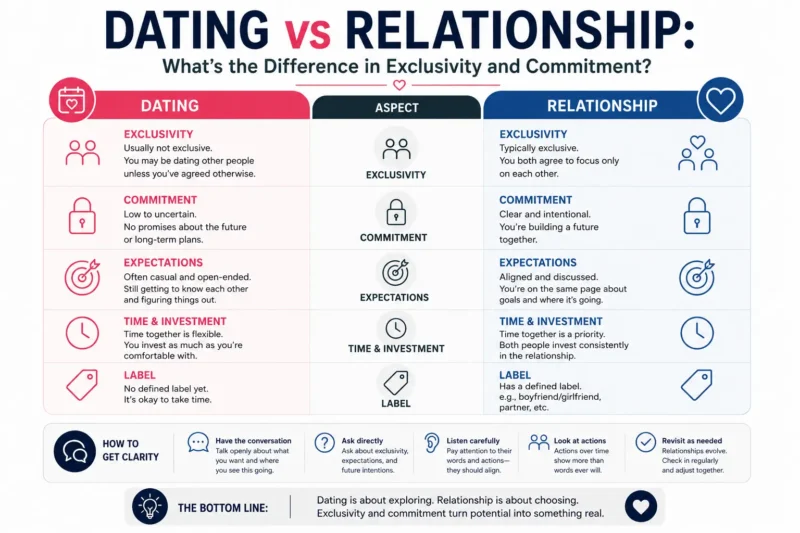
Dating vs. Relationship: What’s the Difference in Exclusivity and Commitment?
See a decision-stage page that helps readers compare the next best option.
Compare options