
Who Influenced Marcus Aurelius? Rusticus, Epictetus, and His Stoic Teachers
Marcus Aurelius learned Stoicism through teachers, texts, and examples—not in isolation. Junius Rusticus connected him to Epictetus, while Fronto, Apollonius, Sextus, family members, and earlier Stoics shaped the voice of Meditations.
Keep Learning—Listen Free
Short, practical audiobooks for your next step.

Imposter Syndrome: Why Success Still Makes You Feel Like a Fraud | Full Audiobook
Imposter syndrome can make real success feel undeserved and every new achievement…

How to Stop Catastrophizing: Break the Worst-Case Thinking Loop | Full Audiobook
Learn how to stop catastrophizing and break the worst-case thinking loop that…

Emotionally Immature Parents: How Their Patterns Shape Your Adult Life | Full Audiobook
Emotionally immature parents can shape adult relationships, boundaries, self-worth and the way…

High-Functioning Anxiety: Why You Look Fine but Never Feel at Peace | Full Audiobook
High-functioning anxiety can make you look calm, capable and successful while constant…

The Art of War Explained: Sun Tzu’s Strategy for Winning Without Fighting | Full Audiobook
The Art of War, Sun Tzu, Art of War explained, strategy, winning…

Arthur Schopenhauer: Why You’re Never Satisfied — The Psychology of Desire | Full Audiobook
Arthur Schopenhauer, Schopenhauer philosophy, the psychology of desire, hedonic adaptation, the hedonic…

Friedrich Nietzsche: What “God Is Dead” Really Means — And How to Create Meaning | Full Audiobook
Friedrich Nietzsche, “God is dead,” Nietzsche philosophy, nihilism, existentialism, the meaning of…

High Agency: How to Become the Person Who Always Finds a Way | Full Audiobook
High agency is the psychology of becoming resourceful, taking initiative, and creating…

How to Find Your Purpose When You Feel Lost: Build a Life That Actually Means Something
Learn how to find your purpose when you feel lost, discover what…
Meditations begins in an unusual way: not with a theory, but with a long act of intellectual gratitude. Marcus Aurelius names people from whom he learned qualities he wanted to imitate—family members, teachers, friends, and philosophical mentors. This first book is one of the best correctives to the image of Marcus as a solitary genius. His Stoicism was inherited, taught, modeled, read, argued over, and practiced in relationships.
The People Who Most Shaped Marcus Aurelius
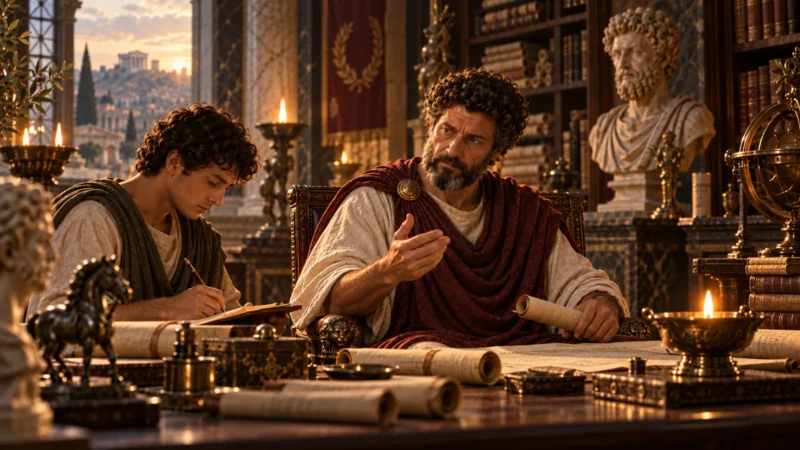
Among the most important influences were Junius Rusticus, a Stoic teacher who introduced Marcus to the writings or teachings of Epictetus; Epictetus himself, whose ideas about judgment, control, and moral purpose strongly echo through Meditations; Apollonius of Chalcedon and Sextus of Chaeronea, philosophical teachers praised in Book 1; and Marcus Cornelius Fronto, his celebrated instructor in rhetoric.
Marcus also credits family members and other mentors with particular habits of character. Book 1 is not a complete intellectual biography, but it reveals how strongly he understood philosophy as something embodied in people.
Junius Rusticus: The Teacher Who Gave Marcus Epictetus
Rusticus receives unusually significant praise. Marcus credits him with teaching seriousness about moral improvement, resistance to empty display, simplicity of communication, and the importance of correcting character rather than merely appearing philosophical. Most famously, Marcus says Rusticus gave him access to notes or books associated with Epictetus.
This makes Rusticus a crucial bridge. Marcus could not have studied personally with Epictetus—the older philosopher belonged to the previous generation—but through Rusticus he encountered a body of Stoic teaching that would become central to his own private practice.
Epictetus: The Voice Behind Marcus’s Stoic Practice
The influence of Epictetus is not limited to quotations. It appears structurally. Both thinkers emphasize the importance of impressions and assent, the distinction between what is and is not up to us, the danger of treating externals as the good, and the need to perform one’s roles in a rational and socially responsible way.
Epictetus often sounds like a teacher speaking to students. Marcus sounds like a student who has internalized the teacher’s voice and now uses it on himself. The difference in genre matters: the Discourses preserve extended teaching and argument, while Meditations compresses many ideas into reminders that assume prior philosophical training.
Apollonius, Sextus, and Other Philosophical Mentors
Marcus praises Apollonius for steadiness, independence of judgment, and consistency under difficulty. Sextus is remembered for kindness, natural authority, family leadership, and the ability to live agreeably with others. Other figures in Book 1 model restraint, patience, seriousness, and public conduct.
We should resist turning every brief tribute into a fully reconstructed curriculum. Marcus tells us what he believed he learned from these people, not everything they taught. That distinction is useful: Book 1 is a map of remembered moral influence, not a transcript of his education.
Fronto and the Education Marcus Never Fully Left Behind
Fronto was one of the leading rhetoricians of his age and trained Marcus in Latin rhetoric. Surviving correspondence between them provides a rare view of Marcus before and during imperial life, including affection, literary education, health concerns, and the demands of public speaking.
Later philosophical tradition sometimes frames rhetoric and philosophy as rivals, and Marcus’s Book 1 gratitude to Rusticus includes distancing himself from rhetorical display. Yet it would be too simple to imagine that he discarded Fronto’s influence. Meditations may be deliberately unornamented, but Marcus was a highly educated writer whose command of language was formed within elite rhetorical culture.
The Older Stoic Tradition Behind Them All
Marcus belonged to a school that already had centuries of development behind it. Zeno of Citium, Cleanthes, Chrysippus, and later Roman Stoics helped shape doctrines about virtue, nature, reason, emotions, cosmopolitanism, and externals. Marcus rarely writes as a historian of these ideas because Meditations is not trying to teach the school’s development from scratch.
His closest practical dependence is often on Epictetan themes, but concepts such as the four virtues, living according to nature, social duty, and the moral neutrality of externals belong to the broader Stoic inheritance.
Book 1 of Meditations as an Intellectual Family Tree
Why begin private philosophical notes by naming other people? One answer is that Marcus thinks character is learned through models. He remembers what patience looked like in one person, simplicity in another, seriousness in another, and public responsibility in another.
The structure also tempers the myth of self-sufficiency. The emperor begins by acknowledging debts. In a philosophy famous for internal agency, Marcus still recognizes that education, example, correction, and friendship helped form the agent who now tries to govern himself.
Marcus Aurelius Learned Philosophy Through People, Not Quotes
The modern lesson should be modest. Reading maxims can introduce ideas, but Marcus’s own formation involved teachers who corrected him, texts that demanded study, family models, rhetorical training, and years of practice. Philosophy was not a feed of isolated sentences.
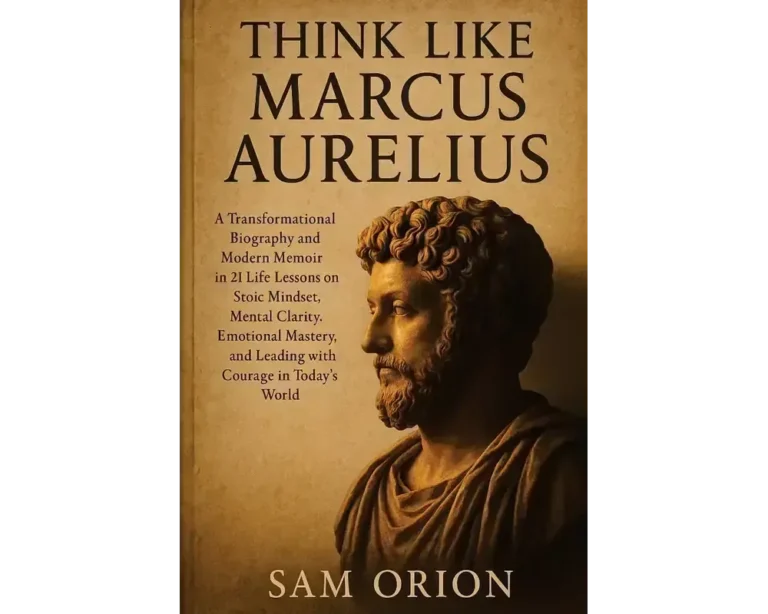
That makes a stronger reading path available today: read Marcus beside Epictetus; study the concepts behind the quotations; notice which people in your own life model judgment or justice; and treat disagreement and correction as part of philosophical education rather than threats to an identity. The wider framework in Think Like Marcus Aurelius helps connect those inherited ideas to the practical Stoic disciplines Marcus rehearsed for himself.
Want the complete system?
Explore the full book for a deeper, structured guide.
Think Like Marcus Aurelius
Discover timeless Stoic wisdom reimagined for the modern world. Think Like Marcus Aurelius blends biography and memoir to deliver 21 powerful life lessons on…
View the BookMore in Mindset & Self-Growth
View category
Marcus Aurelius’ Accomplishments: Emperor, Philosopher, and Stoic
Marcus Aurelius is remembered for Meditations and the ideal of the philosopher-emperor, but his record also includes frontier defense, administration through plague and revolt, and difficult choices that complicate the legend.
Keep exploring

Money, Business & Personal Growth
See the wider Mayobook topic hub with guides, answers, comparisons, and books.
Explore the topic
Stoic Journaling Like Marcus Aurelius: A Practical Guide to Daily Reflection
Go deeper with a longer structured guide connected to this topic.
View guide