

Guide
Free Grant Money for Bills and Personal Use: A Safe Step-by-Step Search & Apply Plan
Learn how to find legitimate free grant money for bills and personal use. Follow a safe checklist, spot scams fast,…
Read nextA decision-support comparison for choosing a workable balance between spending, saving, and togetherness.
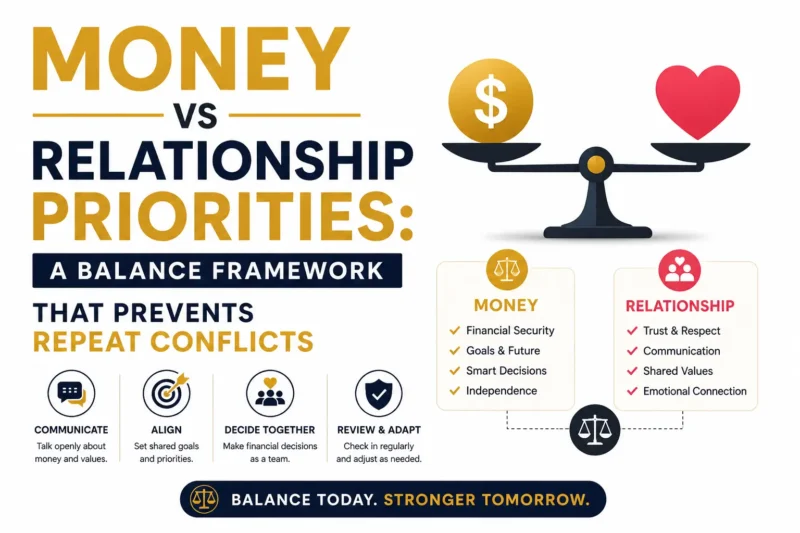
If money and relationship priorities keep colliding, the problem usually isn’t either person—it’s mismatched expectations about timing, risk, and what “support” looks like. Use a simple framework: define what money is for (security, freedom, shared experiences), name what the relationship needs most right now (time, reassurance, teamwork), and agree on a few measurable shared goals. This prevents endless debates and replaces them with decisions you can revisit. When one partner is overwhelmed financially or emotionally, prioritize stabilization first, then negotiate the lifestyle layer second—so you protect both the budget and the bond.
Most couples don’t fight about money because they “don’t care.” They fight because money becomes a stand-in for safety, respect, and future plans. One partner may feel anxious about bills and want structure, while the other may feel disconnected and want presence. That mismatch can look like stubbornness, but it’s often two different ways of trying to reduce uncertainty. This comparison page helps you slow down and choose a balance that fits your real constraints—income variability, debt, caregiving responsibilities, and the relationship stage you’re in. Instead of generic advice, you’ll compare priorities by criteria like decision speed, conflict risk, and what needs to be communicated first. You’ll also get practical guidance for making agreements that hold up when stress rises, plus examples of when to adjust your plan. If you’re tired of repeating the same arguments, this is a way to turn “money vs relationship” into a shared system.
Money and relationships are both emotional systems, not just spreadsheets and schedules. When they collide, it often feels personal: one person thinks the other is careless, while the other thinks the first is cold. The good news is that you can rebalance without turning every conversation into a courtroom. The key is to compare priorities in a way that matches your current stress, your communication style, and what you both need to feel safe.
A lot of “money vs relationship priorities” arguments begin with a hidden assumption: that the other person’s priority is their personality. If you’re the one pushing for budgets, it can feel like you’re the only responsible one. If you’re the one pushing for time or experiences, it can feel like you’re being treated like a luxury.
In reality, money anxiety and connection needs are both attempts to reduce uncertainty. Money can represent safety, control, and future freedom. Time and attention can represent love, teamwork, and emotional safety. When those meanings aren’t named, every discussion becomes a proxy debate about who cares more.
Look for patterns, not one-off fights. Misalignment often shows up as repeated topics that never resolve, such as:
One partner agrees to a plan, then quietly breaks it when emotions spike.
Spending is framed as “bad” or “selfish,” while time needs are framed as “unreasonable” or “dramatic.”
Decisions happen in the middle of stress—right when someone is already activated.
You keep negotiating details instead of clarifying the values underneath.
If any of those sound familiar, you don’t need better arguments—you need clearer agreements about what money protects and what the relationship needs to thrive.
When people say they prioritize money, they usually mean a bundle of needs:
Security: Bills get paid, emergencies are covered, and debt is managed.
Predictability: routines and expectations reduce anxiety.
Options: saving supports future choices like moving, changing jobs, or taking a risk.
This is why money matters even in loving relationships. It’s not about hoarding; it’s about reducing friction and buying stability. If your partner hears “money priorities” as “you don’t care about us,” the conversation needs a translation step: explain what the money protects and how you’ll still protect connection.
Likewise, relationship priorities often include:
Presence: quality time, attention, and emotional availability.
Reassurance: feeling chosen, not postponed.
Teamwork: shared goals and consistent follow-through.
Meaning: spending that reflects shared values, not just consumption.
When relationship needs go unmet, money can start to feel like rejection. That’s why a money mindset matters here too: the goal isn’t to frame spending as “reward” or saving as “punishment.” It’s to connect decisions to the relationship you’re building.
A practical comparison: two workable balance styles
This style leads with predictability. It works when uncertainty is high or when one partner feels financially unsafe. The structure might look like a clear budget, a debt payoff plan, and a small allowance for shared enjoyment. The relationship is not optional; it’s just funded intentionally.
| Factor | Option A | Option B |
|---|---|---|
| Primary aim this season | Financial stabilization and predictability | Connection and shared experiences as the main driver |
| How decisions get made | Budget-first rules with limited flexibility | Values-first choices with a spending ceiling |
| What conflict usually sounds like | “We can’t afford that” vs “You don’t make room for us.” | “You’re overreacting” vs “I need reassurance, not excuses.” |
| Where alignment starts | Clarifying why money matters and what it’s protecting | Clarifying what the relationship needs to feel secure and seen |
| Best use when | Cash flow is tight, debt is active, or plans are uncertain | You’re stable enough to invest in connection and momentum |
This style leads with emotional safety and shared meaning. It works when you’re stable enough to invest and when the relationship needs momentum. You choose experiences that both people genuinely value and set a spending ceiling so neither partner feels blindsided.
| Criteria | Option A | Option B | Best fit |
|---|---|---|---|
| Core belief about money | Money reduces risk and buys options | Money supports closeness and shared meaning | Use Option A if uncertainty is high; Option B if stability is solid |
| Conflict trigger | Spending feels unsafe or careless | Withholding feels distant or dismissive | Match the plan to the partner whose nervous system is most activated |
| Decision speed | Faster for routine choices (clear rules) | Faster for meaningful choices (clear values) | Choose A when emotions run hot; choose B when you’re aligned on values |
| Communication requirement | Transparent numbers and shared categories | Transparent intentions and consistent check-ins | The best fit depends on whether the real issue is information or reassurance |
| Flexibility | Lower day-to-day flexibility; higher long-term predictability | Higher day-to-day flexibility within agreed limits | Choose A for debt payoff; choose B for relationship-building seasons |
| How you measure progress | Savings rate, debt reduction, emergency fund milestones | Quality time, shared goals, reduced resentment, agreed experiences | Use a dual metric: stability + connection |
The difference isn’t which is “better.” The difference is what you protect first: stability or connection. A workable balance names both, then chooses a leader based on your season.
How to talk about money without turning it into a power struggle
Try this approach for your next conversation:
Start with the feeling, then the meaning. “I feel anxious when bills are unclear because I want us to feel safe.”
Ask for the other person’s meaning. “When you want more time, what are you hoping it will change for you?”
Translate, don’t accuse. “So it sounds like you’re not against budgeting—you want budgeting that includes us.”
Agree on a decision rule. For example: “If it’s under $X, we decide together; if it’s over, we review it monthly.”
If you’re using a money app or even a simple shared spreadsheet, make it serve the conversation rather than replace it. The point is shared visibility and shared understanding, not surveillance.
Habits change when they’re specific and forgiving. Instead of “we should save more,” choose one behavior you can repeat.
For stabilization-first (Option A), habits might include:
Automating bills and minimum debt payments.
Setting a weekly check-in for only the categories that moved.
Creating a small “connection allowance” so fun isn’t negotiated from scratch.
For connection-first (Option B), habits might include:
Choosing one shared experience per week or month and budgeting for it ahead of time.
Setting a spending ceiling for non-essentials.
Doing a brief intention check: “Does this align with our shared goal?”
If you’re tempted to rely on “money pics” or real money pictures as motivation, use them carefully. Visuals can help, but they can also increase pressure if one partner feels judged for not saving fast enough. Better: track progress together, celebrate small wins, and keep the tone collaborative.
If the same argument returns every month, the issue is usually not the amount. It’s the decision process. Ask:
Are we deciding too late, when emotions are already high?
Do we have a pre-agreed rule, or are we renegotiating each time?
Does one partner feel unheard, or does one partner feel unsafe?
If you can’t answer those quickly, start with a simple reset: pick one category (like dining out or subscriptions) and create a clear rule for it. Then review it after four weeks. Small wins build trust in the system.
If you notice contempt, stonewalling, or fear-based escalation, pause the debate and focus on repair. Money conversations are easier when your relationship feels safe enough to disagree. In some cases, a couples counselor or financial therapist can help you build a shared language for both stability and connection.
Start by separating two questions that often get mixed together: “Do we have enough money?” and “Do we feel supported?” Money vs relationship priorities aren’t a zero-sum contest; they’re two systems that both need inputs. If you only optimize for one, the other system will demand attention through conflict.
Next, identify your current season. If stress is high—tight cash flow, looming deadlines, or recent financial setbacks—use an Option A structure first. That means clear categories (bills, debt, savings) and a small, predictable allowance for connection. The goal is not to remove fun; it’s to stop uncertainty from hijacking your conversations.
If stress is lower and the relationship needs momentum—long-distance strain, emotional distance, or low shared time—use an Option B structure first. That means choosing experiences or relationship investments that both partners genuinely value, while still agreeing on a spending ceiling. This is where a money mindset shift helps: you’re not “spending vs saving,” you’re funding what matters.
Here’s a practical way to choose between them without guesswork: decide which conflict you most want to prevent this month. If you’re mostly arguing about affordability and safety, start with Option A. If you’re mostly arguing about feeling seen and included, start with Option B. Then build a dual metric: one stability metric (like emergency savings or debt reduction) and one connection metric (like a weekly date or a shared project).
Finally, make agreements that survive real life. Use a monthly review, not a weekly interrogation. Pre-commit what happens when something unexpected occurs. And if you find that money conversations repeatedly trigger shutdown, anger, or contempt, consider outside support—because relationship repair is part of financial health too.
Use these connected pages to deepen context, compare alternatives, and move confidently toward the right next step.
Learn how to find legitimate free grant money for bills and personal use. Follow a safe checklist, spot scams fast,…
Read next
Want better money habits without overwhelm? Try this simple 7–30 day system: track spending, set goals, build a realistic budget,…
Read next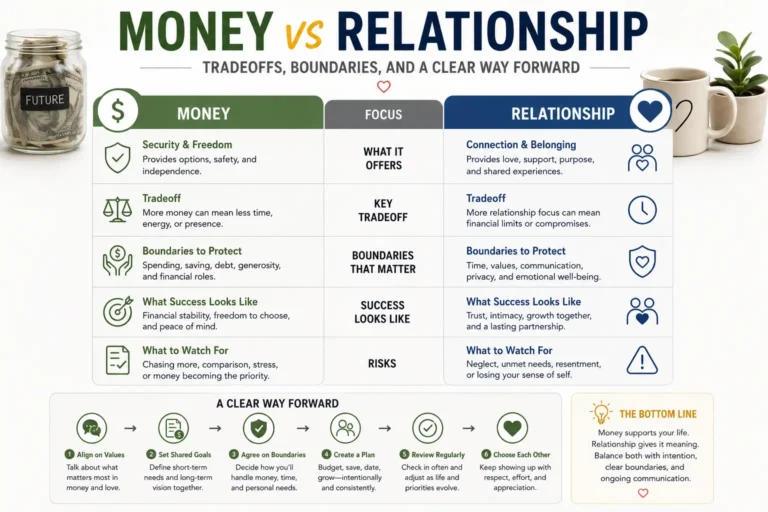
Money vs relationship isn’t a zero-sum choice. Compare the real tradeoffs, spot the conflict triggers, and learn how to balance…
Read next
Money in economics is more than cash. It’s a tool that helps people trade, measure value, and hold purchasing power…
Read nextYes. Money often carries emotional meanings like safety, fairness, and future freedom, while relationship priorities carry meanings like presence, reassurance, and teamwork. When those meanings aren’t discussed, the same topic can trigger different fears in each person. Conflict becomes less frequent when you translate feelings into shared goals and create decision rules that both partners can trust.
Start with your current season. If you’re dealing with debt or unstable cash flow, prioritize saving and clarity first, then fund experiences with a small, agreed allowance. If you’re stable and feeling disconnected, prioritize shared experiences but keep a spending ceiling and track a stability milestone. The best plan includes both: one metric for security and one for connection.
Don’t treat avoidance as resistance. Set a short, predictable cadence—like a monthly review with a fixed agenda—so conversations don’t feel like surprises. Use a shared view of accounts, then focus on decisions rather than blame. Ask what the avoiding partner needs to feel safe enough to participate, and start with one category to build momentum.
It can help if the tool supports clarity and teamwork. Choose a simple system you both understand, and use it to reduce uncertainty, not to monitor. Agree on what gets reviewed, how often, and what decisions require discussion. If the app becomes a trigger for criticism, switch the focus to shared goals and supportive check-ins.
First, separate the amount from the meaning. Ask what the purchase represents emotionally—comfort, independence, celebration, or feeling included. Then create a rule for that category (like a monthly allowance) and schedule a quick check-in when exceptions are needed. When you name the need, the argument becomes problem-solving instead of personal judgment.
Consider outside help if conflicts escalate quickly, repeat in the same cycle, or involve contempt, shutdown, or persistent fear. If you can’t agree on a decision process even after trying a structured monthly review, professional support can help you build communication skills and financial boundaries. Getting help early can prevent months of resentment and improve both stability and closeness.
Balancing money and relationship priorities is less about choosing a winner and more about choosing the right leader for your season. When uncertainty is high, stabilization-first rules protect both your budget and your emotional safety. When you have breathing room, connection-first choices remind you why the money exists in the first place. The most reliable outcome comes from agreements you can revisit monthly, plus one stability metric and one connection metric. If you keep repeating the same fight, don’t just adjust the numbers—adjust the decision process and the meaning behind it.