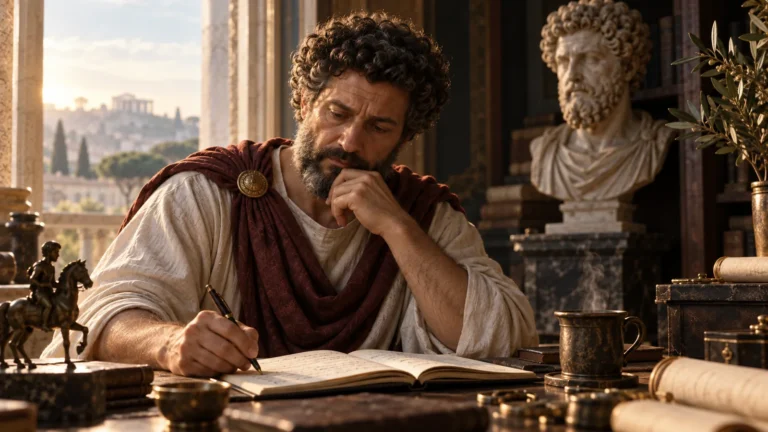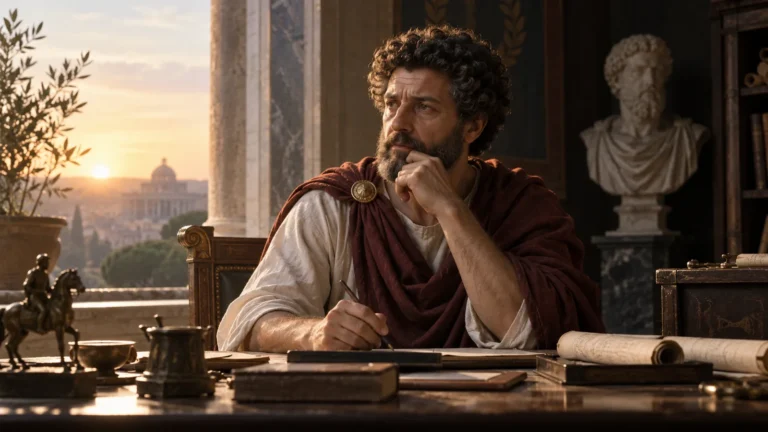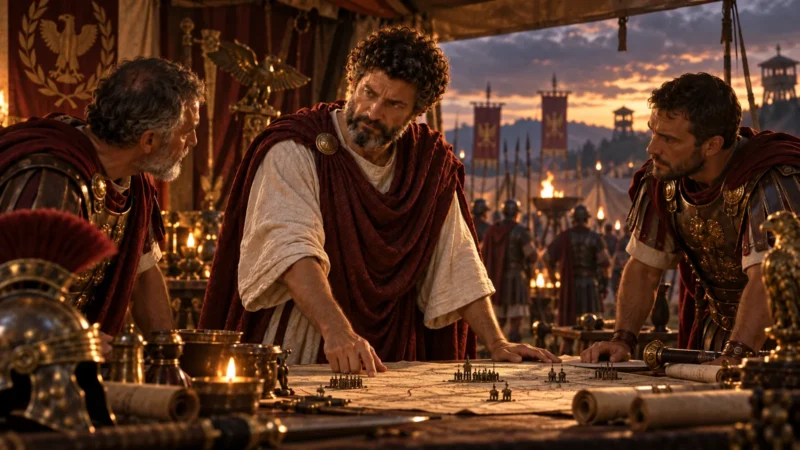
This is a philosophy of stewardship more than image. Power is an external circumstance. The moral question is how it is used.
Lead Yourself Before Trying to Control Others
Marcus spends strikingly little time in Meditations fantasizing about controlling people. Instead he keeps returning to his own judgments, impulses, speech, and conduct. This is consistent with the Stoic inheritance from Epictetus: another person’s mind is not yours to command; your use of your own agency is.
For a leader, that distinction is practical. You can set expectations, design incentives, make decisions, coach, hire, fire, reward, and enforce standards. You cannot guarantee admiration, motivation, loyalty, or agreement. Leadership becomes distorted when every tool is used to produce emotional control over other people rather than clear responsibilities and fair conditions.
Power Is an External; Character Is the Test
Stoicism classifies rank, wealth, reputation, and influence among external goods that may be reasonably preferred but do not constitute virtue. For a leader, this is a severe standard. Promotion does not prove wisdom. Authority does not prove justice. A large audience does not prove truth.
Marcus warns himself against becoming “Caesarified”—absorbing the habits and vanity of imperial status. The word captures a recurring leadership danger: roles that begin as responsibilities gradually become identities that must be protected.
A useful question is: What am I unwilling to hear because of the position I hold? If bad news becomes dangerous to the messenger, status has begun controlling information.
Justice and the Common Good Are Not Optional Extras
Modern leadership content sometimes borrows Stoic calm while dropping Stoic justice. That produces a philosophy of executive composure rather than Stoicism. Marcus repeatedly describes human beings as made for cooperation. In the broader school, justice is one of the four cardinal virtues.
Leadership decisions therefore require more than “Can I execute this?” They require “Who bears the cost? What is owed? Is the burden being transferred unfairly? Does this policy treat people as instruments for someone else’s status or gain?”
Justice also complicates loyalty. A leader may owe loyalty to an organization, but not obedience to fraud, abuse, unsafe practice, or deliberate deception. Social duty is not blind compliance.
Difficult People Are a Leadership Problem—and a Character Test
Marcus begins Book 2 by preparing himself to encounter people who are meddling, ungrateful, arrogant, deceitful, jealous, and unsocial. The famous passage is sometimes used as permission to endure difficult people silently. Its deeper logic is different: expect friction without allowing another person’s conduct to decide your own.
A leader still needs boundaries and consequences. Patience does not require leaving misconduct uncorrected. The Stoic discipline is to distinguish accountability from retaliation. Can you document behavior instead of inventing motives? Can you correct without humiliation? Can you make the consequence serve a legitimate purpose rather than your anger?
Do Not Confuse Emotional Control With Leadership Quality
A leader who never raises their voice can still be unjust. A leader who remains calm while withholding information can still be dishonest. Stoic self-command is valuable because it should make better ethical action possible, not because composure itself is the highest virtue.
The same is true of vulnerability. Stoicism does not require leaders to perform invulnerability. Marcus’s private notes show repetition, frustration, fatigue, and the need to remind himself of principles he had not permanently mastered. A credible leader can acknowledge uncertainty or error without abandoning responsibility.
Make Decisions Without Needing Certainty or Applause
Leadership often requires acting before every fact is available. Stoicism does not solve uncertainty; it disciplines the way a person enters it. Gather the best evidence available. Distinguish what is known from what is assumed. Identify the preferred outcome. Ask what duties and virtues constrain the options. Act, then revise when reality provides new information.
Reputation pressure deserves special attention. Leaders can begin optimizing decisions for how they will appear in a meeting, earnings call, board discussion, or social feed. Marcus’s repeated contempt for posthumous fame is not a reason to ignore stakeholders; it is a reminder that applause is a poor substitute for a sound decision.
Use the Four Virtues as a Leadership Audit
| Virtue | Leadership question | Common failure |
|---|---|---|
| Wisdom | What is true, and what information am I filtering out? | Certainty theater |
| Courage | What responsible action am I avoiding because it threatens status or comfort? | Conflict avoidance |
| Justice | Who is affected, and what is owed to them? | Self-serving optimization |
| Temperance | Where is ambition, anger, appetite, or excess taking more than it should? | Overreach and overwork |
Leadership Means Designing Conditions, Not Only Giving Advice
Stoic ethics is personal, but leadership has institutional effects. A leader’s private character matters because it shapes systems: who gets heard, how errors are reported, whether dissent is punished, whether workloads are sustainable, and whether incentives reward behavior the leader publicly condemns.
This is where modern application must go beyond quotations. “Do the right thing” is not enough if the organization makes the right thing systematically costly and the wrong thing profitable. Justice may require changing process, incentives, or authority itself.
The Leadership Questions Marcus’s Own Reign Leaves Open
Marcus’s historical record is not a footnote to the leadership lesson. It is part of it. He conducted long imperial wars. Christians were persecuted in some regions during his reign, although his direct role in specific episodes remains debated. Most famously, he elevated his biological son Commodus, who became co-emperor before Marcus died and later acquired a disastrous reputation.
Hindsight can oversimplify the succession. Marcus faced dynastic expectations, legitimacy concerns, civil-war risks, and uncertainty about the future. Yet the result still raises a hard leadership question: how should a leader distinguish loyalty to a person or dynasty from stewardship of an institution after the leader is gone?
The gap between ideal and record is valuable because it prevents Stoicism from becoming a personality cult. A person can understand excellent principles and still make consequentially bad judgments. Readers who want to connect these leadership lessons with Marcus Aurelius’s wider practical ethics can continue with Think Like Marcus Aurelius, which places power, duty, control, emotion, and character inside one framework. For adjacent material on habits, resilience, leadership, and practical life mastery, explore Mayobook’s Self-Help, Habits & Life Mastery topic hub.
A Stoic Leadership Review for the End of the Day
- Truth: What information did I avoid because it threatened my preferred story?
- Power: Did anyone have to manage my ego before they could tell me the truth?
- Justice: Who carried the cost of my decision?
- Courage: What necessary conversation did I postpone?
- Temperance: Where did ambition, speed, or anger become excessive?
- People: Did I correct behavior without reducing a person to that behavior?
- Outcome: Did I judge the decision only by whether it succeeded, or also by whether the process and conduct were sound?
- Tomorrow: What one repair or clarification should happen next?
Leadership as Stewardship of Character and Power
The durable Marcus Aurelius lesson is not “be the calmest person in the room.” It is more demanding: treat authority as a circumstance, not a moral credential; build a mind that can hear unwelcome facts; make justice part of performance rather than an optional value; correct difficult people without becoming difficult in the same way; and remember that the office will outlast—or at least should matter beyond—the ego of the person temporarily holding it.
Marcus Aurelius is useful to leaders precisely because he does not let power solve the problem of character. His notebook suggests the opposite: the greater the power, the more often the character may need to be recalled to itself.