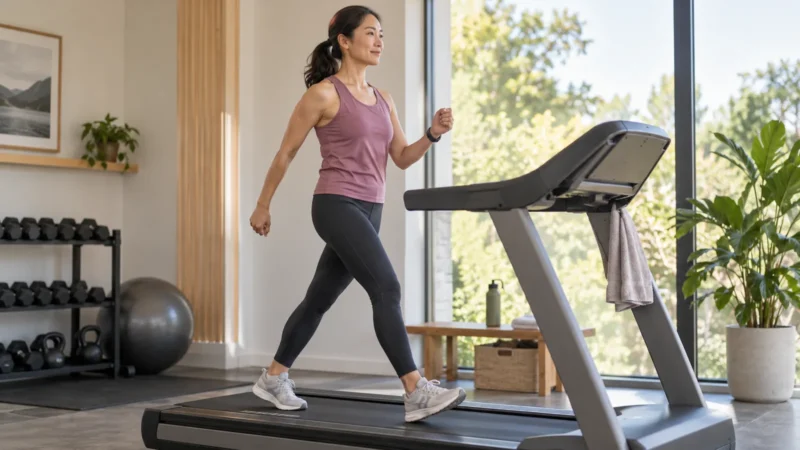
A treadmill has useful advantages. The surface is predictable, weather is irrelevant, and speed can be repeated precisely. The tradeoff is that rapid button changes, belt speed, and incline can make the session less forgiving if you choose settings that are too aggressive.
How to Set Up the 3-3 Intervals
Start with five to ten minutes of comfortable walking. Choose an easy speed you could maintain while speaking comfortably. Then raise the speed for three minutes to a pace that noticeably increases breathing while still allowing safe walking form. After three minutes, return to the easy speed for three minutes.
Repeat the pair for as many cycles as your current fitness allows. Beginners can start with two or three cycles. More experienced walkers can use five. The quality of the effort contrast matters more than forcing the full duration immediately.
Choosing Your Fast and Easy Speeds
There is no universal mph number. Height, stride length, walking economy, age, fitness, medications, treadmill calibration and incline all influence how a speed feels. A setting that is brisk for one person may be an easy pace for another.
Use the talk test. CDC guidance describes moderate activity as an effort where you can talk but not sing, while vigorous activity makes speaking more difficult. Your fast interval should feel clearly harder than recovery, but it does not have to become a run.
Your easy speed should be low enough for breathing to settle. If you begin the next fast interval still struggling to recover, reduce the recovery pace or the previous fast pace.
A Practical Starting Method
Instead of searching for a published “Japanese walking mph,” find your own baseline. Walk at a comfortable pace for several minutes. Increase the belt by a small amount and notice the change. Continue in small increments until the pace feels purposeful but controlled. That becomes a starting fast setting. Then choose an easy speed that lets you recover without stopping.
Record the settings if they work. You can adjust them later as fitness changes. A note in your phone with easy speed, fast speed, incline and perceived effort is often enough to make future sessions more consistent.
Do You Need Incline?
No. Incline is optional. The original interval-walking concept does not require a treadmill incline, and adding one can increase the workload quickly. If flat walking at your fastest safe walking speed is no longer challenging enough, a small incline can be one progression option.
Do not increase both speed and incline aggressively at the same time. If incline goes up, walking speed may need to come down. A steeper grade can also increase calf, Achilles and cardiovascular demand.
How to Change Speed Safely
Know the controls before starting. If your treadmill has programmable intervals, set them in advance. If you change speed manually, make small transitions rather than jumping several mph at once.
Use the handrails briefly if needed while the belt changes speed, but avoid hanging on them throughout the interval just to tolerate a pace that is too fast. Continuous rail holding changes your walking mechanics and can make the displayed speed misleading.
Use the emergency stop clip when available. Keep phones, towels and water bottles where they cannot fall onto the belt.
What If the Fast Speed Makes You Jog?
If your gait naturally turns into a jog, you have crossed beyond brisk walking. That is not inherently bad exercise, but it is no longer the same walking-only method. If your goal is Japanese walking, reduce the speed slightly or add a modest incline instead of forcing a run.
What About Walking Pads?
A walking pad can work if it is stable, long enough for your stride, and capable of reaching a speed that creates a meaningful fast interval. Many walking pads have lower maximum speeds and fewer handrails than treadmills. That means the safest Japanese-walking settings may be different.
Do not improvise incline by placing objects under the machine unless the manufacturer explicitly supports it. Keep the area around the pad clear and make sure the remote or speed control is easy to reach.
Treadmill vs Outdoor Japanese Walking
Treadmill walking offers precise speed control, a predictable surface and indoor convenience. Outdoor walking adds natural changes in terrain, wind and pacing and may feel more enjoyable. Neither is universally superior.
Treadmill users can compare sessions more easily because the machine records speed and time. Outdoor walkers may rely more on perceived effort, route landmarks and pace from a watch or phone.
How to Progress on the Treadmill
Progress one variable at a time. First, complete the planned number of cycles comfortably. Then consider a small increase in fast speed. Later, if flat brisk walking is no longer demanding enough, add a modest incline. Avoid making every session harder than the last.
Another form of progress is improved recovery. If the same fast speed produces less breathlessness and you recover more quickly at the same easy speed, your fitness may be improving even before you increase the belt settings.
A Beginner Treadmill Progression
- Session 1–2: two or three cycles, flat treadmill, conservative fast speed.
- Session 3–4: repeat the same settings and check recovery.
- Session 5–6: add one cycle if the previous sessions felt controlled.
- Later: make a small speed increase on the fast interval only.
- Use incline only when speed changes alone no longer create enough challenge.
Common Treadmill Mistakes
- Copying another person’s fast speed.
- Using too much incline too soon.
- Making the easy interval almost as hard as the fast one.
- Changing speed so abruptly that balance becomes difficult.
- Holding the rails continuously.
- Skipping the warm-up because the treadmill feels controlled.
- Looking down at the console for long periods instead of maintaining stable posture.
How to Use Heart Rate Without Letting It Run the Workout
A watch can help you see trends, but short intervals can expose sensor lag. Some medications also change heart-rate response. Use heart rate as supporting information rather than a universal target. The fast interval should feel challenging and controlled even if the number differs from another person’s.
Hydration, Heat and Indoor Conditions
Indoor gyms can be warm and poorly ventilated. Heat raises perceived effort even when speed stays the same. If a normal treadmill setting suddenly feels much harder, check the room temperature, hydration, sleep and fatigue before assuming you have lost fitness.
A Sample Full Treadmill Session
Warm up for 5–10 minutes. Complete five cycles of 3 minutes brisk and 3 minutes easy. Keep the treadmill flat initially. Cool down for several minutes. If you are new to intervals, begin with fewer cycles and add volume only after the current session feels repeatable.
For broader exercise and weight-management context around treadmill interval walking, explore Mayobook’s Fitness, Weight Loss & Body Transformation hub.
When to Stop
Stop for chest pressure, faintness, unusual dizziness, sharp pain or symptoms that feel medically concerning. If you have balance limitations or a health condition that changes exercise tolerance, use settings appropriate to your situation and seek individualized guidance when needed.
The treadmill is a useful tool for Japanese walking because it makes effort repeatable. The correct settings are not the fastest ones; they are the ones that produce a clear, controlled contrast between work and recovery while preserving safe walking form.