
Most people think they are good listeners, but if you look closely, much of our “listening” is actually waiting to speak, rehearsing what we’ll say next, or silently defending ourselves. If you have been wondering how to enhance listening skills, it is likely because you sense that something deeper is possible in your conversations: more trust, more understanding, more connection, and less misunderstanding or conflict.
Listening well is not just a communication trick. It is an emotional and relational skill that draws on your nervous system, your attention, your empathy, and your ability to stay present with another person’s reality even when it is uncomfortable. When you learn how to enhance listening skills in an emotionally intelligent way, you change not only how others feel around you, but how safe and grounded you feel within yourself.
This guide will walk you through the psychology of listening, the nervous system foundations, practical techniques, and everyday rituals that help you become a truly present, reliable listener. We will explore how to listen in relationships, at work, during conflict, and when emotions run high – and how to do all of this without abandoning your own boundaries or energy.
Why Listening Is Harder Than It Sounds
At first glance, listening seems simple: someone talks, you pay attention, you respond. But in reality, there is an entire inner world operating while someone speaks to you. Thoughts, memories, fears, judgments, and interpretations are all swirling in the background.
Psychologists call this internal noise. Internal noise might sound like:
- “How do I respond to this?”
- “What do they want from me?”
- “I don’t agree with this at all.”
- “This reminds me of something that happened to me.”
- “I need to defend myself.”
- “I am already exhausted; I can’t handle this conversation.”
When your internal noise is loud, your external listening becomes shallow. You hear the surface of what is said, but not the heart of it. One of the first keys in learning how to enhance listening skills is not forcing yourself to “try harder,” but noticing what is happening inside you while someone is speaking.
Ask yourself during a conversation: “What is going on in my mind right now that is making it hard to really hear them?” This simple question gently shifts your attention from automatic reaction to conscious presence.
Regulating Your Nervous System Before You Listen
Listening is not just a mental act; it is a nervous system experience. When you feel stressed, rushed, threatened, or overwhelmed, your body naturally shifts into fight, flight, or freeze. In that state, it becomes very hard to listen with patience or empathy. Your system wants to protect you, not connect with someone else’s reality.
To truly learn how to enhance listening skills, it helps to practice simple regulation tools before and during conversations:
The 5-Breath Reset
Before a meaningful conversation, or when you feel yourself getting tense, try this:
- Inhale gently through your nose for a count of four.
- Hold for a count of two.
- Exhale slowly through your mouth for a count of six.
- Repeat this for five full breaths.
This slightly longer exhale signals to your body that you are safe enough to relax. A calmer body allows for a calmer mind, which supports deeper listening.
Softening Your Body
As you listen, notice your shoulders, jaw, hands, and stomach. Are you clenching, tightening, or bracing? Gently soften the muscles and let your shoulders drop a little. Even this small shift sends a quiet message: “I do not have to be on high alert; I can be here.”
Creating an Inner Anchor
Choose a simple inner phrase such as, “I am here with you,” or “I don’t need to rush.” Repeat it silently as you listen. This helps you return to presence when your mind starts drifting or reacting.
How to Enhance Listening Skills by Quieting Your Inner Narrator
Every person listens through a filter shaped by their past: childhood experiences, cultural messages, former relationships, and old wounds. This filter creates an inner narrator that not only hears the words being spoken, but also adds its own storyline.
Your inner narrator might say:
- “They’re attacking me.”
- “Here we go again; they always do this.”
- “They are just like my mother/father/boss/ex.”
- “This isn’t fair.”
- “They never listen to me, so why should I listen to them?”
When your narrator is in charge, you are no longer really listening to the person in front of you. You are listening to your history. To gently quiet this narrator, try this practice in real time:
- Notice when a strong reaction rises (defensiveness, anger, hurt, frustration).
- Silently say, “This is my story about what they’re saying, not the full reality.”
- Ask yourself, “What did they actually say, word for word?”
- Then ask, “What might they be feeling underneath these words?”
This shift from “my story” to “their experience” is one of the most powerful ways to enhance listening skills. It moves you from assumption to curiosity.
Listening vs. Waiting to Speak
There is a world of difference between truly listening and simply waiting for your turn to speak. Most of us, if we are honest, spend a lot of time in the second category.
Waiting to speak looks like:
- Rehearsing your response while the other person talks.
- Interrupting or jumping in as soon as there is a pause.
- Finishing their sentences for them.
- Quickly pivoting the conversation back to yourself.
- Thinking about how to defend or prove your point.
Listening looks like:
- Letting them finish their thought without rushing.
- Paying attention to tone, energy, and feelings.
- Reflecting what you heard before offering your perspective.
- Staying curious instead of assuming you already know.
- Allowing silence without panicking.
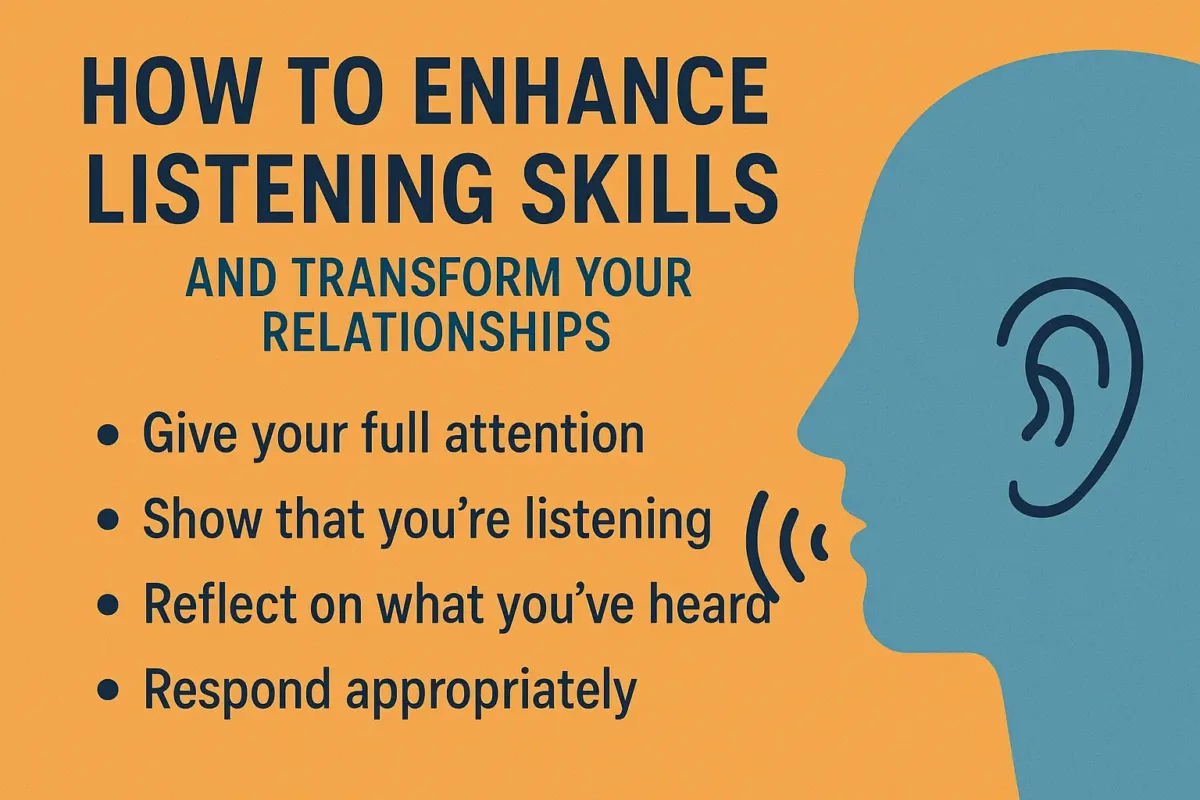
If you want to learn how to enhance listening skills quickly, try this one shift: before you reply, reflect. Offer back what you heard:
“So what I’m hearing is that you felt dismissed when I changed the subject, and it made you feel alone with what you were going through. Did I get that right?”
Reflecting slows things down, reduces misunderstanding, and helps the other person feel genuinely seen.
Active Listening: The Three-Layer Approach
Active listening is often reduced to nodding, saying “mm-hmm,” and making eye contact. Those things help, but they are not the core of truly active, emotionally intelligent listening.
Real active listening has three layers:
1. Reflection
You summarize or paraphrase what the person is saying in your own words. This shows that you are tracking the content.
“It sounds like you’ve been carrying a lot of stress at work, and you feel like no one notices how much effort you’re putting in.”
2. Validation
You acknowledge the emotional reality of what they are feeling, without minimizing or arguing with it.
“That makes sense. Anyone in that situation would feel exhausted and unappreciated.”
3. Curiosity
You ask gentle, open questions that invite them to go deeper, if they want to.
“When did this start feeling so heavy for you?”
“What part of this is hurting the most?”
“What would feel supportive for you right now?”
When you practice reflection, validation, and curiosity together, people experience you as a safe person to talk to. Over time, this three-layer approach can transform your relationships, your parenting, your leadership, and your friendships.
How to Enhance Listening Skills in Relationships
Listening becomes especially important – and especially challenging – in close relationships. With partners, family, and close friends, your emotional history is activated. Old arguments, unresolved hurts, and patterns of feeling dismissed or misunderstood can make listening feel risky.
Here are three powerful ways to listen better in your closest relationships:
Ask What They Need Before You Respond
Instead of assuming you should fix, advise, or comfort, ask a simple question:
“Do you want me mainly to listen, to help you problem-solve, or to share my honest perspective?”
This removes guessing, reduces tension, and lets the other person feel considered and respected.
Listen for the Feeling Beneath the Story
When your partner says, “You never pay attention,” the surface content is criticism, but the feeling might be loneliness or fear of being unimportant. When a child says, “You’re always working,” the deeper feeling might be missing your presence.
Ask yourself: “What might they be feeling under these words?” and listen as if the feeling is the main message.
Stay Through the Discomfort
There will be moments when you hear something that triggers defensiveness or shame. You may feel the urge to argue, correct the details, or shut down. In those moments, take one slow breath and silently say, “I can stay with this for a little longer.”
Staying present does not mean you agree with everything being said. It simply means you are willing to hear it before you respond.
Listening at Work: Leadership, Teams, and Clients
In professional settings, listening is not just polite; it is strategic. Leaders who know how to enhance listening skills create cultures of trust. Team members who listen well reduce conflict and misunderstandings. Client-facing professionals who listen deeply form stronger relationships and close more meaningful deals.
Try these three practices at work:
Set the Frame
At the beginning of a meeting or important conversation, ask:
“What would make this conversation feel useful for you?”
This question helps the other person feel considered and gives you a clear target to listen for.
Mirror Key Points Before Moving to Solutions
Instead of jumping straight into advice or plans, first mirror what you’ve heard:
“Just to make sure I’m understanding, the key concerns for you are timing, budget, and making sure the project doesn’t overwhelm your team. Is that right?”
Once they feel heard, they are far more receptive to your ideas.
Use Clarifying Questions Instead of Assumptions
Rather than assuming what someone means, use questions like:
- “When you say ‘urgent’, what timeframe are you imagining?”
- “What would success look like from your perspective?”
- “Is there anything you’re worried we might be overlooking?”
These questions elevate the quality of your listening and the clarity of your work.
Mindful Listening: Bringing Presence Into Every Conversation
Mindfulness is one of the most powerful tools for anyone learning how to enhance listening skills. It teaches you to notice what is happening inside you without being completely controlled by it.
Here are three simple mindful listening practices you can use daily:
One-Breath Pause
Before you respond in a conversation, take one conscious breath. Just one. This short pause gives your brain time to choose a response instead of a reflex.
Name and Tame
If you feel triggered while listening, silently name your emotion: “I feel defensive,” “I feel hurt,” or “I feel tense.” Research shows that naming emotions reduces their intensity and helps your rational brain stay online.
Full-Attention Moments
At least once a day, choose one conversation to give your full presence. Put your phone away, close your laptop, and face the person fully. Even two or three minutes of undivided attention can change how someone experiences you.
Protecting Your Energy While You Listen
Deep listening does not mean becoming an emotional sponge for everyone around you. You are allowed to have limits. You are allowed to say, “I care, but I don’t have the capacity for this conversation right now.” You are allowed to ask for a pause or a boundary.
Healthy listening includes:
- Not tolerating disrespectful or abusive language.
- Letting people know when you are overwhelmed or tired.
- Requesting a break in heated conversations.
- Honoring your own emotional and mental needs.
You can say things like:
“I want to give this the attention it deserves, but I am exhausted right now. Can we talk about it later today or tomorrow?”
“I’m listening, but I also need to share how I’m feeling when you’re ready to hear it.”
Protecting your energy does not make you a bad listener. It makes you a sustainable one.
Books to Deepen Your Listening and Emotional Intelligence
Certain books can become lifelong companions as you learn how to enhance listening skills and communicate with more wisdom and heart. The Mayobook collection includes several titles that beautifully support this journey:
- The Art of Social Intelligence – a powerful guide to understanding emotional cues, social dynamics, and communication patterns so you can respond with greater empathy and awareness.
- Breaking Free – ideal if your listening is affected by old wounds, defenses, or patterns that keep you guarded in relationships.
- Rise to Lead – for developing leadership-level presence and communication, especially useful for managers, entrepreneurs, and emerging leaders.
- The Magic of Positive Affirmation – helps you reshape your inner dialogue so you can listen without constant self-criticism or fear of judgment.
- Think Like Martin Luther King Jr. – a deep dive into calm conviction, moral courage, and emotionally grounded communication even in tense or high-stakes situations.
If you feel called to deepen your emotional and relational skills, you can explore more transformational reads at https://mayobook.com/shop.
FAQ – How to Enhance Listening Skills
Why do I struggle to listen even when I care about the person?
Struggling to listen is usually not a sign that you do not care. It often means your mind is overloaded, your nervous system is activated, or your own emotions are being stirred up by what the other person is saying. Learning how to enhance listening skills starts with calming your internal state, so you have the capacity to be present.
What is the fastest way to enhance listening skills?
One of the fastest ways to enhance listening skills is to practice a one-breath pause before responding. This simple habit gives your brain just enough space to shift from reacting to consciously choosing your response. Pairing this with reflection – summarizing what you heard before sharing your view – quickly improves the quality of your listening.
How can I listen better during conflict?
During conflict, your nervous system often goes into defense mode. To listen better, focus first on regulating your body: slow your breathing, soften your muscles, and notice your emotional triggers. Then, intentionally shift into curiosity by asking, “What is most important to this person right now?” and “What are they afraid of or needing?” This does not mean you ignore your own needs; it simply means you listen fully before responding.
How do I stop interrupting people?
Interrupting often comes from anxiety, enthusiasm, or fear of forgetting what you want to say. A practical approach is to gently place your tongue on the roof of your mouth while someone else is speaking – this makes it physically harder to interrupt. Combine this with an inner reminder: “Let them finish.” You can also keep a small note where you jot down your thoughts instead of blurting them out.
Can mindfulness really improve my listening?
Yes. Mindfulness helps you notice thoughts, emotions, and impulses without immediately acting on them. When you are more aware of your inner world, you can stay grounded while someone else talks, instead of being pulled away by your reactions. This presence is the foundation of deep, attentive listening.
How can I enhance listening skills in my romantic relationship?
Start by asking your partner what they most need when they share: listening, comfort, honesty, or problem-solving. Then, when they speak, focus on reflecting and validating before offering advice. Listening for the feeling underneath their words – like hurt, fear, or loneliness – often matters more than getting every detail “right.”
What if I feel overwhelmed by other people’s emotions?
If you are naturally empathetic, it can be easy to absorb other people’s feelings. Practice grounding techniques before and after emotional conversations, and remind yourself, “These feelings are theirs, not mine to carry.” Setting gentle limits, like asking for breaks or shorter conversations when you are depleted, allows you to keep listening without burning out.
How do I listen better at work, especially as a leader?
As a leader, listening means creating space for others to share honestly without fear of punishment. Set clear intentions at the start of conversations, mirror back key points, and ask clarifying questions. When people feel heard, they are more likely to trust your decisions and collaborate with you.
What are signs that I am becoming a better listener?
You may notice people opening up to you more, conflicts de-escalating faster, and others explicitly saying, “Thank you for listening” or “I feel understood.” You might also feel less reactive, more patient, and more connected to the people in your life. These are all signs that your work on how to enhance listening skills is taking root.
Can I enhance listening skills on my own, or do I need a course or coach?
You can absolutely begin enhancing your listening skills on your own with intention, practice, and reflection. Books, articles, and journaling are powerful tools. That said, some people find that a coach, therapist, or communication workshop gives them structured feedback and faster growth. Both paths are valid; what matters most is your willingness to practice.
Conclusion: Listening as a Daily Act of Care
Learning how to enhance listening skills is not about becoming a flawless communicator. It is about choosing, again and again, to show up with presence, curiosity, and respect for the inner world of the person in front of you. It is about slowing down enough to hear not just words, but hearts.
Every conversation is an opportunity to practice: to breathe, to notice your reactions, to soften your defenses, and to lean a little more into understanding. Over time, these small choices add up to something profound – relationships that feel safer, connections that feel deeper, and a self that feels calmer and more grounded in every exchange.
You do not have to get it perfect. You just have to keep listening, one moment at a time.
If this spoke to you, you’ll love the full information in this book; begin your deeper reading → See the book on Mayobook.