
We rarely talk about how much of our life is quietly shaped by habits. The way you reach for your phone first thing in the morning, the late-night scrolling when you promised yourself you would sleep earlier, the snacks you grab when you feel stressed, the way you react when you feel criticized – these are not random choices. They are patterns your brain has learned to repeat. If you are here wondering how to break bad habits, it is not because you lack willpower or discipline. It is because your nervous system and your mind are still running an old script that once made sense, but no longer serves the person you are becoming.
The good news is this: bad habits are learned, and anything learned can be relearned. You are not stuck with the patterns you have now. You can gently interrupt them, rewrite them and build new ones that reflect your values instead of your fears. In this guide, we will explore a deeply human, science-backed and emotionally intelligent approach to behavior change. You will learn how habits form in the brain, why self-sabotage is often a misunderstood form of self-protection, and practical strategies to break the loop and build new, healthier routines.
These are not harsh, shame-based strategies. This is a calm, compassionate roadmap for understanding how to break bad habits in a way that honors your nervous system, your history and your humanity.
Understanding the Habit Loop: Why Bad Habits Are So Hard to Break
Before you can truly learn how to break bad habits, it helps to understand how they formed in the first place. Neuroscience describes a simple model called the “habit loop,” made up of three parts: cue, routine and reward.
The cue is the trigger – a time of day, a feeling, a place, a person or even another action. You feel stressed, bored, lonely, excited or overwhelmed. You walk into the kitchen. You sit down at your desk.
The routine is the behavior you repeat – grabbing your phone, snacking mindlessly, lighting a cigarette, opening social media, procrastinating on a task, shutting down emotionally or lashing out.
The reward is what your brain gets from the habit – distraction, temporary comfort, a hit of dopamine, a sense of control, a moment of relief, a familiar pattern that feels oddly safe even when it hurts you long-term.
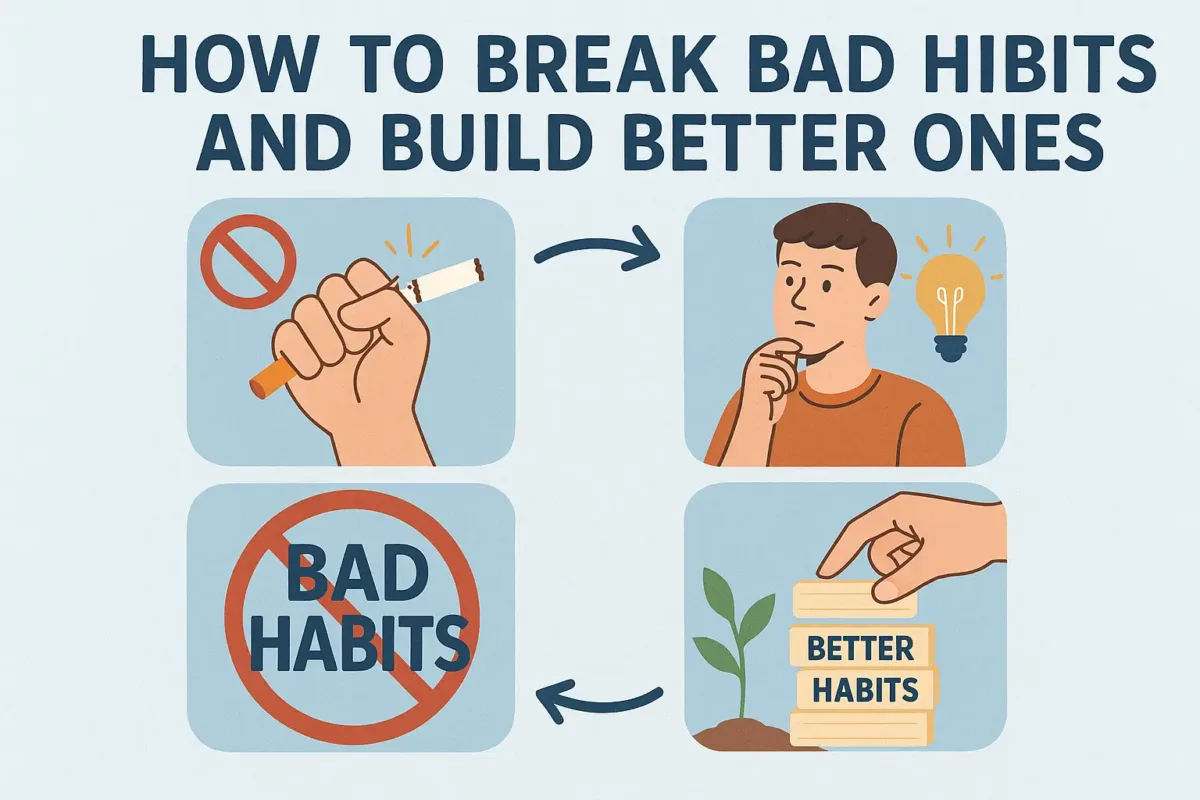
Once this loop repeats enough times, your brain starts to automate it. You no longer think, “I feel anxious, so I will scroll social media.” Your body just moves. That is why willpower alone rarely works. You are not fighting a single decision; you are interrupting an entire system the brain believes is efficient.
The most powerful way to break bad habits is not to attack the routine with force, but to become curious about the cue and the reward. What is this habit doing for you at an emotional level? What pain is it soothing? What stress is it managing? When you bring compassion and awareness to the loop, you gain real leverage to change it.
Self-Compassion: The Secret Ingredient in Breaking Bad Habits
Most people try to change their habits by criticizing themselves into better behavior. They say things like, “I am so lazy,” “What is wrong with me?” or “I will never get it right.” This kind of inner language does not motivate long-term change. It increases shame – and shame often drives us back into the very habits we are trying to escape.
If you want to truly learn how to break bad habits, self-compassion cannot be optional. It has to sit at the center of your approach.
Self-compassion means you treat yourself the way you would treat a dear friend who is struggling. You recognize that you are human, that your habits were formed in specific emotional contexts and that you learned to cope the best way you could at the time. You did not wake up one morning and consciously decide to self-sabotage. Your nervous system found something that made you feel a little safer, and it held on.
Instead of thinking, “I should have changed by now,” you might say:
- “Of course this habit is hard to break – it has been with me a long time.”
- “I am learning. I do not need to be perfect to be worthy of change.”
- “Every small shift I make counts, even when it feels slow.”
Research from psychologists like Dr. Kristin Neff shows that self-compassion leads to more motivation, better resilience and healthier long-term behavior change. When you feel safe inside your own mind, it becomes easier to face your habits honestly instead of hiding from them.
Spotting Your Bad Habit Triggers with Gentle Awareness
A key step in learning how to break bad habits is identifying what activates them. Triggers are not always dramatic. Sometimes they are as subtle as a certain kind of boredom, a conversation with a specific person or walking past a familiar place.
Begin by observing, without judgment, when your habits show up. You might keep a small note in your phone or journal where you track:
- What time of day the habit appears.
- Where you are physically.
- What you are feeling emotionally (stressed, lonely, tired, anxious, excited).
- What you were doing just before the habit.
Over a few days or weeks, patterns emerge. You might notice you always snack late at night when you feel emotionally drained. You might see that you procrastinate most when a task feels unclear or when you fear being judged. You might realize you scroll endlessly when you feel unimportant or disconnected.
These insights are gold. They show you that your habit is not random, and you are not out of control. Your behavior is responding to something meaningful inside you. Once you understand that “something,” you can design replacements that truly fit.
Replace, Don’t Just Remove: Designing Better Routines
One of the most effective principles in behavior change is this: it is much easier to replace a bad habit than to simply remove it. If you take away a familiar routine without giving your brain a new pattern, the empty space often pulls you back into the old behavior.
Instead of asking only how to break bad habits, ask: “What new habit can I practice when that cue appears?” You keep the cue, but change the routine and upgrade the reward.
For example:
- If your cue is stress after work and your habit is numbing out with mindless scrolling, you might replace it with a 10-minute walk, a shower, a breathwork practice or a few pages of an inspiring book.
- If your cue is feeling criticized and your habit is angrily lashing out or shutting down, you might replace it with taking a pause, breathing slowly, writing your feelings down or speaking one sentence of truth calmly.
- If your cue is boredom and your habit is snacking, you might replace it with stretching, journaling, learning something new or tidying a small area.
The key is to choose replacements that still meet the emotional need your original habit was serving: comfort, distraction, connection, stimulation, soothing, a sense of power or relief. When the new habit gives you a similar or better reward, your brain is far more willing to let go of the old one.
Using Mindfulness to Interrupt the Habit on Autopilot
Bad habits tend to run when you are barely aware of what you are doing. Mindfulness is the practice of waking up inside the moment, noticing your thoughts, feelings and impulses without instantly acting on them. It is one of the most powerful tools for anyone serious about learning how to break bad habits.
You do not need long meditations to benefit. Small, consistent practices are enough to begin rewiring your brain.
Try this simple mindfulness pattern when you feel a habit starting to kick in:
- Pause. Even for two seconds.
- Name. Silently acknowledge what is happening: “I am feeling anxious and reaching for my phone,” or “I am hurt and about to shut down.”
- Breathe. Take a slow breath in and out, letting your shoulders relax.
- Choose. Ask, “What is one small action I can take right now that is more aligned with who I want to be?”
This simple “pause–name–breathe–choose” sequence can gently interrupt autopilot and open the door to a new behavior. Even if you still fall back into the old habit sometimes, you are practicing awareness – and awareness is a habit too. The more you build it, the more freedom you have.
Aligning Your Identity with the Habits You Want to Build
Many people focus only on actions when they think about how to break bad habits. But the deepest, most sustainable changes come when you shift your identity – the way you see yourself at the core.
If you secretly believe, “I am chaotic,” “I always fail,” or “I am not disciplined,” your brain will subconsciously gravitate toward habits that confirm that identity. Not because you enjoy suffering, but because the brain likes coherence. It tries to keep your behavior consistent with your inner story.
One powerful approach is to ask, “Who am I becoming?” and “What kind of person would naturally live with the habits I want?”
For example:
- Instead of “I am trying to stop procrastinating,” you might say, “I am becoming someone who takes small steps quickly.”
- Instead of “I want to stop emotional eating,” you might say, “I am becoming someone who listens to my emotions with kindness and cares for my body with respect.”
- Instead of “I have to stop scrolling,” you might say, “I am becoming someone who protects my focus and peace of mind.”
Identity-based habits are powerful because they are not about forcing yourself to behave. They are about growing into a truer version of yourself. Each time you choose a new habit, you cast a vote for the person you are becoming.
Small Wins, Not Perfect Streaks: How Real Habits Are Built
Perfectionism is one of the biggest enemies of habit change. The belief that you must “start over” every time you slip can keep you stuck in cycles of all-or-nothing thinking. Real transformation is messy and non-linear. There are good days, hard days, regressions and quiet breakthroughs.
If you want to truly master how to break bad habits, shift your focus from perfect streaks to small wins.
Celebrate things like:
- Pausing once before you react, even if you eventually fall into the old pattern.
- Choosing a new habit one time today, even if yesterday was rough.
- Becoming more aware of your triggers, even if you still feel pulled by them.
Habits are built through repetition, not perfection. Each time you interrupt the old loop and choose a slightly different path, you are strengthening a new neural pathway. Over time, that path becomes the easier one to walk.
Emotional Healing and the Roots of Self-Sabotage
Sometimes the question is not just how to break bad habits, but why those habits exist in the first place. Many so-called “bad” habits began as ways to manage pain, abandonment, fear, loneliness or pressure. What looks like self-sabotage is often self-protection in disguise.
For example:
- Procrastination can be a shield against the fear of failure or criticism.
- Overworking can be a way to avoid feeling unworthy or unlovable.
- Emotional eating can be a way to comfort parts of you that never felt safe.
- Staying in unhealthy relationships can come from a fear of being alone.
This does not mean the habits are helpful now – but understanding their emotional roots allows you to approach them with tenderness instead of cruelty. You can begin asking, “What is this part of me trying to protect?” and “Is there a kinder, more conscious way for me to meet that need?”
Sometimes, healing your habits also involves healing your story: your childhood experiences, cultural conditioning, attachment patterns, people-pleasing tendencies, perfectionism and the beliefs you carry about your worth. When you tend to the root, the branches slowly change.
Practical Daily Rituals to Support Habit Change
Breaking bad habits is easier when you surround yourself with supportive structures. Think of your environment, routines and small daily choices as scaffolding that holds you while you grow.
Here are some practical rituals that make behavior change more sustainable:
- Morning check-in. Spend 3–5 minutes asking: “How do I want to show up today? What one habit am I focusing on?”
- Environmental design. Make the bad habit harder and the good habit easier. Remove triggers from sight, and place helpful cues where you can see them.
- Evening reflection. Gently review your day: What went well? Where did you struggle? What did you learn? No judgment – only information.
- Accountability. Share your goals with a trusted friend, coach or community that understands you are human and does not expect perfection.
- Celebration. Acknowledge even tiny progress. Your brain needs to feel rewarded to keep going.
These rituals are not about controlling yourself. They are about creating a life that quietly supports the person you are becoming.
How to Break Bad Habits with Support from Transformational Books
You do not have to walk this path alone. Books can act as mentors, mirrors and maps when you are changing your life from the inside out. Within the Mayobook collection, several titles beautifully support the journey of learning how to break bad habits and build a more aligned life.
- Breaking Free – a powerful companion if your habits are tied to past wounds, old patterns or emotional entanglements you are finally ready to outgrow. It helps you understand and untangle the deeper roots of self-sabotage.
- Productivity Hack – perfect if your bad habits show up as procrastination, distraction or inconsistency. It offers grounded, practical tools to structure your time and energy without burning out.
- Rise to Lead – ideal for rebuilding confidence, courage and inner leadership as you step into new habits that require you to be more visible, decisive and self-directed.
- Think Like Marcus Aurelius – a beautiful guide to developing inner calm, discipline and stoic emotional strength so you can stay steady when old habits try to pull you back.
- The Magic of Positive Affirmation – a powerful tool for reshaping the inner language that either keeps you stuck or liberates you into new patterns of behavior.
If you feel called to dive deeper, you can explore more transformational reads at https://mayobook.com/shop. Your next breakthrough may begin with a single chapter.
FAQ – How to Break Bad Habits
What is the most effective way to break bad habits?
The most effective way to break bad habits is to understand the habit loop – cue, routine and reward – and then gently redesign it. Instead of relying on willpower alone, bring awareness to your triggers, add self-compassion, and replace the old routine with a new, healthier behavior that meets the same emotional need. Over time, repetition of the new habit gradually weakens the old pattern.
Why is it so hard to break bad habits even when I really want to?
It is hard to break bad habits because they are deeply wired into your brain as efficient shortcuts. Your nervous system often uses them to manage stress, fear, boredom or pain. Even when your logical mind wants to change, your body may still reach for what feels familiar and safe. This does not mean you are weak; it means your system is trying to protect you. Change becomes easier when you work with your brain and body instead of shaming them.
How long does it take to break a bad habit?
There is no single number that applies to everyone. Some studies suggest new habits can begin to form in 21–66 days, but the real timeline depends on the depth of the habit, your emotional connection to it, your environment and the consistency of your practice. It is more helpful to focus on showing up daily in small, sustainable ways than to chase a specific deadline.
Can mindfulness really help me break bad habits?
Yes. Mindfulness is one of the most powerful tools for anyone learning how to break bad habits. It helps you notice your impulses as they arise, rather than acting on them automatically. When you pause, name what is happening and take a conscious breath, you create a gap in which a new choice becomes possible. Over time, this awareness reshapes your relationship with your own behavior.
What should I do when I slip back into an old habit?
Slipping back is part of the process, not proof of failure. When you fall into an old habit, pause and gently ask: “What was I feeling or needing right before this happened?” and “What can I learn from this moment?” Then, instead of starting from zero, simply begin again from where you are. Treat each slip as information, not evidence that you will never change.
How can I stay motivated to break bad habits over the long term?
Long-term motivation grows when you connect your habits to a deeper “why.” Rather than focusing only on what you are trying to stop, ask who you are becoming and why that matters to you. Surround yourself with reminders of your values, supportive people, transformative books and small daily rituals that bring you back to your intention. Motivation is not a constant feeling; it is a relationship you nurture over time.
Should I try to break many bad habits at once?
For most people, it is more effective to focus on one or two key habits at a time. Trying to overhaul your entire life all at once can overwhelm your nervous system and lead to burnout. Start with a habit that has a meaningful impact – something that, if it shifted, would positively affect other areas of your life. As you build confidence and capacity, you can expand to other patterns.
How does my environment affect my ability to break bad habits?
Your environment quietly influences your behavior all day long. Visual cues, clutter, people, technology and even lighting can either reinforce old habits or support new ones. Designing your surroundings – by removing triggers, making good choices more convenient and creating calm spaces – makes it much easier to follow through on your intentions.
Can affirmations help with breaking bad habits?
Affirmations can be very helpful when they are honest, specific and rooted in self-compassion. Repeating phrases that align with who you are becoming – such as “I am learning to choose what supports my peace” or “I can take one small step today” – helps gradually shift your identity and inner dialogue. This makes it easier to choose new behaviors aligned with your values.
Is professional help ever necessary to break bad habits?
Yes, sometimes working with a therapist, coach or counselor can be incredibly beneficial – especially if your habits are tied to trauma, addiction, depression or anxiety. Professional support offers tools, perspective and a safe space to process what you are carrying. Seeking help is not a sign of weakness; it is a sign of commitment to your healing.
What role does self-compassion play in breaking bad habits?
Self-compassion is foundational. When you treat yourself with kindness, you create an internal environment where growth is possible. Instead of shutting down in shame, you stay open to learning. Instead of attacking yourself when you stumble, you ask what you need and how you can support yourself better next time. This compassionate stance makes long-term transformation far more sustainable.
Conclusion: You Are Allowed to Outgrow Your Old Patterns
Breaking bad habits is not just about changing what you do; it is about changing how you see yourself. You are allowed to outgrow coping mechanisms that once helped you survive. You are allowed to build a life that feels more aligned, peaceful and honest. You are allowed to become someone new, gently, one small choice at a time.
Each moment you pause, notice a trigger, choose a kinder response or reach for a healthier habit, you are quietly rewriting your story. The process may be slow and imperfect, but it is profoundly powerful. You are not behind. You are not broken. You are in motion.
And that movement, however subtle, is the beginning of a different future.
If this spoke to you, you’ll love the full information in this book; begin your deeper reading → See the book on Mayobook.